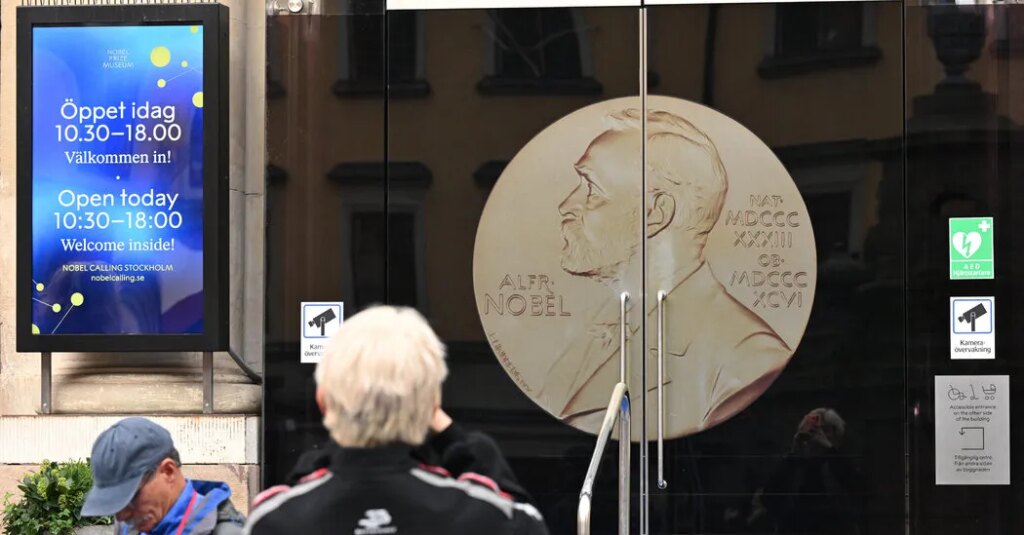
The chair of the Norwegian Nobel Committee, Jørgen Watne Frydnes, told the world on Friday morning that Navi Pillay had won the Nobel Peace Prize. One person who hadn’t been informed yet: Ms. Pillay.
“My message to her would be: If you see a Norwegian number calling, please pick up,” Mr. Frydnes said at the announcement in Oslo. “I would love to talk to you very soon.”
Ms. Pillay, a South African human rights lawyer, was not the first Nobel laureate that the prize committees in Norway and Sweden haven’t immediately reached to break the news.
It was around 1 a.m. in a “cheap hotel room in California” in 2024 when Geoffrey Hinton, a pioneer of research in artificial intelligence, got a call saying he was a winner of a Nobel Prize in Physics.
He did not know his work was even being considered for the honor. Was it a prank? Or could it be a dream?
“It is a million times more likely to be a dream than a reality,” Dr. Hinton thought.
Either way, one thing was certain: There was a Swedish-accented voice with life-changing news on the other end of the phone.
“It was quite confusing,” Dr. Hinton said.
The surprise is by design. The winners of the Nobel Prizes remain a secret, even to the winners themselves, until hours or minutes before they are publicly announced.
“There’s no heads-up,” said Thomas Perlmann, the secretary-general of the Nobel Assembly, who makes what is always “an interesting phone call” to the winner of the Nobel Prize in Physiology or Medicine.
Each of the six Nobel Prizes is managed by one of four institutions, which all enlist different callers. The only call that originates outside Sweden is the one made to the Nobel Peace Prize winner, who is selected by a five-person committee appointed by the Norwegian Parliament.
The unexpected calls are a last bit of secrecy to protect the process from outside influence, Dr. Perlmann said. But he acknowledged that it added to the “mystique” of it all.
“These calls from Stockholm are quite famous,” Dr. Perlmann said.
Yet those calls sometimes go unanswered.
Paul Milgrom, a professor at Stanford University who was awarded the Nobel Memorial Prize in Economic Sciences in 2021, had turned off his cellphone that night, as he does every night. So he found out when Robert B. Wilson, another Stanford economist and his neighbor, rang the doorbell at 2:15 a.m. The two men shared the prize.
“Paul? It’s Bob Wilson. You’ve won the Nobel Prize,” Mr. Wilson said in the moment, which was captured on doorbell camera footage. “And so they’re trying to reach you.”
Mr. Milgrom had long brought Mr. Wilson oranges, apples and figs from his yard, but the news Mr. Wilson brought was even sweeter.
“I was glad to share the moment with him,” Mr. Milgrom said.
Not everyone is happy to be notified in the middle of the night. Dr. Perlmann can think of at least one “incredibly angry” winner roused by his call.
“He became very friendly very fast,” Dr. Perlmann said. “We like to try to reach them before they find out any other way.”
For Dr. Perlmann, the call window is the 90 minutes between when the formal decision and the official announcement are made.
One of last year’s winners in medicine, Fred Ramsdell, was off the grid in the Rocky Mountains and could not be reached before the public announcement. This year’s winners — Karl Deisseroth, Peter Hegemann and Georg Nagel — were much easier to contact: Mr. Deisseroth is a night owl; the other two were in Germany.
“I got hold of all three,” Dr. Perlmann said. “An easy year, definitely.”
Joel Mokyr won the Nobel in economic science last year but had been blocking calls from unknown numbers for much longer.
“I thought I had a better chance of being elected pope, and I’m Jewish,” Mr. Mokyr said.
The post So you’re getting a Nobel Prize? Don’t expect a heads-up. appeared first on New York Times.