The art world, by its very nature, is visual.
Against the crisp white walls of galleries across the globe, monumental mixed-media canvases, like those by the German painter and sculptor Anselm Kiefer, or towering organic forms by the French visual artist Marguerite Humeau, make their presence felt — perceptibly, texturally and physically.
But there are periods when certain pieces must retreat from view into protective crates and shipping containers, into what some refer to as “the shadows.” Periods such as the run up to major international art fairs, for example, including the days and weeks preceding Frieze London and Frieze Masters, which both open to the public on Thursday.
At this very moment, hundreds of artworks — some made up of hundreds of separate elements, many with sky-high price tags and made by artists represented by galleries from all over the world — are making their ways by air, land and sea to the center of the British capital, where they will be displayed over five days for the viewing pleasure of tens of thousands of visitors.
A lot is at stake. The journeys made by those pieces do not happen by chance. Instead, from those previously mentioned shadows emerge logistics experts, registrars, crate fabricators, art handlers and others who ensure that every gallery’s precious cargo is in the safest of hands.
“Art logistics is the vital, invisible backbone of the global art market,” said Leila Alexander, the global director of the White Cube gallery, which has spaces in London, Hong Kong, Paris, New York and Seoul, and includes Kiefer and Humeau on its roster.
“For this year’s Frieze London presentation, we started working on the curatorial plans the moment the doors closed on the previous edition” of the fair, Alexander said in an email. “Planning for shipping begins several months in advance, particularly when an artist is making a new body of work that we will present at a fair,” she said, adding that this year the gallery would be showing new works by Ilana Savdie, who is based in New York.
There are numerous factors to consider when it comes to planning shipping timelines, Alexander said, among them framing and other technical requirements.
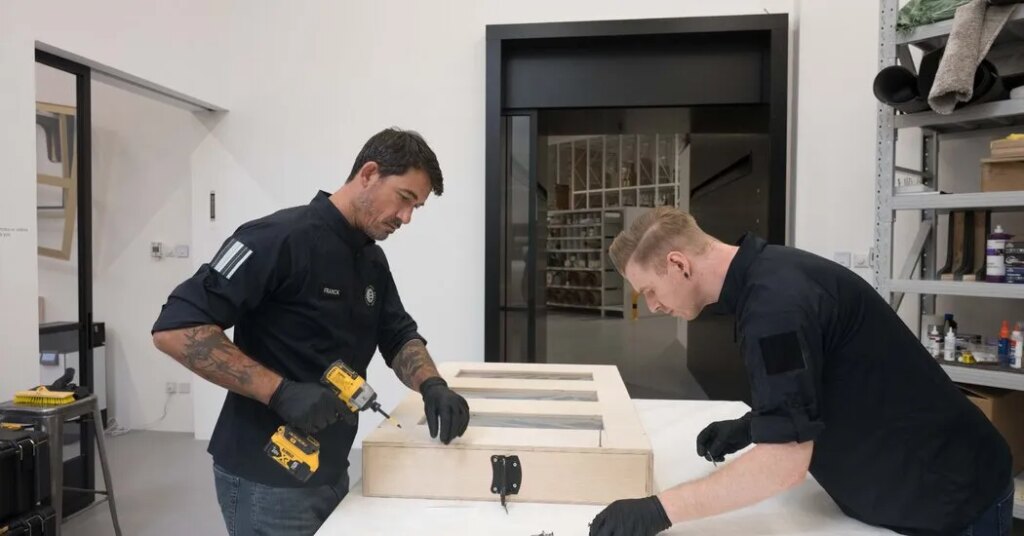
At Eythos, an art logistics company, such considerations are the realm of Franck Vidal, who is the head of fabrication. His team of carpenters and joiners is responsible for crafting the frames and crates that will ensure an artwork’s safe passage. But before they can build, they first need to know specifications and any quirks.
“To me,” Vidal said in an interview at Eythos’s global headquarters on the edge of the Port of Hong Kong, “the journey starts on the screen or as data.” From those particulars, a bigger picture emerges. Vidal learns what “inner layers” — the materials used to pack and protect each work — will be required, and a designer begins to envision the crate that will transport each piece.
There is much that is not revealed, though. “I don’t know the artwork, I don’t know the provenance,” Vidal said. The less he knows, he said, the more discreet the operation can remain.
Then the fabrication team builds the crate. “If I vulgarize it, it’s a unique box for a unique item,” Vidal said, but he made clear that there was considerably more care and detail that went into his craft. “It’s vital that an artwork travels with no vibration, with humidity control and no water around, heat protections,” he added. “There is no compromise.”
Crate completed, the art handlers must carefully place the work within its container and send it on its way. If traveling locally, the piece usually goes by truck; if the destination is farther afield, it will go by a ship or a plane.
“We use sea freight rather than airfreight when time and geography permit,” Alexander said.
If the work is shipping internationally, customs must be cleared and country-specific regulations must be met.
“We don’t want any surprises, so we prepare for each and every thing,” Alex Kang, the global head of operations at Eythos, said in a video interview from the company’s Seoul office, where he was stationed ahead of Frieze Seoul in September.
Because a crate might end up on the other side of the world, where different languages or alphabets may be used, handlers communicate using symbols sprayed onto the crates.
“It’s an international language,” Vidal said. “We prepare for the next people — in the U.S., in the U.K., wherever in the world — to receive a box and to understand immediately with the signage where to open to take the best care of the item.”
Installation for an art fair is swift. Often handlers have just a day and a half to install the booths before the doors open. For Samuel Nieto, who spent several years as an art handler before joining Eythos as global head of execution and systems, this is “the fun stuff.”
“With this short time, you need to be focused,” he said, citing spatial awareness, organization and adaptability as crucial. Perhaps counterintuitively, Nieto said that he found heavier artworks easier to install. Smaller works, or those containing several small pieces, can leave more room for error. He recalled once establishing “a system of cranes” to install a motor that weighed 120 kilograms (about 265 pounds) at a height of 10 meters (about 32 feet) in a gallery space.
The aim, for all involved, is the same. “Our primary concern is always the safety of the artwork,” Alexander said, a sentiment that is shared by Vidal.
“In the end, what we do is we work in the shadows for an artwork to stay alive, to keep its value,” Vidal said.
“This is the invisible job,” he continued. “There is a whole industry behind that is working meticulously to really enrich the level of enjoyment for the one who is looking at the artwork or the one who is collecting.”
No sooner will the Frieze fairs close their doors in London than the handlers will be back at work, removing all trace of the artworks in as little time as they took to install them. This industry is allowed scant opportunity to rest.
“There’s always another art fair,” Kang said.
The post An Invisible Industry Operates in the Shadows of the Art World appeared first on New York Times.