Sally Schultz thought she had struck gold when she purchased land in Rio Rancho Estates, an unincorporated, census-designated community just outside the city of Rio Rancho, New Mexico. A single mother of four, Schultz came there following a divorce to build a homestead of her own and finally gain some stability in her life.
For $3,500, she was able to purchase half an acre for her trailer in a rural area located close to numerous elementary schools and parks. In a relatively short time, she was able to coax crops like corn, squash, and green chile from the ground. This cheap land became Schultz’s haven, giving her a second chance at life.
WIRED has made this article free for all to read because it is primarily based on reporting from Freedom of Information Act requests. Please consider subscribing to support our journalism.
Then a missile company showed up next door.
“We’ve already been through so much,” she says, “and now we have to leave. It is the unknowing that is scariest.”
Castelion, a startup founded in November 2022 by three former SpaceX executives, is building Project Ranger, which it claims will be America’s “largest dedicated hypersonic manufacturing production facility.” Construction is set to be complete by the end of the year.
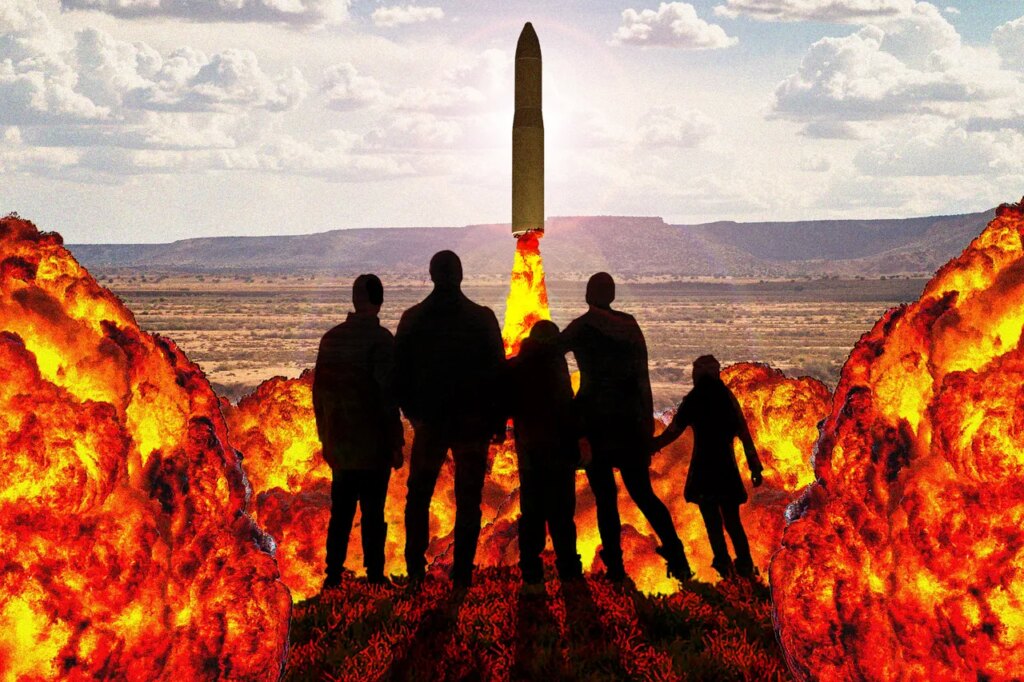
The company’s chosen site for its mega-campus is, in some cases, it appears, a little more than 1,000 yards away from roughly 450 properties in Rio Rancho Estates, including Schultz’s. That puts the homes squarely within a danger zone should any explosive chemicals stored onsite catch fire.
A year into Castelion’s relationship with the state of New Mexico, the company—which declined to speak with WIRED for this story—still hasn’t answered basic safety questions, even as an official hazard assessment found buildings would simply be left to burn in the case of fire, releasing hydrochloric acid gas into the air. Emails between the company and Rio Rancho officials reviewed by WIRED also show Castelion was negotiating fire safety standards even after construction was well underway.
“I live next door to where World War III will be manufactured,” says local resident Laura Lundberg.
Big Plans
Castelion has become a bit of a darling among the new wave of defense tech startups. The company has recently hit a valuation of $13 billion—more than four times its Series B valuation of $2.8 billion from last year.
It has received over $500 million in US military contracts in just 18 months, swiftly securing its spot as one of the “Arsenal of Freedom” suppliers.
The firm touts its ability to make hypersonic missiles—a label for any missile flying at five times the speed of sound or higher—at a lower cost than its competitors. The US Army’s Dark Eagle is the most mature domestic hypersonic weapon, and it costs an estimated $41 million per missile, according to a 2023 Congressional Budget Office study. Castelion’s main product, Blackbeard, is a solid-rocket-powered missile that was set to sell for $384,000 per unit.
In reality, the missiles are looking as if they will turn out pricier than initially advertised.
Castelion kicked off the year with a nearly $50 million Navy contract to build full-scale prototypes of its Blackbeard missile. By June, the Navy expanded the effort, adding another $23.4 million to supply the first 50 operational Blackbeard prototypes. Then, in August, the Navy doubled down with another $90 million contract to cover manufacturing services for the same 50 Blackbeards—pushing the total to $163.4 million for 50 missiles, or $3.3 million per unit.
And most recently, in September, the Navy awarded Castelion the company’s largest contract yet—up to $200 million.
Recently, Castelion released the first photo of its Blackbeard hypersonic strike missile, but concrete performance figures for Blackbeard remain hidden. Castelion has not publicly released any test data to verify its weapon’s efficacy.
Project Ranger will become Castelion’s biggest manufacturing and testing hub. The company broke ground on the 1,000-acre facility on January 21, and it’s targeting mass production as early as next year.
The facility wasn’t always supposed to be in New Mexico, though.
Unredacted
In August 2023, the company applied to build a rocket factory in Churchill County, Nevada, under a different name—Pallas Industrials. Chief financial officer Andrew Kreitz signed a special use application, which disclosed the company’s plans to build rocket motors and ground-test them up to eight days a month at the site.
In response to the application, Churchill County officials provided eight pages of staff analysis and required the company to provide testing conditions and safety protocols. Not long afterward, Pallas Industrials pulled out of Nevada under the new name: Castelion. A few months later, the company began testing the soil in western Rio Rancho.
Rio Rancho Estates residents say that by the time they started noticing soil-probing trucks in the spring of 2025, Castelion was already in a conversation with New Mexico officials about using the land for the missile factory.
In June 2025, Sandia National Labs delivered a hazard report as part of the New Mexico Small Business Assistance Program, originally intended to help local small businesses access the expertise of Los Alamos and Sandia National Laboratories at absolutely no cost.
Under the Freedom of Information Act, Sandia later released a heavily redacted version of the report. Instead of scrubbing the underlying data layer of the file, the lab simply put black ink highlight over black text, leaving the full unredacted report accessible via copying and pasting.
The report alleges Castelion’s plans to build and operate the missile factory present significant risks.
It identifies a massive “storage facility fire” as the worst-case scenario. Castelion is set to store colossal stockpiles of propellants on Project Ranger’s site. The company has publicly stated its plans of working with at least one heat-sensitive chemical oxidizer—ammonium perchlorate—and storing up to 250,000 pounds inside covered magazines and bunkers, according to the Sandia report. But outside those bunkers, the report notes, Castelion is allowed to keep up to 81,000 pounds of active explosive material at a time inside the hazardous integration facilities during the assembly process.
A detonation of the facility’s largest allowed stockpile of explosive material would require a buffer from the nearest inhabited building of almost nine football fields in length. Sandia calculated that a worst-case explosion could shatter large windows as far as almost four miles away and have a 3.2 percent chance of causing minor eardrum damage to people 400 yards from the detonation.
Sandia declined to provide comment for WIRED. One of the hazard reports authors, Meg Davidson, has since left Sandia Labs and is now a senior manager of strategic partnerships at Castelion. She did not respond to requests for comment.
The report identifies a fire at the test stand as “the most probable foreseeable hazardous event.” A chemical fire would release a toxic haze containing byproducts like hydrogen chloride and chlorine. In gas form, both are highly corrosive and can cause severe eye, skin, and respiratory tract burns. Even short-term inhalation at high concentrations can cause chemical lung damage and asphyxiation.
Emails obtained through public records requests reveal that the Rio Rancho Fire Department determined 17 of the 26 buildings at the Project Ranger site would be left to burn if a fire ignited, due to the risks a chemical blaze would pose first responders. Firefighters would be barred from even entering the high-risk facilities.
Such events are hardly unheard of. WIRED reported on a June incident at Anduril’s Mississippi facility where a test run of an ammonium perchlorate–based rocket motor ended in an explosion. The blast—which didn’t cause any casualties—underscored the technical risks of scaling solid propellant production.
In May, a storage tank holding approximately 7,000 gallons of methyl methacrylate, a flammable liquid used to manufacture acrylic plastics and resins for military and commercial aircraft, began to overheat at a GKN Aerospace plant in Garden Grove, California, leading local authorities to evacuate more than 40,000 residents.
Despite these warnings, internal emails obtained through public records requests reveal that Castelion was still negotiating critical fire-response requirements between March and May—even as construction had already started.
Castelion’s site developer, Bryce Barlow, wrote to the city on March 23 that the company had not yet finalized the fire-flow response, offering to discuss the question by phone or in person instead.
After a few weeks, the requirements were replaced by city manager Matt Geisel with a statement that hard numbers would appear in the plans later on. Castelion only needed a signed memorandum of understanding to proceed—backed by the governing body’s resolution and a serviceability letter.
“Great news! Saves all of us both legal bills and headaches,” Kreitz wrote in response.
‘A Done Deal’
In August 2025, prior to Castelion’s formal announcement that it had selected New Mexico, Republican state senator Jay Block appeared before the Sandoval County Commission to speak in support of financing Project Ranger. Before becoming state senator, Block was a county commissioner.
The county had approved $125 million in industrial revenue bonds and had passed a resolution giving itself control over the state land picked for the site. The commissioners granted an astounding 95 percent discount on what Castelion would normally owe in property taxes. Finally, the county agreed to abate compensating taxes on out-of-state equipment, lowering the upfront costs for the incoming missile manufacturer to relocate to New Mexico.
Block’s district includes Rio Rancho as of January.
“I strongly supported Project Ranger as it moved through the local approval process, because I believed Rio Rancho and Sandoval County had the workforce, infrastructure, and defense heritage to help Castelion succeed,” Block tells WIRED.
Castelion held its first public information meeting on Project Ranger in October 2025.
“All of this happened behind the scenes. By the time it was public, it was already a done deal,” says Zachary Darden, a Rio Rancho resident who ran an unsuccessful bid for mayor on a platform opposing the development.
In November, emails show Alberto Solís, Rio Rancho’s economic development manager, coordinated Castelion CFO Kreitz’s four-day trip to New Mexico—part of the outreach process required by the state. The CFO asked to attend a Chamber of Commerce “Jingle Mingle” mixer and an event with the Sandoval Economic Alliance, a local nonprofit tasked with recruiting new business to the county.
More than a month after Kreitz’s networking trip, Castelion held its groundbreaking ceremony. Local residents weren’t invited, but many of the state’s most prominent political and business figures were. Block was there as well as US senator Martin Heinrich. So were Gregg Hull, Rio Rancho’s then mayor and Republican candidate for governor, as well as Governor Michelle Lujan Grisham. County and state economic development officials were also in attendance.
“Castelion’s Project Ranger shows what a strong public-private partnership can deliver for a local community,” Rob Black, New Mexico’s secretary of economic development, tells WIRED.
Residents living next to the site, though, are contemplating whether the risks are too high to stay. But for most living in Rio Rancho Estates—a low-income neighborhood—the costs of relocation might be too high.
“This land is affordable for people who need it,” says community member Jason Clifford. “We were sold out by our local officials.”
The post A New Mexico Community Was a Place to Build a Life. Then a Hypersonic Missile Factory Showed Up appeared first on Wired.