In September, OpenAI announced an apparent solution to one of the seven “Millennium Prize problems” in mathematics: Navier–Stokes, a longstanding question about a set of equations describing the behavior of fluids such as water and air. It was an exciting development, but one that also caused turbulence and discombobulation in the mathematics community.
On Tuesday, when the firm released a trove of hundreds of results, no new Millennium proofs were among them. But select findings seemed to represent significant progress on some, if not all, of the five remaining open questions that stand as the most prominent in the field.
What, exactly, are these very specialized open questions? They are difficult for non-mathematicians (and even most mathematicians) to understand. But here is an attempt at a summary, and a bit of insight into how OpenAI’s new results may — or may not — help pave the way toward resolution.
What is the Riemann hypothesis?
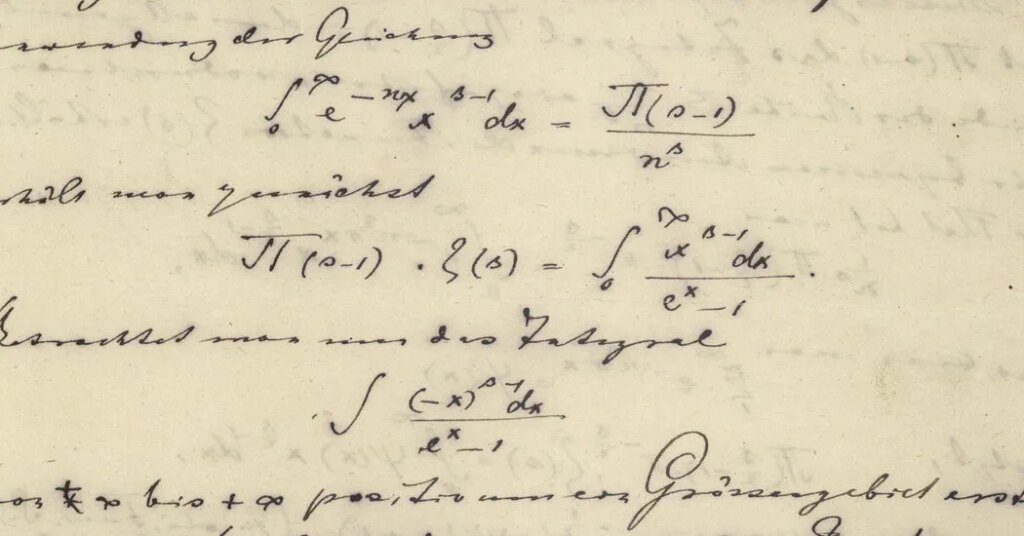
Formulated in an 1859 paper by German mathematician Bernhard Riemann, the problem is about prime numbers (a whole number greater than 1 that can only be divided evenly by itself and 1, such as 2, 3, 5, 7, 11, 13 and so on) and how they are distributed along the number line stretching to infinity.
Moving further along the number line, primes become rarer: Up to 100, some 25 percent of the numbers are prime; up to one million, only about 7.8 percent are prime. Riemann made a working hypothesis that provides a precise formula for estimating, or counting, how many primes exist below any given number.
Riemann intended to return to the problem himself, but he died at 39.
“It’s a great problem,” said Peter Sarnak, a mathematician at Princeton University and the Institute for Advanced Study, during a lecture he delivered on the Riemann hypothesis at Harvard in April. “It’s firstly elegant, easy to state, it’s falsifiable,” he said.
A proof “would be monumental mathematically,” Dr. Sarnak continued. “It implies things in many, many different fields. That’s why it’s interesting.”
But the “knockout” applications, he said, are in the proofs for conjectures that mathematicians pursuing the problem have proposed over the years — extensions of the original hypothesis that apply it to a broader mathematical universe.
Dr. Sarnak is among a majority of experts who believe the Riemann hypothesis is true. If the hypothesis is proved false, you would still be able to solve some other problems. But “it would burst our bubble,” he said. “A lot of us would be very upset.”
Problem No. 3 on the OpenAI release list is the “the quasi-Riemann hypothesis.” Dr. Sarnak noted that this result was verified by Lean, a computer proof assistant, and thus is probably correct. But these findings fall short of the original Riemann hypothesis, so they don’t solve the Millennium problem.
“It is a major achievement,” Dr. Sarnak said — if it is correct.
Alex Kontorovich, chair of the department of mathematics at Rutgers, was bowled over by the new result, calling it an achievement that would result in an “instant Fields Medal” if a human had generated it. Asked about whether it was a steppingstone to a proof of the full Riemann hypothesis, however, Dr. Kontorovich was equivocal.
“Yes and no,” he said. “It is a fundamental breakthrough in our understanding — that is completely undeniable.” But he doesn’t see how anything resembling the same kind of argument will fully solve the original Riemann. “You’re going to need genuinely new ideas to prove the full hypothesis,” he said.
Time — perhaps not much — will tell.
What is the Birch and Swinnerton-Dyer conjecture?
The Birch and Swinnerton-Dyer conjecture was formulated in the early 1960s by British mathematicians Bryan John Birch and Sir Peter Swinnerton-Dyer — assisted by an early vacuum-tube computer, the EDSAC-2. It is a fundamental problem in number theory and involves counting points on elliptic curves, which are described by a certain type of cubic equation. Number theorists consider elliptic curves fertile proving grounds for investigating and understanding the properties of whole numbers.
Manjul Bhargava of Princeton University, who won a Fields Medal in 2014, has pondered this problem from time to time. In an email, he outlined one way that he likes to explain it. In school most students learn the quadratic formula, which describes how to solve quadratic equations. It’s possible to find the rational solutions to quadratic equations with any number of variables; there is even an algorithm that can find all the solutions.
“It is also known how to solve cubic equations in one variable,” Dr. Bhargava said. “But when we get to cubic equations in two variables, it is UNKNOWN how to find the rational solutions!”
That is the next frontier. And that’s why the Birch and Swinnerton-Dyer conjecture is important. The conjecture proposes an algorithm that would solve all cubic equations in two variables, making it the next step in the ultimate quest to solve all equations in all degrees.
In the OpenAI list, Dr. Bhargava said, problem No. 2 gets at this conjecture and achieves “meaningful progress” where mathematicians had already made significant headway. At that, it gives researchers stronger results on which to build even more, he said, but “there is still a lot that remains to be done” to prove the full conjecture.
What is the Hodge conjecture?
Problem No. 32 on the OpenAI list touches tangentially upon the Hodge conjecture. It is “definitely interesting,” David Mumford, a mathematician at Brown University, said in an email. “But it’s a very special case of Hodge, I think. But maybe I’m wrong.”
The Hodge conjecture was originally presented in 1950 by the British mathematician Sir William Vallance Douglas Hodge.
“I know the problem well,” Dr. Mumford said. But when asked to translate for New York Times readers, he acknowledged: “It is a hard problem to explain.”
“It concerns varieties, the bread and butter of algebraic geometry,” said Dr. Mumford, who won a Fields Medal in 1974.
Algebraic geometry bridges the study of equations (algebra) and the study of shapes like circles and spheres (geometry).
“Varieties” are shapes defined by a specific type of equation, and they come in every dimension, Dr. Mumford said. In one dimension — say the blank page of a notebook — there are curves. The simplest curve is the circle, which is the set of solutions to the equation x² + y² = 1. In higher dimensions, the solutions involve complex numbers, including infinity.
The Hodge conjecture concerns subvarieties, which are varieties contained within a fixed bigger variety, like mathematical nesting dolls. (For a visual on this hierarchy: if the fixed bigger variety is a three-dimensional space, a two-dimensional surface within that space is a subvariety, as is a one-dimensional curve within that space.)
In the 1920s, the mathematician Solomon Lefschetz developed a theory that says a subvariety is one dimension less than the bigger variety. Dr. Lefschetz’s work inspired Dr. Hodge to make his conjecture, which asserts the same interconnection of subvarieties when separated by two or more dimensions.
In addition to the nesting-doll-like hierarchy of subvarities, the scenario evokes shadows, like bones projected on an X-ray.
Topology, a pliable and squishy geometry, shows shadows or outlines of a space or shape. The algebraic systems of equations represent the rigid bone-like frameworks inside. The Hodge conjecture asks whether every shadow displaying a certain symmetric signature is connected to a bone casting the shadow.
Proving the Hodge conjecture to be true, Dr. Mumford said, will require a radically new approach. There are, however, significant suggestions that the Hodge conjecture is false. “That’s where I would put my money,” Dr. Mumford said.
“If it is false, there might be a relatively simple example that will disprove it, and A.I. could well be a big help,” he said. “Finding counterexamples seems to be what A.I. is really good at.”
What is P vs. NP?
P vs. NP is a problem in theoretical computer science, a discipline that connects mathematics with computer technology.
Michael Sipser, a computer scientist at M.I.T. who has dedicated his life to this problem, unpacked it as follows: “P” represents computational problems that can be solved quickly, while “NP” represents problems whose solutions can be checked quickly. Intuitively, solutions are easier to check than to find — for example, in Sudoku. The crux of P vs. NP is to determine whether that intuition is correct. That is, can we show that some problems have quickly checkable solutions that are very hard to find?
The answer has been elusive, to say the least.
Proving that P does not equal NP would establish a theoretical limit to computation — analogous to establishing the speed of light as a limit in physics. “The understanding gained through proving this limitation would be revolutionary, and the consequences vast, though at this point unpredictable,” said Dr. Sipser.
Proving P does equal NP is thought to be unlikely, he said. But if true, it would open up extraordinary new ways of using computers for optimization and other tasks such as code-breaking. “Our inability to answer P vs. NP is an enormous gap in our understanding of these devices that play such a large role in our everyday lives today.”
He noted that theorists have been stuck on this problem for decades and have made essentially zero progress in recent years.
Problem No. 129 on the OpenAI list — called the “Sakoda-Sipser state succinctness conjecture” — is tangential to P vs. NP, Dr. Sipser said. “I had worked on it for a year or so as a graduate student back in the 1970s, thinking it might be a ‘baby’ version of P vs. NP, and it remained unsolved until now,” he said.
He added that solving P vs. NP, as with a number of these big problems, would require coming up with an entirely new approach. “I do not know what that might entail. I wish I did!” Dr. Sipser said.
What is Yang-Mills & the Mass Gap?
According to Edward Witten, a theoretical physicist at the Institute for Advanced Study, nothing in the OpenAI release directly addresses the Yang-Mills problem. “However, they did solve a problem that has long been recognized as a potentially much simpler analog of the Yang-Mills problem, but with a close parallel between the two,” Dr. Witten said in an email. This is problem No. 215 on OpenAI’s list.
Viewed most simply, Yang-Mills and the mass gap is about physics versus mathematics — the physical theories work in experiments, but the rigorous math needed to support the theories has not yet been proven.
The starting point is quantum field theory, which was developed in the late 1920s. Classic quantum field theory gives a framework for electrodynamics — describing electricity, magnetism and light, which all satisfy linear equations. “However, quantum field theory is so complex that it has been difficult to understand it mathematically,” said Dr. Witten, who in 1990 became the first physicist to win a Fields Medal.
Quantum Yang-Mills theory provides a framework in which nonlinear equations generate the nuclear forces that bind protons and neutrons in atomic nuclei. Devised by theoretical physicists C.N. Yang and Robert Mills in 1953 and published the following year, this theory’s importance was not immediately understood.
In 1973, David Gross of the University of California, Santa Barbara, and Frank Wilczek of M.I.T., along with independent work by David Politzer of Caltech, revealed a physical property called asymptotic freedom.
This discovery, Dr. Witten said, allowed physicists to better understand the nuclear force. And it indicated that proving the existence of quantum Yang-Mills theory in four-dimensional spacetime was central to understanding the mathematical framework of modern subatomic physics.
Despite some advancements on this part of the problem, progress has been slow.
The second part of the problem involves the so-called mass gap. “At the cost of taking some slight liberties,” Dr. Witten said, the essential idea is “to explain why protons and neutrons (and other similar particles) have mass, instead of flying away like photons at the speed of light.” The notion of the gap, he said, refers to the difference between zero, which is the smallest mass allowable by relativity theory, and the mass of the lightest particle predicted by Yang-Mills theory.
Physicists believe that such particles do indeed possess mass, based on real-world experiments and computer simulations.
“But unlike the first part of the problem,” Dr. Witten said, referring to Yang-Mills, “where we have ideas about possible approaches, the level of understanding we have today does not, in my opinion, provide a clear guideline for how to solve the second part,” meaning the mass gap.
“It will not surprise me if it turns out that the mass gap part of the Yang-Mills problem is the last of the Millennium Problems to be solved,” Dr. Witten said last month.
But that was before he saw OpenAI’s problem 215. Dr. Witten wrote back with an update on Wednesday: “It is a total of five papers, making it clear that they studied this problem very thoroughly,” he said. “The papers are way too complicated for me to understand much in detail about what they’ve done at the moment.”
“I am very surprised that they were able to prove the mass gap” in the analogous problem, he added, saying that he “did not think it would be accessible to available methods. I remain skeptical about the mass gap in the Yang-Mills case, but we will see.”
The post What Are the Remaining Millennium Prize Problems? appeared first on New York Times.