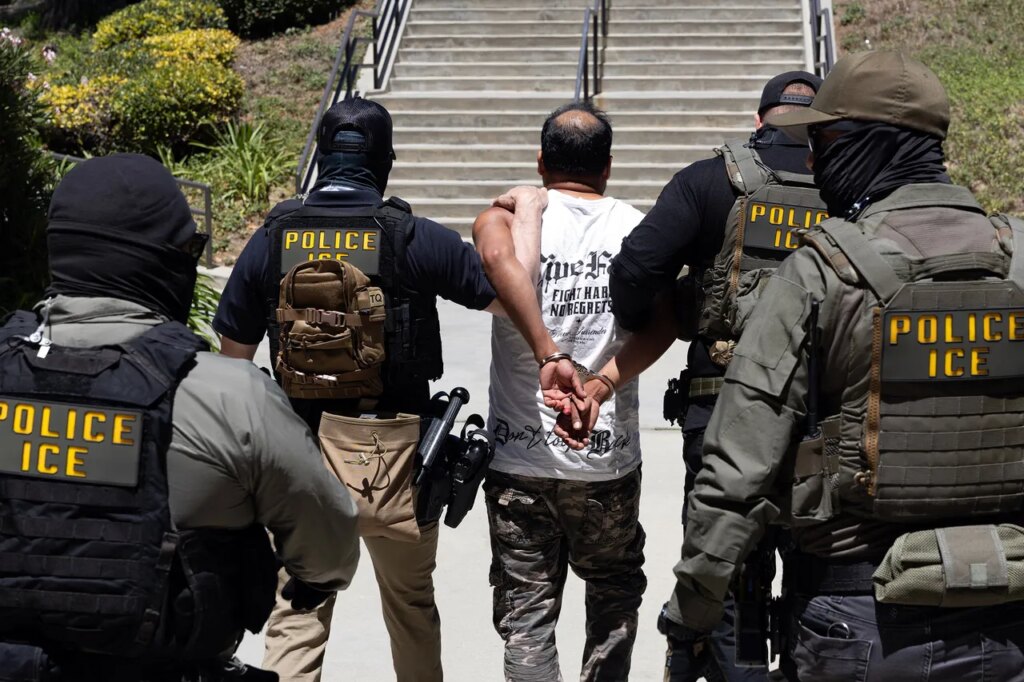
As the Trump administration has carried out a nonstop effort to undermine the midterm elections this year, the Department of Homeland Security (DHS) appears to have looked into whether it could use a Palantir-supported tool to track people it believes have voted illegally.
The revelation is found in a tranche of documents obtained through a Freedom of Information Act request and published this week by Democracy Forward, a legal advocacy group. As well as revealing that DHS officials have investigated over 150 nonprofit groups in search of evidence they’re helping noncitizens register to vote, the documents show how Immigration and Customs Enforcement (ICE) is now central to federal voter fraud investigations.
WIRED has made this article free for all to read because it is primarily based on reporting from Freedom of Information Act requests. Please consider subscribing to support our journalism.
More specifically, Homeland Security Investigations (HSI)—one of ICE’s two major components—is spearheading the effort to uncover voter fraud, with its Innovation Lab (known internally as iLab) developing tools for agents.
ICE, it seems, wants to build “a system that is going to get good at determining how to find people to investigate and potentially bring action against,” Chinmayi Sharma, an associate professor at Fordham Law School who has closely tracked the ELITE tool, tells WIRED.
“You would want to build off of what already exists, what might already have the infrastructure and data sources that you would want.” says Sharma.
“iLab’s processing focuses on DOJ voting rolls and [US Citizenship and Immigration Services] data; criminal histories are currently excluded, with efforts underway to address this,” a worker in HSI’s Countering Transnational Organized Crime unit wrote on May 26 in an email with “Voter Fraud” in the subject line. (Like other workers, their name was redacted in the records released to Democracy Forward.)
“Coordination with iLab continues,” they wrote, “particularly on ingesting processed voter roll data into the ELITE enforcement system to enhance lead management, analytical review, and investigative tracking.”
The existence of ELITE, which stands for Enhanced Leads Identification & Targeting for Enforcement, was first reported in January by 404 Media, which revealed that ICE agents using the Palantir-supported tool can create maps featuring potential deportation targets, pull up files on each target, and see a “confidence score” on the person’s current address.
“Voter roll data has never been integrated into ELITE,” a Palantir spokesman tells WIRED.
ELITE was again mentioned in a July 7 email with an attachment named “Fraud WAR”—WAR typically refers to a weekly activity report—from a DHS worker who shared an update on the agency’s “election integrity investigations,” including the news that Connecticut, Georgia, Kentucky, Missouri, Michigan, and New Mexico had “been enriched by the iLab and are pending Palantir entry into ELITE.”
What specifically was enriched and pending Palantir entry is unclear from the records, but in another email in the same chain, a DHS official said that someone from the agency would send the update to the White House.
“ICE does not disclose the existence of investigative methods and techniques,” an agency spokesperson tells WIRED.
“While ICE Homeland Security Investigations is not able to comment on any active investigations, HSI is actively rooting out and investigating election fraud wherever it can be found,” a DHS spokesperson tells WIRED.
The White House did not comment on ICE’s possible use of ELITE to track noncitizen voters in a statement provided to WIRED.
The claim that noncitizens are voting in numbers sufficient to sway the outcomes of US elections has been a central narrative pushed by the Trump administration in the run up to next month’s midterms. All available evidence shows that noncitizen voting is vanishingly rare.
DHS, under secretary Markwayne Mullin, has led the charge on identifying noncitizen voters, but has so far only found a handful of possible cases. Earlier this week, the Justice Department announced it had brought charges in 16 cases involving foreign nationals allegedly committing voting-related crimes. (All were lawful permanent residents.) Last month, a whistleblower alleged that federal employees directed by DHS leadership may have broken the law when they searched state websites for illegally registered voters.
While Mullin and the Trump administration have been vocal with their claims about noncitizen voting and short-term victories ahead of the midterms, in the background, ICE appears to have been working on tools that will work in the long term.
The May 26 email sent under a “Voter Fraud” subject line characterizes a weekly report as emphasizing “a network-based investigative approach, prioritizing organization and facilitation analysis over individual leads, now stated as a strategic direction.”
The language used in the documents related to the agency’s new approach to identifying voter fraud suggests this system was not live or even in pre-deployment at the time, but rather being built for the future, Sharma believes.
“I could be wrong,” says Sharma, “but there’s a reason you choose to build voter fraud [investigations] within DHS when it does not intuitively fall within what you would think of as DHS’s purview, and I think it’s because of the authorities, the infrastructure, the vendor relationships, the contract vehicles and privileges. There’s just a lot of synergies you can take advantage of.”
The post ICE Emails Discuss Using Palantir-Supported Tool to Investigate Voter Fraud appeared first on Wired.