American healthcare, the priciest healthcare system in the world, is set to get even more expensive
In the coming weeks, the roughly 160 million Americans who get health insurance through work will log into their benefits portals and pick a plan for 2027. Even for people used to rising healthcare costs, what they see may come as a shock. Employer health plan costs are projected to rise 8 to 10% next year, the largest increase in more than 20 years and double the average increase of the 2010s.
This spike is just the second in a series of three successive shocks to healthcare costs and coverage. The first came in January 2026, when the 24.3 million ACA Marketplace enrollees saw their after-subsidy premiums rise by an average of 114%. The second is the sharp increase in premiums and out-of-pocket costs for those who get insurance at work, the third year in a row of elevated increases. The third comes next January, when Medicaid work-reporting requirements take effect, which CBO projects will eventually push nearly 6 million people out of coverage.
History suggests that the American political system makes a bold attempt to reform healthcare about once a generation. President Harry Truman fought for national health insurance in 1945. President Lyndon B. Johnson signed Medicare and Medicaid into law in 1965. President Bill Clinton pushed for reform in 1994. And President Barack Obama passed the Affordable Care Act in 2010. With healthcare costs already among voters’ top concerns, these shocks may create the next generational window for reform.
In the meantime, here’s how the looming healthcare hike will impact insurance costs, wherever you get your coverage.
If you buy your own insurance
The enhanced premium tax credits were first passed in the 2021 American Rescue Plan Act pandemic relief bill, then extended in the 2022 Inflation Reduction Act. They expired on December 31, 2025, after Congress declined to renew them in the One Big Beautiful Bill Act (OBBBA).
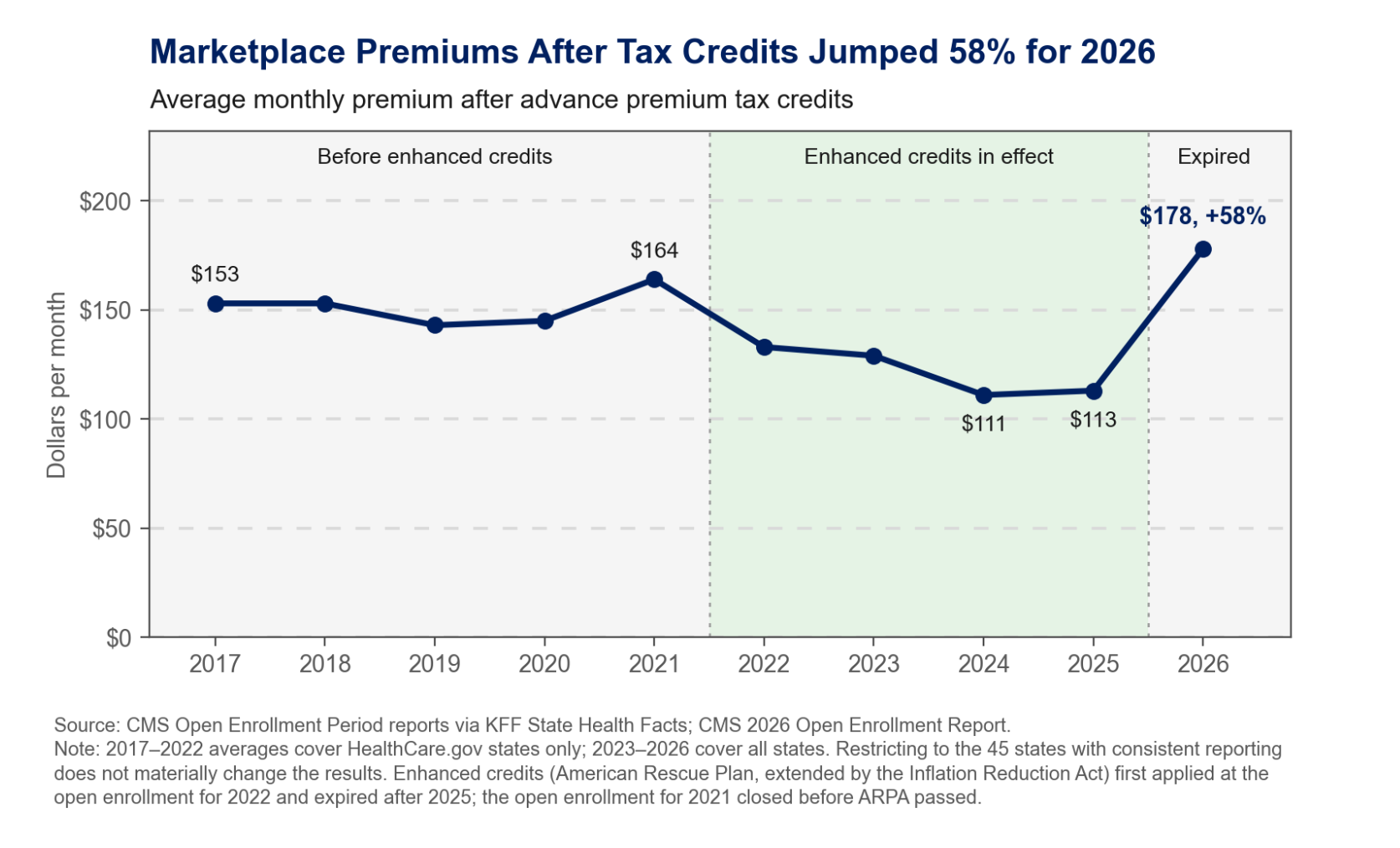
KFF estimates this decision raised after-subsidy premiums by 114%, or about $1,000 a year. In response, some people left the market and enrollment fell 12%, from 21.8 million to 19.2 million. New Mexico, the one state that replaced the federal subsidies with its own money, was the only state where enrollment grew. Others traded down to skimpier plans, but still are paying more. The share of enrollees in the least generous bronze plans went from 30% to 40%, and the average deductible rose by more than $1,000 to $3,786.
Even after all that switching and leaving, the average premium paid by people on the Marketplaces hit $178 a month in 2026, 58% higher than in 2025 and above the $164 people paid in 2021, the last year before the enhanced credits. Those who left were healthier than those who stayed, so insurers have proposed another 15% increase for 2027, stacked on top of this year’s 20%
If you get insurance through work
About 160 million Americans get health insurance through an employer. Most employers hold open enrollment for two or three weeks starting in October or November, for the plan year beginning Jan. 1.
The best data we have on 2027 costs comes from the large benefits consulting firms. They project total costs will rise 8 to 10% next year, the largest increase since 2003 and double the average increase of the 2010s. These firms point to more use of care, expensive new drugs, GLP-1s, hospital consolidation, and AI-assisted billing. For a typical worker, an increase that size works out to roughly $400 to $500 more next year.
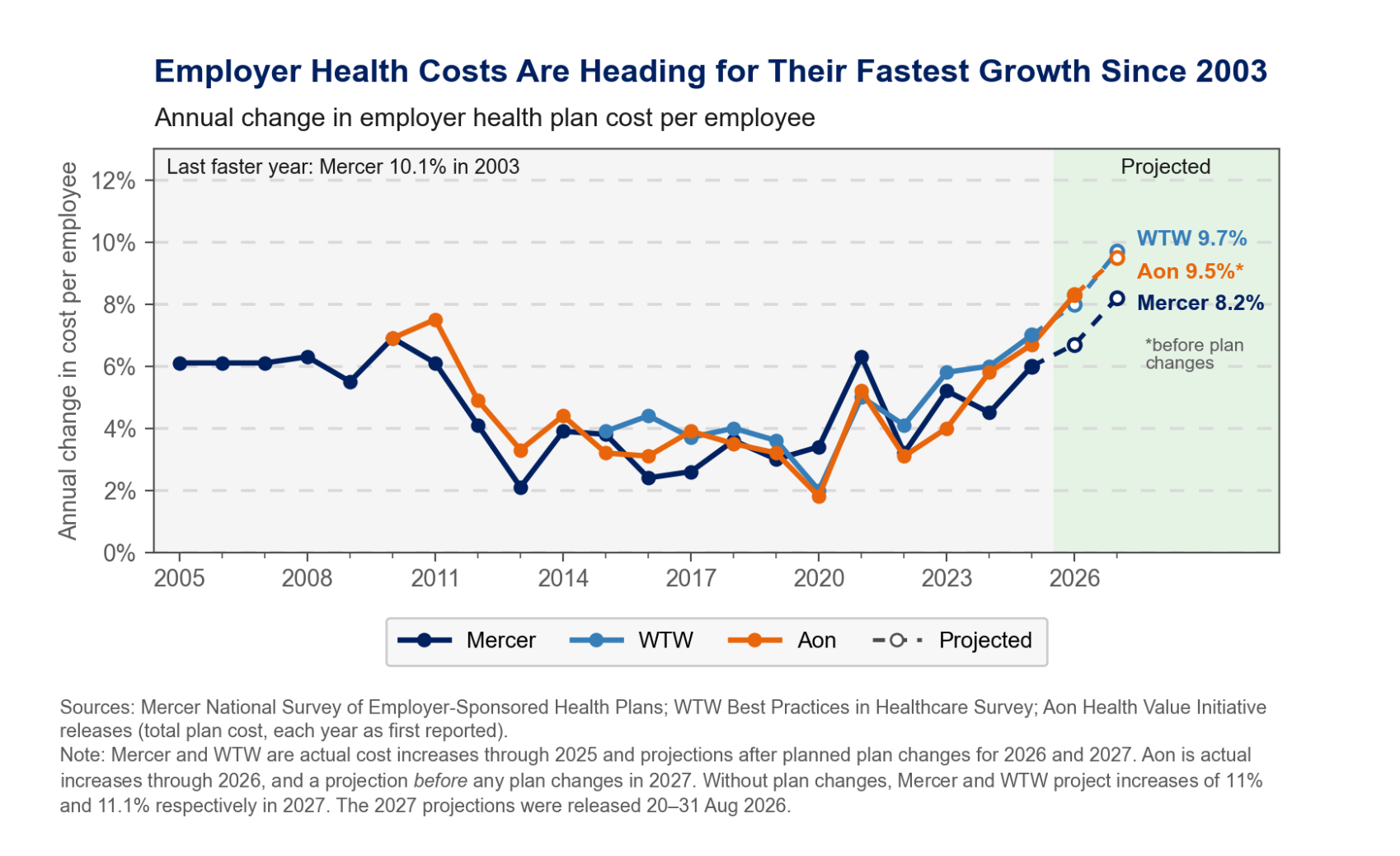
These projections are for total cost, which combines what workers pay in premium contributions and what employers pay. The available data on workers’ costs show similar increases. Moreover, economic research shows that workers also indirectly pay the employer share through smaller wage increases.
And these totals understate the full cost increase, since many employers have made plans less generous to hold costs down. One common change is to raise deductibles, which shifts costs onto workers. Another is to cut back on what’s covered. The share of large employers covering GLP-1s for obesity, for example, has fallen from 72% to 60%. Remove those changes, and the consulting firms estimate costs would have climbed another one to three percentage points.
If you’re on Medicaid
The third shock is to the Medicaid program. Starting January 1, 2027, OBBBA requires the 44 states (including Washington, D.C.) that expanded Medicaid to require adults covered by the expansion to document 80 hours a month of work, school, or community service. The CBO estimates that the requirement will push about 5.7 million people off Medicaid by 2034, leaving 5.3 million more people uninsured.
Most of those people should not lose coverage. The evidence suggests they will meet the criteria and lose coverage anyway because of the paperwork burden. When Arkansas imposed a work requirement in 2018, employment did not change. Instead, more than 18,000 people lost coverage within seven months, even though 95% either met the requirement or qualified for an exemption.
The work requirement is not the only Medicaid cut. OBBBA also requires eligibility checks every six months instead of once a year, shortens retroactive coverage, and limits the provider taxes states use to fund their share of the program. Counting those provisions, CBO projects 7.5 million more people will be uninsured by 2034
All of this means we are in the middle of the great healthcare cost hike. In January, after-subsidy premiums on the Marketplaces rose 114%. This fall, we expect the 160 million people who get insurance at work will see the largest increase in a generation. Next January, work-reporting requirements will start pushing millions of people off Medicaid. These shocks will strain family budgets.
They will also create a generational opportunity for reform. The best thing we can do is seize it.
The post The Great Healthcare Cost Hike Is Here appeared first on TIME.