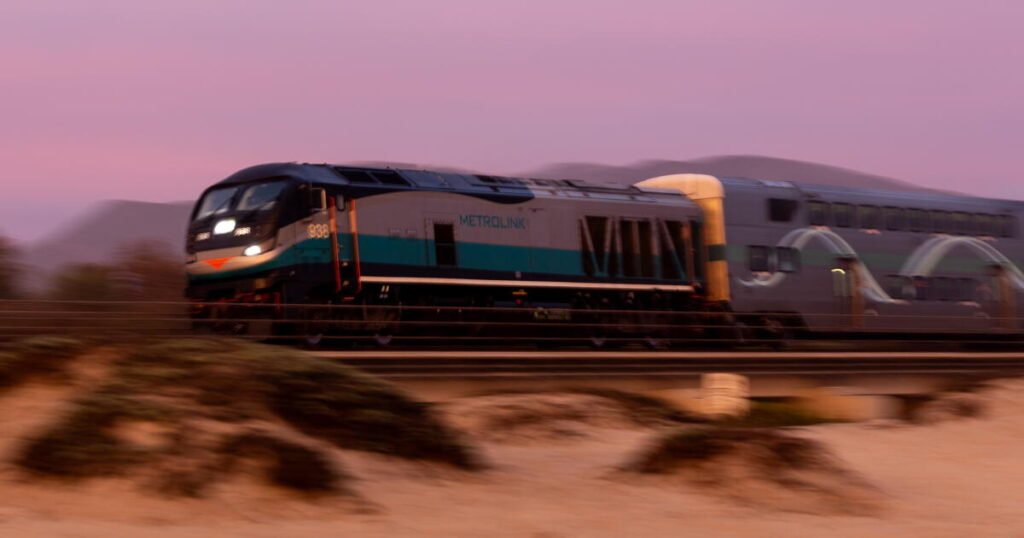
The famed railroad line along the San Clemente coast has found itself on the endangered list amid a relentless assault from rising seas and punishing surf.
Transportation experts have long spoken about the possibility of relocating the tracks in the area, but the California State Transportation Agency is expected to launch a study before year’s end examining what would go into potentially moving the rail line, according to Darrell Johnson, chief executive of the Orange County Transportation Authority.
Johnson said the study would likely take at least several months to complete.
Transportation planners previously said it could cost more than $5 billion to move the tracks inland.
“It will be complex. It will be expensive. It will be long-term in nature,” Johnson said about the study. “We’re very pleased that later this year the state of California is expected to kick off that study. We expect a lot of public engagement with that, and examining the options to frankly respond to these challenges that we’re experiencing right now.”
The stretch of track along the San Clemente shoreline has long offered picturesque views of sandy beaches and lapping ocean waves for passengers traveling between Los Angeles and San Diego. Commuters on the Amtrak Pacific Surfliner can enjoy a snack while taking in the sights, at a fraction of the cost of a plane ticket.
But over the years, landslides, coastal erosion and rockfalls have also threatened the stability of what’s officially known as the LOSSAN Corridor (short for Los Angeles-San Diego-San Luis Obispo) in parts of coastal Orange County.
In September, high tides and powerful wave activity from Hurricane Marie buffeted the San Clemente coastline, temporarily halting Pacific Surfliner and Metrolink service after more erosion and slope damage was spotted near the train tracks.
“As a condition of work on the portion of rail line in San Clemente, the California Coastal Commission required a Long-Term Railroad Adaptation Study due by 2034,” according to a statement from the California State Transportation Agency.
The study has not yet launched, the agency added, and all options are on the table.
“There has been no decision made to relocate the portion of the rail line in San Clemente and it would be premature to identify a route, timeline, or cost before that study has concluded. Relocating a rail line that carries passenger, freight, and military traffic is a major, long-term undertaking that requires careful analysis of engineering, environmental impacts, community effects, cost, and funding, along with close coordination with rail owners, operators, and federal partners,” the agency said in a statement.
“In the meantime, protecting the existing line is essential to keeping trains running safely for the communities that rely on them.”
Over the last five years, coastal erosion, bluff movement, high tides and landslides have significantly disrupted rail service in San Clemente. More than $300 million in local, state and federal funding has been invested in rail protection measures such as sand placement.
Two years ago, the OCTA identified four hot spots of “significant concern” along the San Clemente coast that needed repairs, according to the agency. OCTA secured state and federal emergency funding for repairs, but that work is about a year and a half behind schedule.
“There’s a growing consensus that the lack of sand on beaches results from concrete lining up the channels from years ago,” Johnson said. “Urban development has changed those sediment and flow patterns. Sea-level temperatures also appear to be heating up, and that creates an expanded volume of water.”
Delays along the rail corridor have “cascading” effects throughout the rest of the system, and affect other agencies because they all use similar crews and equipment, according to Fiailoa AhSue, assistant director of track and structures maintenance at Metrolink.
AhSue said that Metrolink, which provides commuter rail service throughout Southern California, will be looped into the relocation study.
“Our responsibility would be to make sure that any new track is inspected and safe for operations,” she said. “That’s what we do for any new work or projects that modify the system.”
The OCTA has already completed its Coastal Rail Resiliency Study, which evaluated strategies to protect the railroad for up to 30 years. A draft of the study didn’t propose only one solution but advocated for 23 different strategies, including bluff stabilization, catchment walls, sand placement, engineered revetments or seawalls and rail-foundation improvements.
The California Coastal Commission requires that relocation studies be conducted as part of its oversight under the California Coastal Act, a law aimed at protecting the state’s 1,100-mile coastline.
“The study would inform where the potential locations for a rail location could be and what other state, local and federal agencies would be involved,” said Shannon Vaughn, coastal program manager for the California Coastal Commission. “We don’t know what all of that entails right now and that’s why a study is required to ask all of these questions and identify issues and potential possibilities.”
The Coastal Commission would only be involved in the rail line’s relocation if the track needed to be moved to a region inside the coastal zone, according to Vaughn. The relocation project could also require permits from the State Lands Commission, State Parks, the U.S. Army Corps of Engineers or U.S. Fish and Wildlife Service, among other agencies.
“It also kind of highlights the complexity of the location of this rail corridor,” Vaughn said. “It’s in such a sensitive area that there are these multiple state agencies that have jurisdiction to protect the public resources through which this rail corridor passes.”
The post SoCal’s famed coastal railroad may have to move to survive rising seas. How could it happen? appeared first on Los Angeles Times.