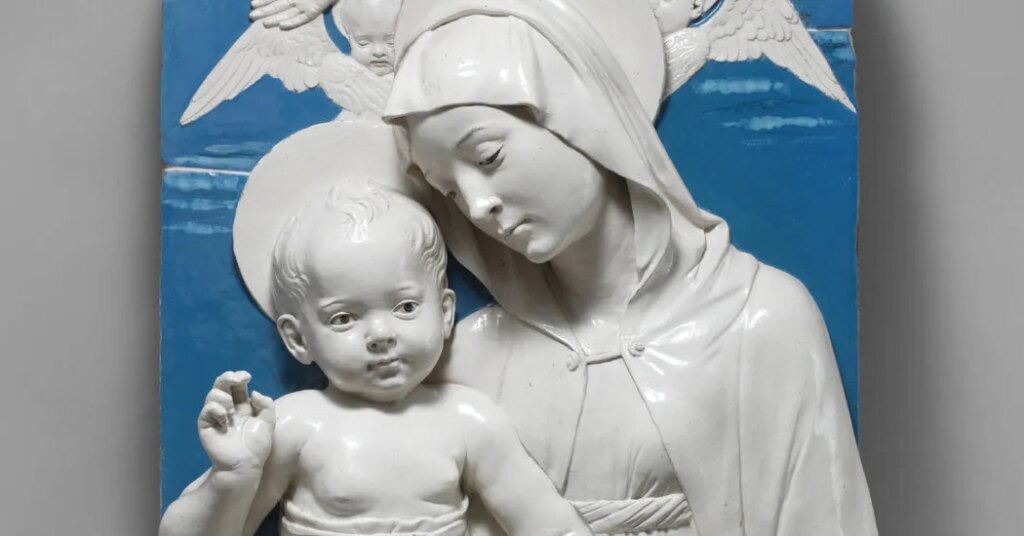
They’re not far from tchotchkes, like the sacred ceramics sold near the Vatican.
They feel sentimental: sweeter-than-sweet Mary, all in virginal white, against a sky so blue it makes your teeth hurt.
They show off new ways to work clay, but we know that important art is about ideas, not technique.
I admit those were some of my knee-jerk thoughts about the 16 statues and reliefs in “Rediscovering Della Robbia at the Met.” They are by three generations of Renaissance sculptors. By the time my visit was over, their “faults” were virtues. They carry us back to a place and time when artistic values were refreshingly different from ours.
The show’s title refers to a Florentine art dynasty. In the 1440s, Luca della Robbia went from working in marble and bronze to inventing the art of brightly glazed ceramics. Around 1470, his nephew Andrea took over the workshop. Andrea’s son Giovanni carried the tradition into the 16th century.
The family’s ceramics changed the look of Florence.
A drab stone facade would suddenly come to life once a Della Robbia relief — maybe some version of Andrea’s white-on-blue Archangel Michael — got cemented on. Unlike a frescoed mural, which could fade and crumble, Della Robbia ceramics hardly lost their luster. Some of them still live happily where first installed.
Those ceramics had a legibility that other materials could barely rival. The white-on-white details of carved marble, or the green-on-green of cast bronze, fade to a blur at a distance; Renaissance paintings have a level of real-world detail that works best at close quarters. But a Della Robbia relief like “Virgin Adoring the Christ Child,” glazed mostly in white but with bold greens and blues, was legible from across a church. It rendered salvation with the punch of a George Lois ad.
The Madonna from a church could also show up in a Florentine home, because the Della Robbias cast their works by the dozen for a new clientele that wanted its own modest objects to pray to. Today, it’s awkward to admit that the hallowed pleasures of art can include the pleasure of ownership; with their novel reproductions, the Della Robbias provided that pleasure to their contemporaries.
A young mother in that Florentine home would have found something else to enjoy in her Della Robbia Madonna and Child. Its subject, the ideal mother gazing fondly at her perfect baby, may strike us as cloying. But in the Renaissance, the holy pair modeled a serenity that was wildly beyond a woman’s normal reach: Illness and death, for both mother and child, was the norm, as Americans today can barely imagine. That Madonna and Child isn’t cloying; it’s hopelessly, painfully hopeful.
Our lady’s husband, allowed an education she’d never get, might have admired their Della Robbia for another reason. Reading the Latin writings of Pliny, he would have learned that the classical marbles dug up around Florence started life brightly painted. The Della Robbias’ ceramics conjured that Roman bling lost to time.
Durability, legibility, accessibility, antiquity: With all these innovations, it’s no wonder Luca was one of his era’s most admired and popular artists. Even a century later, Giorgio Vasari’s history of great artists could insist that Luca would earn the thanks of “all later ages” for inventing an art of color more durable than anything the ancients had.
In the 19th century, Della Robbia sculptures were still such a big deal that Americans could flex their philanthropy by donating them to the Met. By the 1960s, the museum had several dozen. In 1968, the Met was planning a gallery devoted to Della Robbias, though it never materialized as their ceramics began to fall out of fashion.
Beginning in about 1970, most of the Met’s Della Robbias disappeared into storage. By 2016, only six of the family’s works were on view.
The Met’s Denise Allen, who organized this show with the guest curator Federica Carta, said that their exhibition’s gorgeous relief of a young man was dirty when first recovered from storage. “He’d been neglected,” Allen said.
According to Allen, “the Della Robbias worked in the wrong material” — wrong at least to satisfy recent tastes. Colored ceramics came to seem brash and cheap, more like tableware than the high-toned art of Donatello and Michelangelo.
Technical innovation, like Luca’s work with glazes, lacked conceptual heft.
The modernist obsession with “medium specificity” — that a painting should be about what paint can do, a sculpture about shaping matter — left a Della Robbia relief stuck between painting’s color and sculpture’s shapes, as uncommitted as a mullet.
Even these ceramics’ wide appeal became a liability: Over centuries, the Della Robbias’ innovations came to shape the world of sacred schlock sold to tourists, and their originals suffered by association — at least at first sight, prejudged by a critic like me.
But the Met had me looking at these objects with the eyes of the people who first made and loved them.
Rediscovering Della Robbia at the Met
Through Jan. 17, at the Metropolitan Museum of Art, 1000 Fifth Avenue, Manhattan; 212-535-7710, metmuseum.org.
The post The Fresh Charms of Art From the 15th Century appeared first on New York Times.