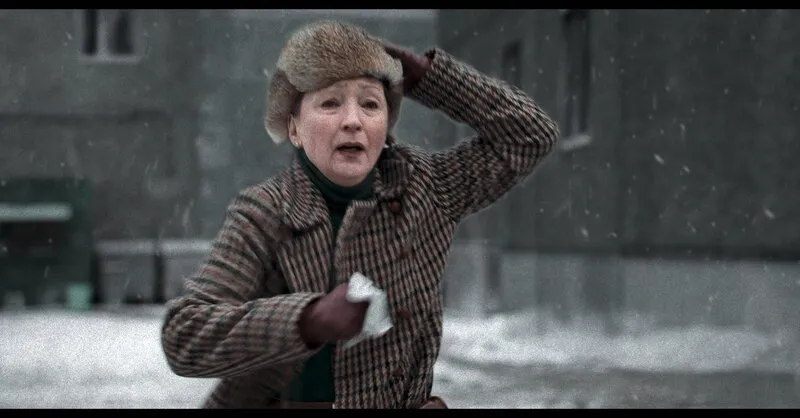
Based on a short story by Olga Tokarczuk, “Winter of the Crow” follows the journey of an outsider in Communist Poland at an especially grim time. Joan Andrews (Lesley Manville) is a British professor of psychiatry who travels to Warsaw to speak at a conference — and happens to be there at the moment in December 1981 when the authorities impose martial law in response to the push for democratic reforms by Solidarity, the trade union and social movement.
Even before the crackdown, Professor Andrews appears uncomprehending of life in Warsaw. She has never visited a Communist country, and the weather itself — blinding snow — seems to disorient her. She is surprised when Alina (Zofia Wichlacz), the student serving as her chaperone, puts her up in a drab family apartment instead of a hotel. She comes to witness the deprivations of the people around her and gains a sense of life under surveillance. That Professor Andrews does not speak Polish, and resorts to increasingly desperate, entitled pleas in English, only adds to the tension in this compelling if slow-burning film.
“Winter of the Crow” itself has an interesting insider-outsider perspective. The director, Kasia Adamik, the daughter and sometime collaborator of the celebrated Polish filmmaker Agnieszka Holland (“Green Border”), left Poland as a child during the time when “Winter of the Crow” is set.
The visuals are quite dark, with grays so bleak the movie at times verges on monochrome. There’s a hint of a redemption arc — will Professor Andrews, despite her superciliousness, find the courage to do right by the activists she has met? — but Adamik is after something more complex, which Manville’s performance embodies in a provocatively ambiguous final shot.
Winter of the Crow Not Rated. In English and Polish, with subtitles. Running time: 1 hour 52 minutes. In theaters.
The post ‘Winter of the Crow’ Review: Life in Communist Warsaw appeared first on New York Times.