When you prompt an artificial intelligence model to make a picture, it starts with an array of dots.
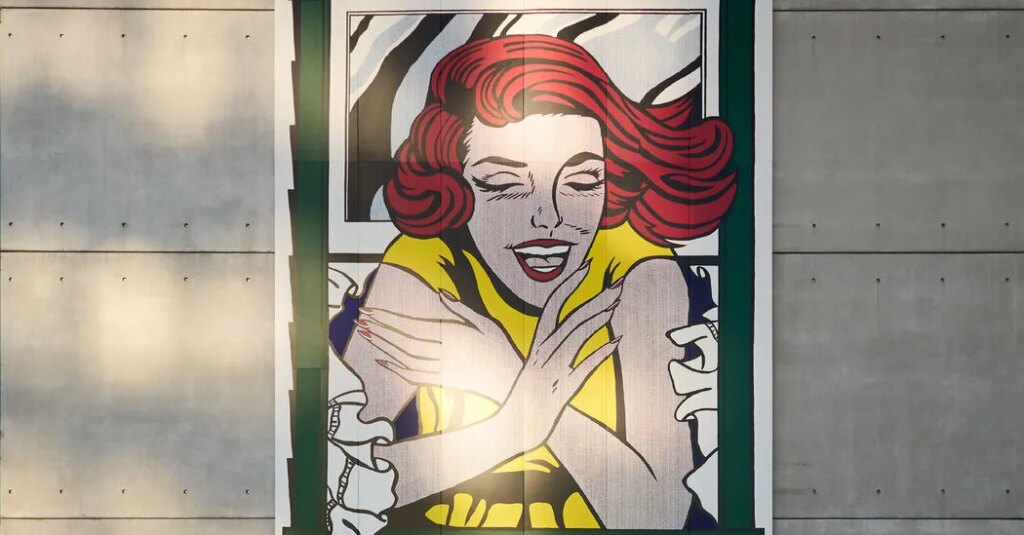
You type in your desires — beautiful girl laughing at a window; fighter plane soaring through the clouds — and the model initially renders a grid of randomly colored pixels. Then it gets to work, switching this speck for that one, guessing whether a blue pixel should be next to a red pixel or another blue one, until each little zone of the grid looks something like life. In this way, as the model reconstitutes the billions of images it has ingested (or plagiarized), the noise resolves into an uncanny collage of a beautiful girl, though her hair or elbows might pass through the window sill. It is a new image, but never an original one; it has countless sources, but no author; it is poison.
Six years ago, when the Whitney Museum of American Art decided to organize the first major retrospective of the artist Roy Lichtenstein in New York in over 30 years, its curators had a hunch that his dotted paintings would have something to say to our times. They believed that his imagery, drawn from comic books and commercial advertising, could resonate with new audiences, who grew up with no awareness of a boundary between high culture and low.
But there was something they did not foresee in 2020: that a new technology would rumble our ideas of original and copy, unique work and mass reproduction, even harder than in the artist’s lifetime. This tidal wave of computational images (do not call them “intelligent”) is subjecting us to minute-by-minute visual acid tests, forcing us to discern, if we can, whether any human lies behind grids of colored dots. Which has made “Roy Lichtenstein: Like New,” opening this weekend, the most momentous exhibition of the season.
His analytical awareness has been underestimated for a while, thanks to his signature style. In the museums, on the auction block, in the Times Square subway station, Lichtenstein has become so visually familiar that any diffusion engine can spit out a dotted picture of your dog “in the manner of Roy Lichtenstein.” You needed only the three letters P-O-P to sum up his importance: Metabolizing mass culture into fine art, he shocked the post-Pollock painting scene and pushed American culture into a supposedly democratic 1960s.
“Like New” troubles that received view of Lichtenstein, looking away from Pop as a visual mode and linking him to more experimental tendencies of that era, such as the pranky post-Dadaist performances of Fluxus. It zeros in on his replicas and facsimiles, and suggests the artist chose popular sources less for their familiarity than as elements in a conceptual chain of reproduction, alteration, circulation. Above all, it makes Lichtenstein — Mr. Pop, Mr. Estrangement, who flattened painting into mechanical, antiseptic components — an unexpected defender of human vision against industry and technology. His dots, unlike the random noise of the image generator, were rendered with a critical spirit, sensory awareness, and something a lot like love.
“Roy Lichtenstein: Like New” has been organized by an unexpected pair: Meg Onli, a curator best known for her work with contemporary art, and Alex Da Corte, a midcareer artist whose videos and performances approach American mass culture with manic sorrow. Two centuries ago, at the Louvre or the Royal Academy, it was commonplace for artists to hang their predecessors’ work in public displays. Today, entrusting a living artist with another’s major museum retrospective is nearly unheard of. (Especially one whose works are this expensive; lenders to the show include Kenneth C. Griffin, the mayor’s favorite out-of-state billionaire, plus MoMA, MOCA and a clutch of Broads, Brants and Blums.)
Not only has Da Corte conceptualized the display here; he’s also included new works of his own and remade several by Lichtenstein, including the 32-foot-tall version (more than twice the original’s size) of “Girl in Window,” made in 1963 for the upcoming World’s Fair in Queens, which now lords over the Whitney’s fifth-floor terrace and is visible from the High Line.
Duplicates and dissemblings come fast and furious. Da Corte and Onli are full of jokes, very good jokes in fact, maybe a couple too many for their own good. As with “Edges of Ailey,” the sensory-overloading dance exhibition in these same galleries two years ago, their Lichtenstein show is both high-concept and high-energy — and it betrays an anxiety, at the increasingly populist Whitney, that classics of the 1960s can only be made legible to young audiences through constant stimulation and Instagrammable backdrops.
Lichtenstein’s oval-shaped mirror paintings are displayed in an oval-shaped silver gallery. A remake of his 1967 “Super Sunset Billboard” stands in front of the Whitney’s western picture window, so if you come at day’s end you can see two sunsets in one. (Like “Girl in Window,” this is not an inkjet printout, but a new hand-painted version by Da Corte and his studio.) A mock-1950s instructional film of Lichtenstein’s teacher Hoyt L. Sherman, complete with narration in the nasal tones of Movietone News, turns out to star Da Corte himself, under pounds of prosthetics.
Not your papa’s Pop, then. If I were holding the remote I’d turn the Laugh-O-Meter down a few ticks. But the jokes are in the service of something; they restore some personality, and perspicuity, to an artist who can be treated as a brand. (We pause here to note the Whitney’s collaboration with the Gap, offering T-shirts, baseball caps and a Ben-Day-dotted quarter-zip fleece that will turn heads on the trading floor.)
Lichtenstein credited Sherman, who experimented with flash bulbs and wearable blinders in his introductory courses at Ohio State University, with teaching him how to look with a perceptual distance that made the world appear just about abstract. Take Lichtenstein’s “Golf Ball” (1962), which distills a dimpled ball into an array of black crescents against a white background, spare as a Mondrian, legible as a Titleist. Pop, or Op? Thing, or idea of a thing? One closely observed golf ball, or an icon signifying “golf ball”? Those conceptual feints could be made meaningful only via a singular human perception that rivaled Cézanne’s — quoted directly in the show in a deadpan painting from the same year, which reduces the French painter’s wife to a teach-yourself-drawing schematic.
In that golden year of 1962, Lichtenstein had his first solo show at the Leo Castelli Gallery, where his paintings drawn from comic books and commercial advertisements mystified critics. (Still, the show sold out!) Onli and Da Corte, in a curatorial coup, have borrowed all eight paintings from that debut, and recreated it as a show-within-the-show, right down to the East 77th Street parquet floor. The housewife cleaning the refrigerator, the downed jet with a cartoon “BLAM”: Here was a painter who seemed to equate avant-garde and kitsch, in ways that some critics read as a capitulation to mass culture. But what if they were more Cézannesque than that? What if remaking, reproducing, reauthoring was the only route left to paint what you see?
“Like” new, but not new; derivative, but innovative; awash in the vapidity that only Americans could pass off as progress, and yet still, somehow, keeping faith with a beauty that could last for all time. Lichtenstein was not Warhol, and throughout this show Da Corte and Onli push hard against the received wisdom that Pop aimed to deflate high art, or that reproduction invalidated artistic originality. On the contrary, as Da Corte writes in the catalog, “Facing machines, living among them, and almost becoming one, Lichtenstein in the early 1960s understood the stakes, for art, to be higher than they had ever been.”
He stayed in the hand — I mean this as a poker metaphor, but it’s true literally — first through the dots, mimicking the halftone patterns of inexpensive printing, which Lichtenstein initially produced by using a toothbrush to force pigment through an aluminum screen. Soon after, he would introduce the motif of the brushstroke: a mark of a painter’s individuality, which he translated into a repeatable sign or symbol. The dots and the brushstrokes were not automations, but performances of automation. If mass culture was reducing human life to a standardized product, Lichtenstein was rechanneling that culture’s own imagery to affirm the uniqueness of human vision — an achievement that registers with even greater force in the dots and dashes of his quasi-abstract architectural studies, and ovals that look like mirrors but reflect nothing.
Da Corte and Onli have a lot of fun with Lichtenstein’s doubles and sequels, hanging nearly identical canvases side by side. They present source imagery from DC Comics, then Lichtenstein’s appropriations from those comics, then a subsequent copy-of-his-copy by another painter, Elaine Sturtevant. The curators nearly go overboard with a display of his later works, hung as tightly as at the old Royal Academy, in which Lichtenstein repainted his earlier paintings in the setting of his own studio. Then they show the stand-alone versions of the paintings-in-the-paintings, and, when one turns out never to have existed, Da Corte just makes it himself (“Comic Painting,” 2026).
The pixel is the smallest unit of color that a screen can display; the dot is the equivalent with printing ink. But whether you are reading these sentences on gray newsprint or a backlit phone, those particles are invisible to the eye.
How can any particles cohere into an image, anyway? What companies transmit them, what algorithms power them? What sources do they draw on, what data sets? Those questions were Lichtenstein’s, and when he scaled up the dots of the halftone into visible, textural marks, he was not just wagging his finger at American consumer culture. He was locating, in the most mechanical and cheapest of mass imagery, a human perception that had to be made visible before it could be defended.
All of which makes this show far more touching than I had anticipated. Touching is a theme here (“please touch,” reads one art display). “Touch, in forms both physical and metaphorical, is what separates the person from the machine,” Da Corte writes in the catalog, “and with touch comes transference, breakdown, transformation.” When you inspect these paintings — not just the pricey originals but the newly made murals that will be destroyed at this show’s end — you may be surprised by their nubbiness, and how thickly the pigment has been lashed through a punched aluminum screen. The dots are raised and tactile. They grow and shrink, chafe or splinter. The sun may be setting on humanity, but look up close: Every dot, and every pixel, means nothing without you and me.
Roy Lichtenstein: Like New Oct. 11 to May 10, 2027. Whitney Museum of American Art, 99 Gansevoort Street, Manhattan; (212) 570-3600, whitney.org.
The post Connecting the Dots Between Roy Lichtenstein and Today appeared first on New York Times.