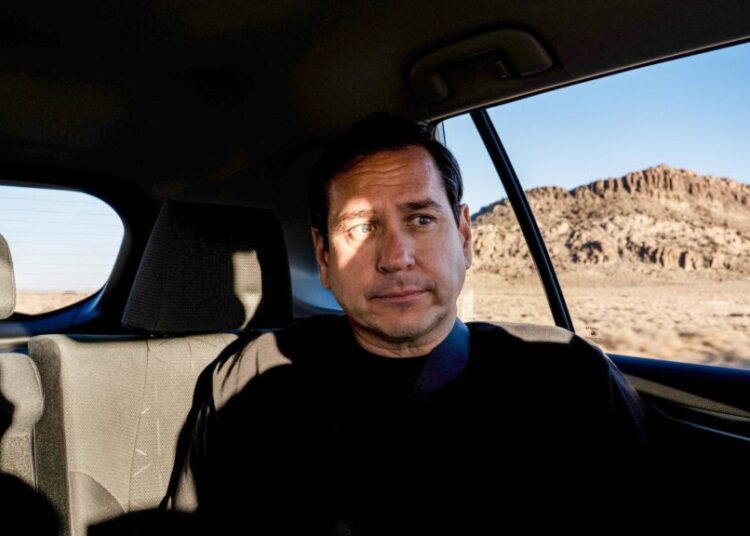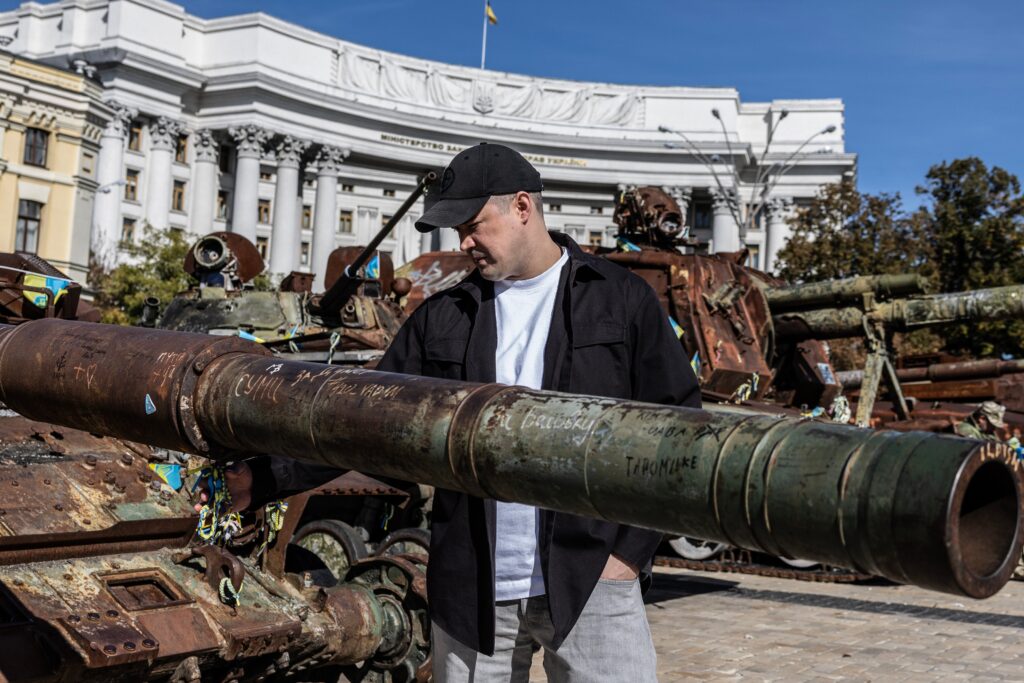
KYIV — AI-powered robots are likely to dominate the next phase in the rapid technological transformation of warfare, and Ukraine cannot afford to debate the societal risks before pursuing such autonomous weapons, the country’s former defense minister, Mykhailo Fedorov, said in an interview.
“The main thing for Ukraine is to survive and preserve our independence,” Fedorov, an architect of Ukraine’s drone program, told The Washington Post. “And we need technology to defeat the Russians.”
While officials worldwide worry about the potential risks of artificial intelligence, including the prospect that rogue AI agents could kill humans, Fedorov said Ukraine was already confronting its own extinction at the hands of Russia and cannot afford to slow or restrict AI on the front lines.
“Our biggest concern is that our enemy, Russia, together with its allies, will move faster toward AI robots; they will build drones without communication links, fully autonomous ones,” he said. “Once the first robots are deployed, it’s basically inevitable and irreversible.”
“The question,” Fedorov continued, “is who will be the first to start using this, who will regulate its use and how.” But regulation, he said, must come afterward, and the priority for Ukraine is to “get there first, gain the advantage and dictate the rules of the game.”
Formerly Ukraine’s minister of digitalization, Fedorov is credited with helping to build the country’s drone fleet, which has proved critical to holding back Russia’s continuing onslaught. Now, he wants to build an army of killer robots.
Fedorov was abruptly removed from his post this summer by President Volodymyr Zelensky amid a broader government reshuffle. He had been defense minister for just six months, and his ouster sparked public protests.
Thousands took to the streets to voice their frustration over a lack of government transparency and to call for Fedorov’s reinstatement. Zelensky offered him other positions, but he refused.
Once a close ally of Zelensky and a veteran of his team, Fedorov is now his political rival.
“Fedorov is almost a new incarnation of Zelensky. They are both emotional, sharp and energetic. They favor quick action and want quick results,” political analyst Volodymyr Fesenko said in an interview. “But Fedorov is more technological, modern, organized and focused on innovation. He is a person of the 21st century.”
At 35, Fedorov is regarded as a young, talented reformer with a keen eye for business. He has support among Ukraine’s metropolitan middle class and its youths, and he is seen as the embodiment of the country’s expertise at technological innovation.
He is less popular, however, outside Ukraine’s big cities. In his brief tenure as defense minister, he oversaw tumultuous changes, angering many in the military’s top brass, who thought he overstepped his authority.
He also frustrated Ukraine’s rank-and-file after he made unpopular changes to soldiers’ fixed-term contracts.
Zelensky said he sacked Fedorov because of his inability to work alongside the former commander in chief of Ukraine’s armed forces, Oleksandr Syrsky, who was subsequently also removed. Fedorov claims that he was fired for pushing reforms, including major audits of military spending.
Recent political missteps, however — including calling for elections, which are illegal in Ukraine under martial law, and joining Italy’s Defense Ministry as a freelance adviser — have alienated many of Fedorov’s supporters.
“He essentially killed off his own protests,” said a former senior official in Kyiv, who spoke on the condition of anonymity to discuss sensitive politics.
Most Ukrainians are against holding elections in wartime, and experts say it would be virtually impossible to hold free or fair elections with millions of Ukrainians displaced from home, living abroad as refugees or deployed in the military.
Dmytro Koziatynski, a Ukrainian veteran who organized this summer’s protests, described Fedorov’s call for elections as “clumsy.”
“His video address made me think that he currently has some major problems with his media team,” Koziatynski said.
In his interview with The Post, Fedorov defended his decision to call for elections.
“When you and your team are, so to speak, fired, while they keep people who are looting the system, who are obstructing victory … there needs to be some kind of renewal of democracy, a new cycle, so that new people come in,” he said. “People who understand the crisis, understand the war, and bring some new ideas that can get us out of this situation.”
Zelensky’s inner circle has been shadowed this year by multiple corruption scandals. “If I see that the country is burning and heading toward catastrophe, how could I just stay silent when I know what is happening from the inside?” Fedorov said.
Since his departure from government, Fedorov has swapped politics for venture investment.
Last month, he announced the formation of a new defense technology company with Palantir CEO Alex Karp as its lead investor.
Just three months ago, Fedorov was battling to procure thousands of drones and streamline the Defense Ministry’s day-to-day operations. Now, he is hosting Zoom calls with potential investors from the United States and the Middle East.
“Now that we’re no longer in government, we have to get those resources somewhere else,” he said. “We are hacking the system this way. … In 2022, we realized that during a technological war like this, the state has to change its role. The state has to become a venture investor.”
One of his central ideas is to use the new tech fund to create an “army of robots,” which he said will “save lives” by replacing humans on the battlefield. It will also solve Ukraine’s persistent shortage of troop reinforcements as it defends against the far larger Russian military.
Oleksandr Pivnenko, commander of Ukraine’s national guard, said Saturday that in some frontline areas, Russian soldiers outnumber Ukrainian troops 6 to 1.
Robotics and semiautonomous systems are already on the battlefield but have yet to enter the front at scale. This past weekend, Kyiv installed AI-guided robotic gun turrets across the city to shoot down incoming drones and strengthen the capital’s flailing air defenses.
Unmanned ground vehicles, or UGVs, “are one of the main growth areas in Ukraine’s army, alleviating manned logistics at the front, performing casualty evacuation and in select cases executing combat tasks,” said military analyst Michael Kofman, a senior fellow at the Carnegie Endowment, the Washington-based think tank.
Fedorov said he aims to put the first “basic” humanoid robot on the battlefield in six months.
Already, there are ethical questions.
In the interview, Fedorov dismissed concerns about his deepening ties with Palantir’s Karp, who has publicly voiced support for technofascist and white-supremacist ideas, and whose company has become embroiled in controversies over data protection and its ties to intelligence and immigration agencies.
“In reality, Ukraine is getting more from Western companies for now than Western companies are getting from us,” Fedorov said, insisting that Palantir does not have access to Ukraine’s battlefield data.
Fedorov said that he remains in direct contact with U.S. tech titans, including Elon Musk, and that Karp was the first person to call him after he was fired this summer.
“He said, ‘Whatever you decide to do, I’d be interested in supporting your team, in doing something together,’” Fedorov recalled. The pair met in the United States a month later, and Karp quickly agreed to be the fund’s first and principal investor.
But Fedorov said he intends to remain in charge.
“We don’t plan to sell a large stake to Palantir,” he said. “Despite the strong interest, we still want to retain full control of the company.”
While Fedorov has railed against corruption in Zelensky’s presidential administration and in the Defense Ministry, he is facing several of his own alleged conflicts of interest.
Critics point to Ukrainian anti-corruption laws that restrict transactions between former officials and private companies for one year after leaving office, if they made decisions related to those companies’ activities. As defense minister, Fedorov oversaw extensive cooperation with Palantir.
There are also questions about the ethics and risks of an ex-minister who had access to classified information now advising a foreign government.
Other critics have dismissed Fedorov’s vision of humanoid robotics as a distraction that does not correspond to Ukraine’s urgent military needs, namely a critical shortfall in missile and drone interceptors to protect against Russia’s relentless airstrikes.
Fedorov has said a part of his new company will focus on the development of interceptors, but that he believes Ukraine urgently needs a “new Manhattan Project,” in partnership with Western companies, to develop cutting-edge war technologies.
“The consequences of our enemy gaining the upper hand will be impossible to predict because, essentially, new autonomous robots and drones are very similar to nuclear weapons,” he said. “The only difference is that they will be more accessible and uncontrolled.”
The post AI-powered robots are next in war tech, Ukraine’s former defense minister says appeared first on Washington Post.