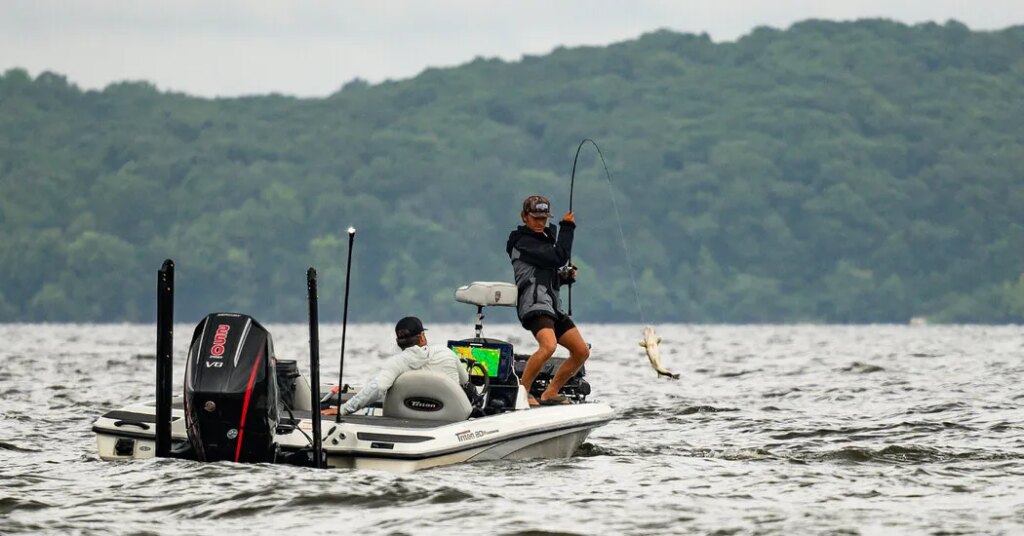
Just before sunrise on a Saturday in August, 25 boats bobbed in the marina at Paris Landing State Park in Buchanan, Tenn., awaiting the start of the final round of the most prestigious event in high school bass fishing.
After “The Star-Spangled Banner” was played, the boats sped onto 184-mile-long Kentucky Lake in search of bass, the heavier the better.
Caige Bragg, a lanky 18-year-old Alabaman who was in first place, motored about 10 minutes south of the marina where he knew the fishing would be fruitful.
Eight hours later, Mr. Bragg returned to the marina and handed the tournament’s organizer a mesh bag with his catch. At a combined 11 pounds 3 ounces, the three fish were enough to secure him the championship, beating out 213 other teams.
For winning the Strike King Bassmaster High School National Championship, Mr. Bragg received a $25,000 boat and a $5,000 college scholarship.
“I just love fishing for bass, to be honest,” he said. “There’s always a puzzle every time. It’s kind of like chess.”
Competitive bass fishing has been around for about 60 years, but in the past decade or two, it has turned into high-stakes pro sport complete with star anglers, big sponsors and media deals. The chance to make a living with a rod, reel and boat — or at least get a college scholarship from it — has in turn spawned a growing number of youth fishing programs across the country.
The sport’s sanctioning body, BASS Nation, short for Bass Anglers Sportsman Society, has about 12,000 anglers in 1,100 high school and youth clubs in 35 states, up from 600 clubs and about 6,000 anglers in a dozen states a decade ago. Bass fishing is sanctioned as a high school sport in at least eight states, with clubs in many other schools. (Mr. Bragg fished for his high school’s club team, the Springfield Anglers.)
Dave Washburn, the vice president of operations at Major League Fishing, one of the top professional tours, said bass fishing, long a hobby, now looked and felt like many other high school sports, complete with jerseys, pep rallies and awards ceremonies.
“For many students, it is the first time their passion is viewed as something that carries the same legitimacy as more traditional sports,” he said.
The rules of the tournament were relatively simple. Each team of one or two high school anglers could catch up to three fish of at least 15 inches in length. The fish had to be alive when they were weighed and returned to the lake afterward. Anglers could use any artificial bait, rods or boats they wanted, but could not seek or receive outside help while fishing.
But as in other youth sports, competing at the highest levels relies on high-end equipment, entry fees and out-of-town travel. New bass boats can cost $100,000, and they must be hauled to events, where parents have to pay for meals, hotels, gas and registration fees. Digital fish finders can cost $2,000 or more, while rods can run hundreds of dollars each.
“This is basically travel league fishing,” said Jake Davis, president of BASS Nation in Tennessee.
Most junior high school and high school bass fishing teams operate as clubs, not sanctioned sports, because schools do not want to insure the boats and anglers. “When you say boats and kids, they think liability,” said Shane Barker, who runs the Tennessee Valley Bass Team, which has 42 school-age anglers, two of whom competed in the national tournament.
Without school funding, teams must raise their own money mostly by selling sponsorships, which Mr. Barker said could cost several hundred to several thousand dollars apiece. The anglers’ team jerseys are often crowded with logos and names of bait shops, marinas and other businesses.
Mr. Barker said it cost about $1,000 per athlete per season, not including boats. Some of his anglers come from single-family homes, and he helps them find affordable rods, lures and other gear at places like Walmart. In the national tournament, most boat captains were the fathers of the anglers. But Mr. Barker, who retired from the Army after 33 years, says many parents do not have four or more hours a day free to captain their children’s boats.
Like other youth sports, though, bass fishing is increasingly seen as a way to win a college scholarship. About 600 colleges have some kind of fishing program, roughly twice as many as a decade ago, said Garry Mason, the head coach of the bass fishing team at Bethel University, about a 30-minute drive from the marina.
There is even a bass fishing combine, held in Alabama, where 100 young anglers showcase their skills for representatives from 25 colleges with bass fishing programs.
Bethel, whose teams have won 13 national titles, was the first college to offer scholarships, starting in 2009. Mr. Mason, who has had 15 graduates fish professionally, walked around the tournament speaking with anglers as they came off the stage, and to their parents. He offered 20 scholarships that weekend.
“I love to see kids attend college because they need to learn about business, taxes and other skills,” he said. “This is a very expensive sport, and you need to know what you can write off and what you can’t, and you need to learn how to promote yourself and obtain sponsors.”
Trey McKinney, 21, the Progressive Bassmaster Angler of the Year, agreed that being a professional was a lot more than just fishing. On the water, pro anglers are followed like Tiger Woods walking up a fairway. But they need to reach fans when they are off the water, too.
“You have to catch bass, but social media is such a big deal to make a living now,” Mr. McKinney said in a phone interview. “You can’t just go to the sponsors and say, ‘What can you do for me?’”
Commercialism was everywhere at the tournament in August. Bass Pro Shops parked a trailer across from the stage and sold snacks, caps, T-shirts and plenty of fishing gear, including $250 rods and bait for as much as $20 a pop. Onstage, Glenn Cale, the tournament director, thanked the sponsors, including Toyota, Progressive and Mercury, the outboard motor company. The anglers he interviewed gave shout-outs to their sponsors back home.
To the side of the stage — where a sign read, “Big Bass. Big Stage. Big Dreams.” — Jake Bragg, Caige’s father, was beaming after his son’s victory in his last high school tournament. He was eager to see his son begin his career as a full-time angler. Caige said he would pass on the $5,000 scholarship he had won because he planned to skip college and try his hand fishing for a living at local tournaments.
“He was probably in 10th grade and he already knew he wanted to make a career out it,” Jake Bragg said. “He’s 40, 50, 60 hours a week on the water.”
The post Need Help Paying for College? Try Bass Fishing. appeared first on New York Times.