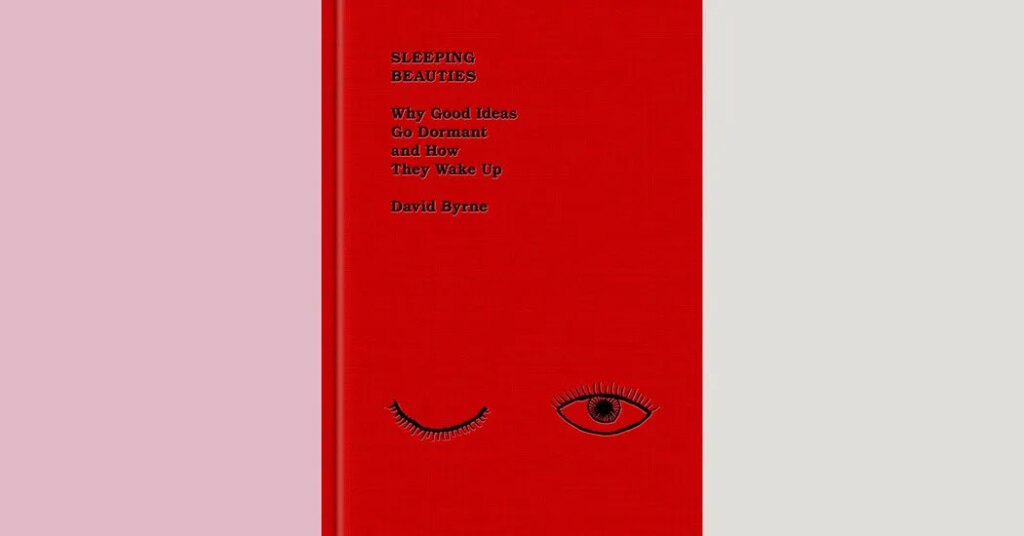
SLEEPING BEAUTIES: Why Good Ideas Go Dormant and How They Wake Up, by David Byrne
David Byrne, the prizewinning musician and a co-founder of Talking Heads, reads esoteric academic journal articles for fun — and uses them to delight and enlighten us.
In his new book, “Sleeping Beauties: Why Good Ideas Go Dormant and How They Wake Up,” Byrne draws on his reading to deliver profound insights about creativity. Throughout our history of information scarcity, the currency of progress was discovery. Now, in the age of information abundance, inspiration and innovation may depend more on rediscovery.
Byrne guides us on a captivating quest to understand how we come to remember forgotten ideas, inventions and technologies. With striking dexterity and range, he explores how advocates reawakened Bach’s compositions and Vermeer’s paintings after one and two centuries of slumber; how technological advances rekindled theories of continental drift and black holes; how accidents resuscitated hand-washing and genetics; and how war renewed interest in the submarine and “The Great Gatsby.”
He traces the term “sleeping beauties” to a 2004 study of scientific papers that were dormant before being revived. It struck a chord with Byrne, who immediately thought of art and artists that had followed similar trajectories. He recounts how Vermeer’s paintings began to disappear from public recognition after his death in the late 1600s and weren’t resurrected until the mid-1800s, when a French journalist and art critic happened to see a Vermeer in a museum, went searching for more of his work and published a catalog of it. We should all be so lucky to have a champion that passionate.
Byrne’s analysis is both cleareyed and hopeful. He acknowledges that we cannot control whether a war or a stock market crash will sink an idea into obscurity or catapult it into acceptance. He reminds us that artistic and scientific geniuses are often overlooked because they emerge ahead of their time — when few are able to recognize their worth — and that it is never too late for our work to find an audience. And he underscores our capacity to rescue ideas that warrant attention.
That brings me to the most vexing question in the book: How? Byrne offers glimpses into the process when he describes how lone individuals brought radio astronomy and Faulkner back to the fore through sheer will and skill. Readers will be hungry to learn more about effective strategies for capturing attention, crafting coalitions and catalyzing cultural trends. They will inevitably wonder how they can protect their own creations from being ignored or discarded. There is evidence, for example, that solutions are less likely to be rejected when we explain the problem first, that showing unbridled enthusiasm can prevent people from taking us seriously and that we’re sometimes more likely to be heard when we highlight the limitations as well as the strengths of our pet projects.
It would be fascinating to see Byrne reflect on such techniques and examine his own successes and failures in getting his music and art on the radar. Comparing triumphs with disappointments could help to illuminate what it takes to produce something that outlasts us. But if Byrne devotes little space to his own experiences here, he gives us backstage access to his mind instead; rather than dwell on what he thinks, he shows us how he thinks.
In “Once in a Lifetime,” his band’s iconic existential song, he rhapsodizes about going through the motions and stopping to ask, “How do I work this?” In his book, he is acutely aware that there is no surefire formula for making ideas last or bringing them back to life. What he presents is far more valuable: a deeply researched, stimulating inspection of how the marketplace of ideas shifts, and what steps we can take to shift it.
“Sleeping Beauties” belongs on the bookshelf of anyone who cares about creativity or culture. Eventually, it may become a sleeping beauty itself, one that deserves to be reawakened by future generations.
SLEEPING BEAUTIES: Why Good Ideas Go Dormant and How They Wake Up | By David Byrne | Penguin Press | 388 pp. | $36
The post What if the Best Ideas Are Already Here, Waiting to Be Rediscovered? appeared first on New York Times.