Hours after the United States snatched Venezuelan President Nicolás Maduro from Caracas in a Special Forces operation, Marco Rubio strode into the side chapel of Saint Augustine Catholic Parish in Miami surrounded by a phalanx of Secret Service agents. Saturday-evening Mass had just begun when the priest saw Rubio enter. The rest of the congregants saw him too. Their heads turned in unison. The city’s favorite son had helped oust a longtime Miami nemesis, and now their hero was among them.
Toward the end of the service, the pastor, Richard Vigoa, walked to Rubio’s seat and administered Communion to the secretary of state, according to several church members who described the scene. The parishioners stood and applauded. Vigoa and Rubio are both Cuban American, as is the overwhelming majority of Saint Augustine. Implicit in the congregation’s euphoria was an expectation: Cuba was next. After 65 years of waiting, Miami’s Cuban exiles believed that the Trump administration—with Rubio at its center—was poised to overthrow the socialist government. “There was this feeling that ‘finally, it’s our moment,’” Nicolás J. Gutiérrez Jr., one of the congregants, told me.
That was nine months ago. Since then, those sky-high expectations among South Florida Cubans have given way to repeated disappointments. U.S. negotiations with Raúl Castro’s grandson appear to have stalled. Talk of a Venezuela-style strike in Havana has dissipated as the military remains mired in Iran. Rubio’s tone toward Cuba, meanwhile, has softened—leaving people here worried that they’ll be let down yet again.
Older Cuban exiles still remember the anguish of the failed Bay of Pigs invasion. Younger ones recall the false hope attached to Fidel Castro’s death and the false start of President Obama’s reconciliation effort. Now Miami finally has a secretary of state whom it trusts to act in Cuba. But even Rubio seems unable to deliver on the community’s singular demand.
In Miami, the intricacies of geopolitics can feel very local. The congregants of Saint Augustine still see Rubio most Sunday mornings. Gutiérrez’s wife walks by him with the church collection plate, but it’s an inopportune moment to ask about U.S. foreign policy, she has decided. Like other Miami Cubans, she has sought out intermediaries. The exiles are searching for insights into the secretary’s planning—and they want to make sure he knows what they’re thinking. One man told me that he had been working through a dentist who gives Rubio’s son helicopter lessons. Another boasted that his daughter had gone to prom with Rubio’s son. Gutiérrez has been emailing a contact at the State Department whom he knows has seen his messages. When I visited him at his home in Coral Gables, he pulled out his phone to show me the proof. “Look—it says, ‘Received. Thanks,’” he said, pointing to the email.
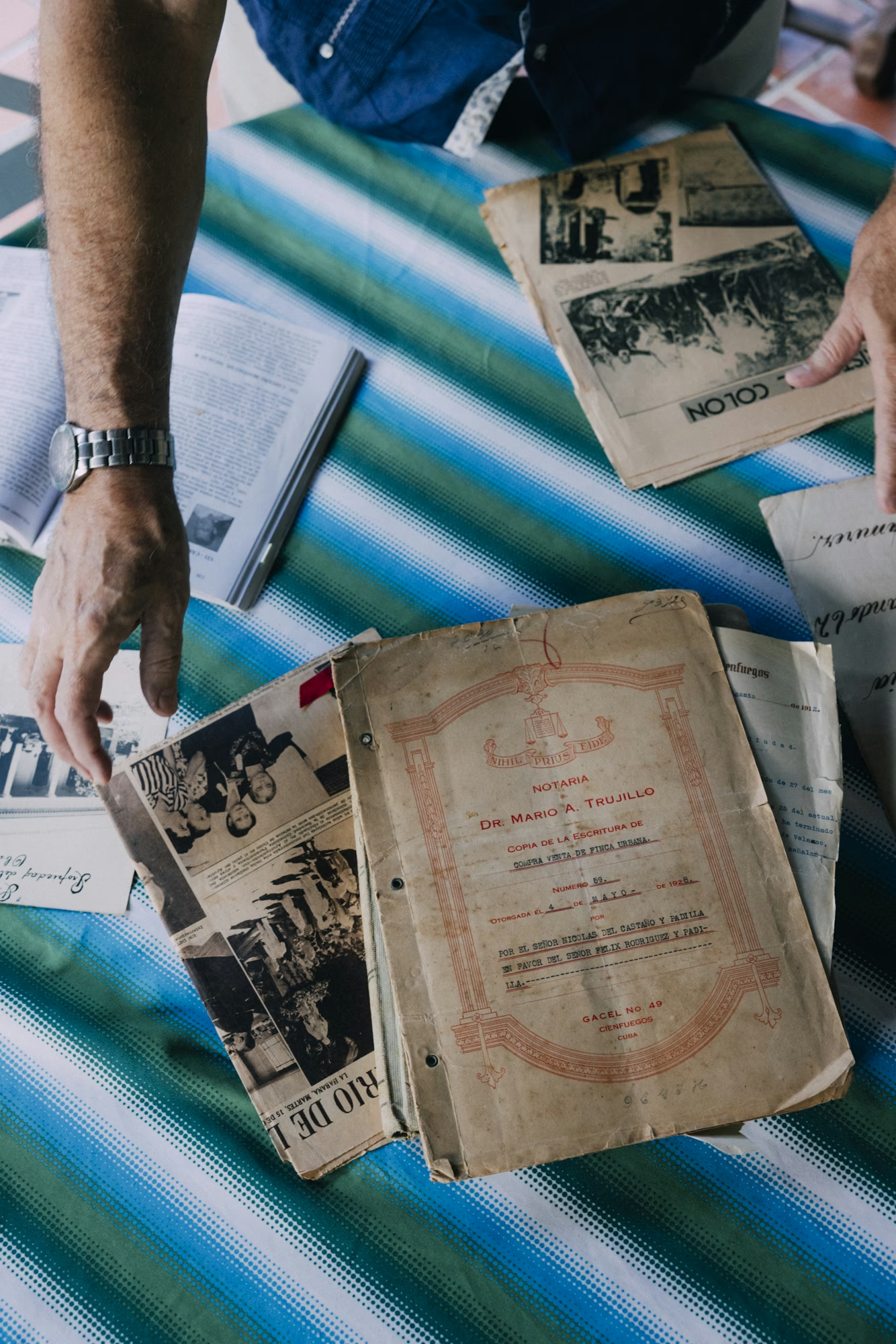
Everyone has their own reasons for wanting to gain Rubio’s ear. Gutiérrez has become one of the leading crusaders for Cuban exiles seeking restitution for their family properties in Cuba. He said his own family had lost 100,000 acres when the Castro regime redistributed and nationalized private property across the island. Gutiérrez is now working with more than 1,000 families in similar circumstances. He wants Rubio’s support in that quest.
Others in Miami have urged the secretary to prioritize the estimated 1,300 political prisoners still jailed in Cuba. Some have ideas about how the economy could be liberalized, or who should run the country, or how to rebuild the electrical grid. They have invited him to conferences and cocktail parties and fundraisers, but he has rarely shown. They’ve been left to decipher Rubio’s public account of what the U.S. has in mind for Cuba.
Immediately after the Maduro raid, Rubio seemed to hint at a looming military operation: “If I lived in Havana, and I was in the government, I’d be concerned—at least a little bit,” he said on January 3 at a Mar-a-Lago news conference. President Trump began talking approvingly about the “Donroe Doctrine” and all of the ways in which his administration would dominate the Western Hemisphere. Rubio, operating as national security adviser as well as secretary of state, seemed perfectly positioned to steer the U.S. away from distant conflicts and back to subduing adversaries in its own backyard.
But then Trump decided to go to war with Iran. As the U.S. again focused on the Middle East—and as the old Venezuelan regime maintained its hold on power, only without Maduro—Rubio seemed to grow more cautious about an intervention in Cuba. At the United Nations General Assembly last week, he struck his most restrained note yet: “Cuba has a golden opportunity to place itself on an irreversible path towards a better future. And we are prepared to be helpful in that regard if they are open to it.”
The group chats and email threads of Miami lit up. Was Rubio preparing the city’s Cubans for another era of disappointment?
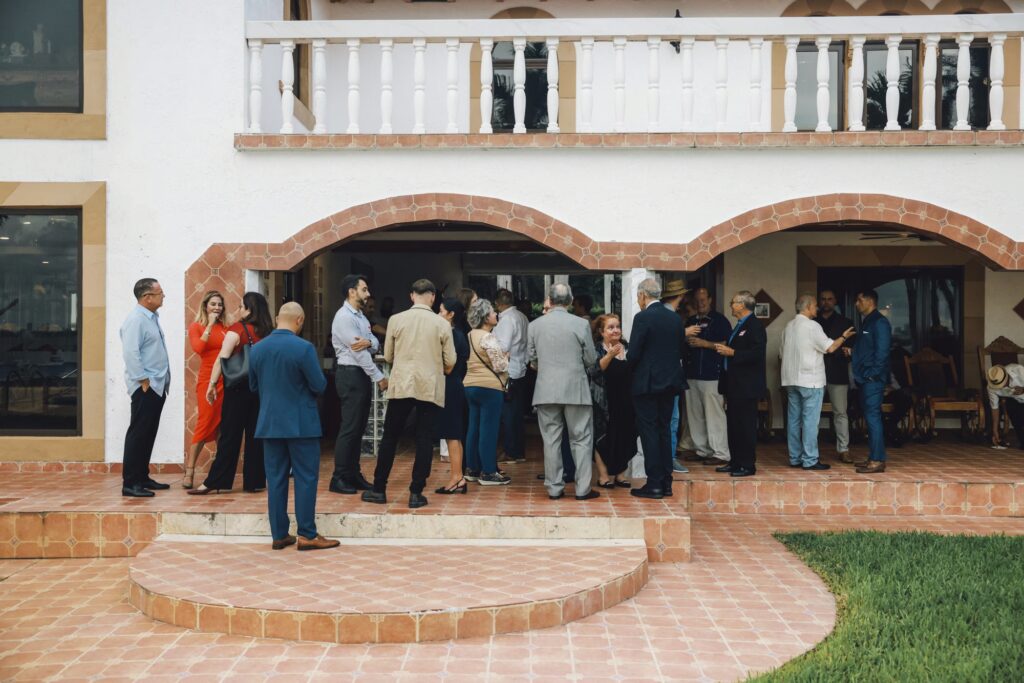
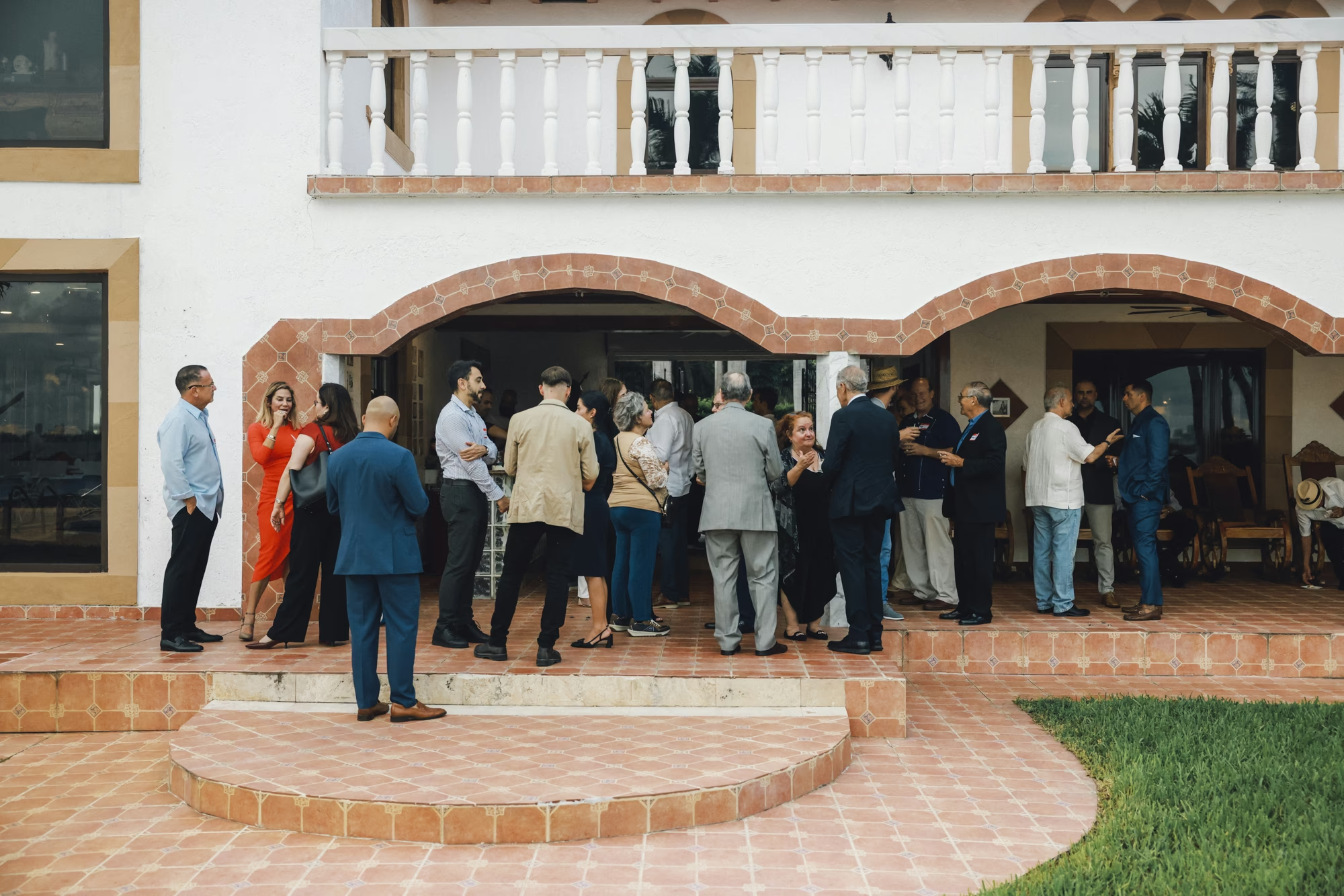
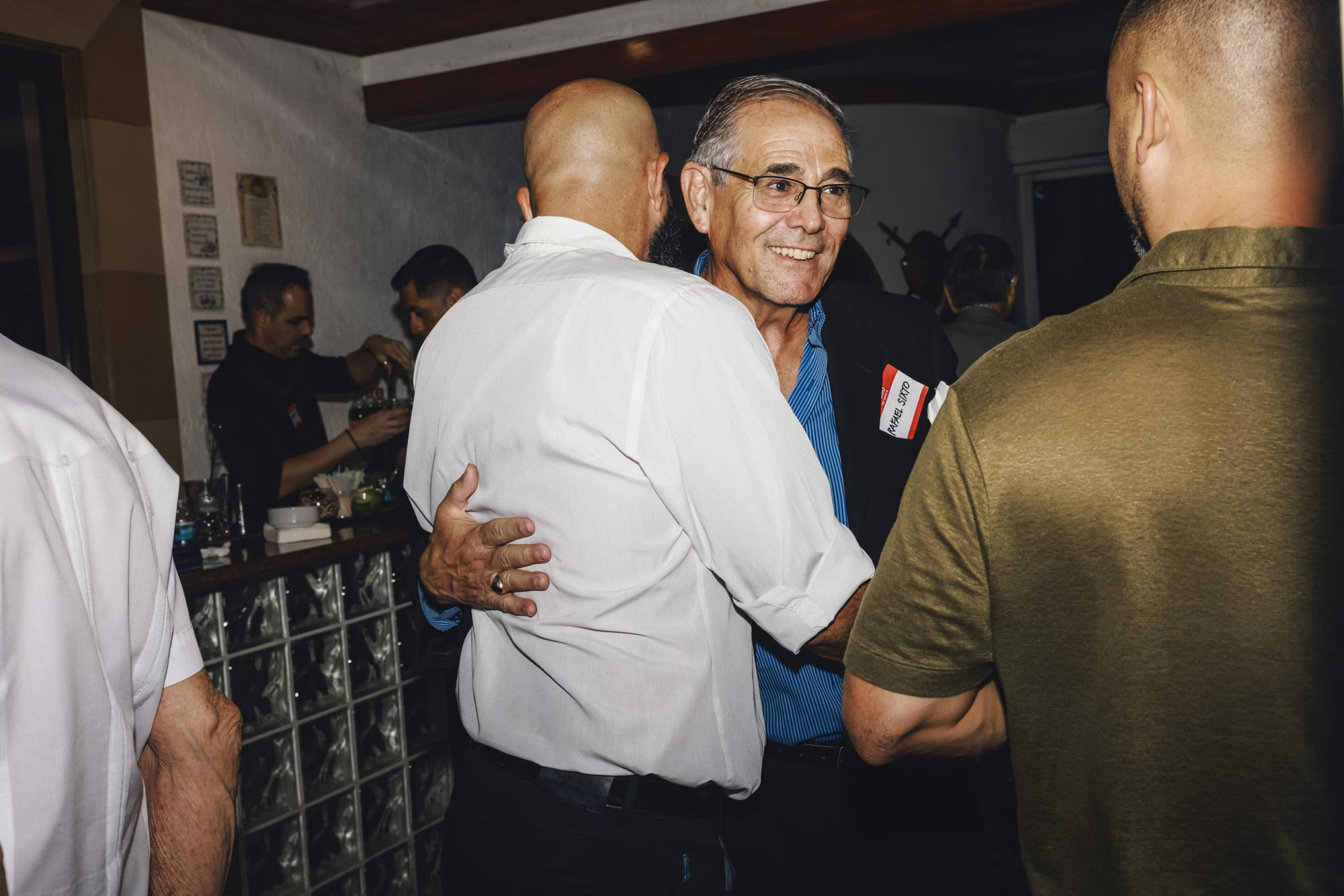
The Sixto brothers, Juan and Rafael, stood on the patio of a Miami mansion. A crowd of Cuban American entrepreneurs was arrayed in front of them. Biscayne Bay glittered behind. Rubio had been invited, but so far, he hadn’t shown up. “This is the opportunity we’ve been waiting for,” Rafael said in a speech to the crowd. “We need detailed solutions. We need a plan of action.”
The brothers and their colleagues had formed the Cuban-American National Chamber of Commerce in the days after the Maduro operation, when it seemed almost certain that regime change was coming for Cuba. They formed 14 committees. They strategized about a future Cuban stock exchange. One of their members flew to Cuba to inspect the country’s oil terminals and report back about future energy investments. It’s possible they were getting a little ahead of themselves.
There are about 1 million Cubans and Cuban Americans in Miami-Dade County, more than a third of its total population. Some arrived just as Castro seized power, in 1959. Others came with the Mariel Boatlift, in 1980, or on small rafts in the mid-1990s. Another wave arrived from 2021 to 2024, as the island’s humanitarian crisis intensified during an economic collapse. Among them were spies dispatched by the Castro regime, as well as anti-Communist militants stockpiling weapons. But mainly, they were an ever-growing mass of exiles praying for the moment when the existing order would unravel in Havana. “Florida is that part of the Cuban stage where declamatory exits are made, and side deals,” Joan Didion wrote in 1987. “Florida is where the chorus waits to comment on the action, and sometimes to join it.”
The exiles have long resisted any attempts by the U.S. government to make nice with the regime. The majority of Miami’s Cuban exiles say they will invest in Cuba only when the Communists are gone. An April Miami Herald poll found that more than half of Cuban and Cuban American respondents in Florida disapproved of the Trump administration’s negotiations with the socialist government. Yet Rubio, it appeared, was supporting talks, seeking an arrangement like the one he had brokered with Delcy Rodríguez in Venezuela, which prioritized economic reforms over a political transition. “South Florida’s Cubans Made Their Wishes Clear and That Must Weigh Heavily on Rubio” was the headline the Herald ran above an editorial about the polling results.
[Read: Cuba’s old economic model is ‘exhausted’]
When the Sixtos’ speeches were over, small groups chatted by the pool. One man came up to Rafael. It was clear that the Trump administration’s momentum on Cuba was slowing, he said. For so many decades, exiles in Miami had prepared for Cuba’s future—building legal frameworks and conducting feasibility studies. Now things appeared to be stalled, again.
“So what are we supposed to do?” he asked Rafael.
“We need a contingency plan!” Rafael said, his own language suggesting diminished expectations. “We need to be ready.”
Rubio’s parents migrated to Miami from Cuba in 1956, before Castro seized power. From the beginning of his political career, he described himself as the son of exiles, even though his family hadn’t been subject to the same political repression as those who left after Castro’s rise. It was a part of the story he told throughout his political ascent—from the first Cuban American speaker of the Florida House of Representatives to the first Cuban American secretary of state.
The group that gathered at the Miami mansion did not want to believe that Rubio, steeped in the politics of el exilio, would accommodate the Castros. Maybe, people told me, he was angling for a secret deal that would lead to the expulsion of the entire regime. Maybe—maybe!—they would tolerate a short political transition, if Rubio promised it would mark the end of communism.
“I don’t trust Trump on Cuba,” one man told me at the party. “But Marco Rubio is our savior.”
By 8 p.m., Rubio still hadn’t shown up. On the printed agenda for the night, there was mention of an unnamed special guest, which excited some of the invitees. Could it be the secretary? Or someone else from the administration who could offer clarity? But when it came time to introduce that cameo, the owner of the mansion, Dr. Jorge Suárez-Menéndez, had disappointing news.
“I’d like to introduce my friend Mary Flynn,” he said. The special guest was the sister of Mike Flynn, Trump’s onetime national security adviser and a leading purveyor of right-wing conspiracy theories. She had little to say about Cuba but shared thoughts about the Democrats and child trafficking. Dinner was served. People gave up on the long-shot possibility that Rubio would appear. Juan Sixto pulled me aside next to the pool. “Rubio supports us,” he told me. “If he was in Miami, he would have been here.”
The consensus was that Rubio was trying his best during an impossible time. Trump had chosen war in Iran over regime change in Cuba, people said. That wasn’t Marco’s fault. (Many people at the party referred to him by his first name, whether they knew him or not.) Two men in their 80s walked by me and Juan as we spoke. Both had been prisoners during the early days of the Castro regime. They had built successful businesses in Miami but still toasted to “next year in Havana” at meetings. “We’re going to move all the money from here to the island,” Juan said. “This is the only group that can do it.”
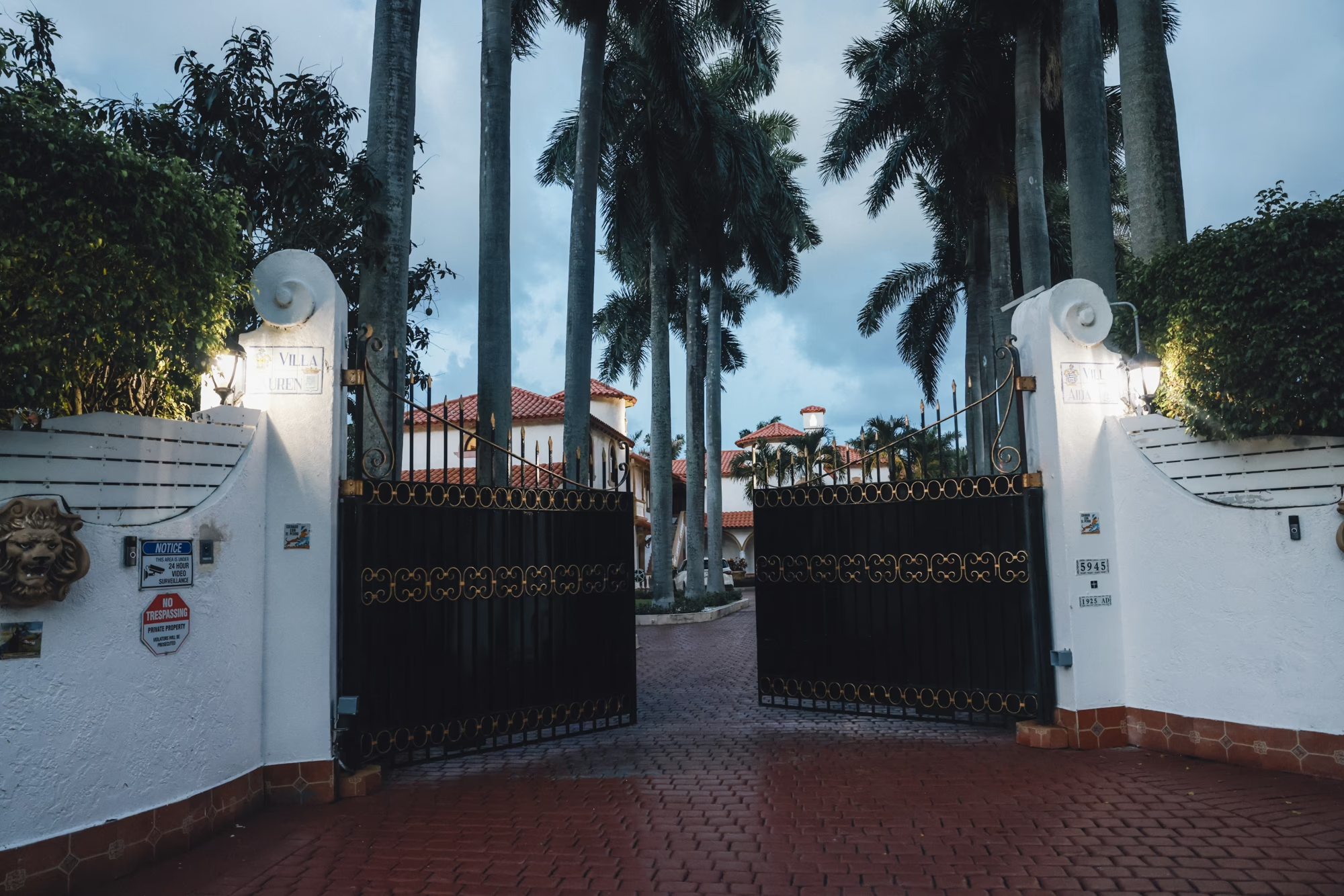
When the cocktail party ended, the guests trickling past the Roman-style fountains in the front yard, I drove west from the mansion toward Hialeah. I passed storefronts that have popped up across the city catering to Cubans looking to send supplies to the island—Envios a Cuba and Todo para Cuba. The best sellers are basic food items and battery packs—signs of how extreme Cuba’s humanitarian crisis has become. The World Food Programme has reported an increase in people going hungry. A 12-by-12-inch box of supplies costs $29 to send from Miami.
The U.S. this year increased sanctions on Cuba and on foreign companies doing business with the regime, an economic vise intended to weaken the government but that Cuban officials say restricts the flow of food and medicine. Roughly 2 million Cubans have left since 2020—about a fifth of the island’s population. Many of them have landed in South Florida, a generation of exiles, most of whom are poor and without permanent legal status. Most still have immediate relatives in Cuba, and they scrape together the money to send boxes of basics to those who could not leave.
[Read: A reverse Ellis Island]
Rubio has spoken publicly about the immense human suffering on the island. “The truth is Cuba has already fallen,” he told Fox News’s Sean Hannity last Monday. But a humanitarian crisis did not mean the regime had collapsed or was on the verge of collapse. Remittances and aid from Miami had helped Cubans eke by, and the regime had eked by too.
With U.S. aircraft carriers and warplanes tied up in the Middle East, there are limited resources available for a Venezuelan-style operation in Havana. Even if the Trump administration wanted to pursue a military option in Cuba, it’s unclear whom its target would be and what a succession plan would look like. On the diplomatic front, too, little seems to be happening. Miami’s exiles have followed the U.S. negotiation with Raúl Castro’s grandson, also named Raúl, with caution. But those talks stalled after the U.S. demanded that the current president, Miguel Díaz-Canel, step down. The result is stasis. Even those in Miami who have spent their days angling to contact Rubio have had to admit: The secretary of state doesn’t seem to have a secret backup plan. “I don’t think that he bears the position of power to make the final decision,” Rosa María Payá, a leading member of the Cuban opposition who says she has discussed Cuba policy with Rubio, told me.
Payá’s father, Oswaldo, had once been considered the most prominent democratic challenger to the Castro regime, before he died in a car crash in Cuba in 2012. An independent investigation later determined that the regime had killed him. Afterward, Rosa María moved to Miami for her own safety, joining the exile community. She observed that those exiles “never really disconnected” from the island. They had waited—and waited—for some combination of U.S. action and domestic conditions to break the regime.
It now appears they have longer to wait. But this is a place that is used to waiting. Along with the disappointment that the Trump administration hasn’t yet acted is a growing sense of inevitability—that the situation in Havana is unsustainable, that regime change is a foregone conclusion. And above all, there’s the belief that Miami’s man in Washington still has a long career ahead of him.
The post Waiting on Marco appeared first on The Atlantic.