Paul B. Spiegel is a professor of practice and director of the Center for Humanitarian Health at Johns Hopkins University.
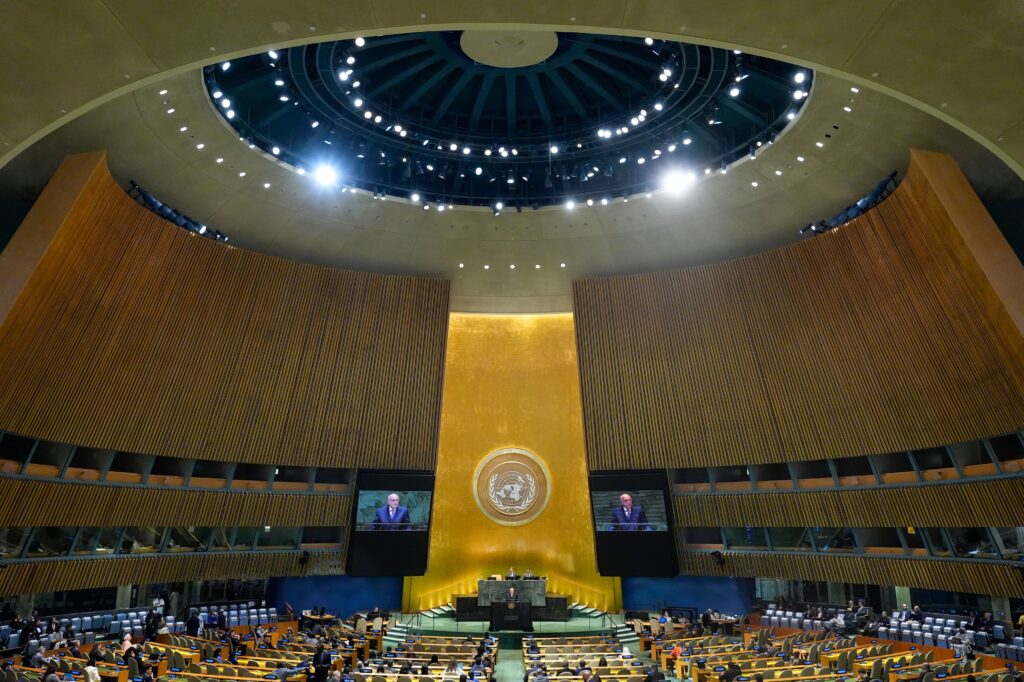
Last month I attended a high-level dinner on the future of humanitarian leadership on the sidelines of the U.N. General Assembly. Around the table were senior U.N. officials, donor governments, heads of international aid agencies and aid leaders from crisis-affected countries. The moderator promised a frank and open discussion.
We did not get one. We got a celebration.
The humanitarian system is in the worst upheaval of its modern history. The American retreat from aid has torn through a sector already overwhelmed by war, hunger and displacement. Programs have closed. Hundreds of thousands of staff have been let go. Agencies no longer ask where help is needed but which desperate people they can still afford to reach. Of the 239 million people the United Nations says need humanitarian aid this year, it aims to reach 135 million and has made only 87 million its immediate priority.
Yet the evening was comfortable, too comfortable. Speakers praised progress, conceded there was still far to go and thanked one another. Most of the national aid leaders lined up to congratulate the U.N.’s humanitarian chief, Tom Fletcher, as the loudest advocates for shifting power to local groups mixed with the institutions they were asking to give it up. It felt less like a reckoning than a reunion.
I have spent more than 30 years in humanitarian health, including with nongovernmental organizations in the field, at the Centers for Disease Control and Prevention and in senior leadership at the U.N. refugee agency. I had déjà vu at that dinner. I used to participate in the same events and in the same self-congratulatory discussions. Now from the periphery, one thing is obvious to me — the international humanitarian system is superb at discussing its own reform and incapable of carrying it out.
That matters because we are confusing collapse with transformation.
Everyone in that room supports “localization,” the decades-old promise to put national and local organizations in charge of their own humanitarian assistance. I recently chaired a commission convened by my humanitarian center at Johns Hopkins University and the Lancet on health, conflict and forced displacement that consulted more than 500 people in 12 conflict-affected countries. Our recently published report put its first recommendation bluntly: invert the power.
Ten years ago, donors and agencies pledged under the landmark Grand Bargain agreement to route one-quarter of humanitarian funding to local and national responders as directly as possible. The system has never come close. Consulting local groups is not localization. Subcontracting them while international agencies keep the money and make the decisions is not localization. Money brings power, influence and prestige, and the money remains with the international community.
Real localization means some international organizations get smaller, others give up functions, and some merge. Frankly, many should not exist in their current form. Everyone knows this. Yet at the dinner only one head of an international NGO said so. The reason is simple: We have asked institutions to lead a transformation that would shrink their own budgets and authority. Most institutions do not volunteer for that.
Only donors can force it. And here the United States has done something paradoxical. Rather than breaking up the old humanitarian hierarchy, Washington has centralized it. Under a deal signed in December 2025, a sharply reduced U.S. humanitarian budget now flows through pooled funds run by the U.N.’s coordination office, called OCHA, anchored by a $2 billion commitment and followed more recently by another $1.8 billion. OCHA, built to coordinate, is now effectively a donor and power broker.
And the money has flowed mostly where it has always flowed — to the U.N. and international NGOs. Analyses have found that the vast majority (96 to 98 percent) of OCHA’s initial allocations went to the usual suspects, with only 2 to 4 percent going directly to local partners. In Chad, one international NGO received $4.5 million in direct pooled-fund grants. Local NGOs received nothing.
Abrupt cuts are not a way to transfer power to local organizations. Instead, they destroy them. Large agencies survive on reserves, political connections and fundraising machines. Small national groups — the very ones the Humanitarian Reset, a strategic plan by OCHA to reform global humanitarian aid, is supposed to empower — simply close. Governments hosting displaced people inherit responsibilities with no funds to meet them.
Here is what donors should do. Stop repeating a 25 percent target the system has missed for a years now, and commit to half: 50 percent of humanitarian funding directly to national and local organizations, and to governments where they are not party to the conflict, by 2030, with progress reported transparently, agency by agency.
If that sounds unrealistic, remember that incremental targets have produced only incremental excuses, and that Fletcher himself has said he wants 70 percent of pooled funds to go to local actors. Donors must hold him to that. Furthermore, every international organization must be required to justify each function it keeps that a national one could perform. And if wealthy countries want a smaller international bureaucracy, invest in the national institutions expected to replace it.
None of this makes humanitarian leaders villains. Quite the contrary. Most are principled people who sincerely want change — starting with the other person. Everyone supports redistributing power as long as someone else gives it up.
The funding crisis is a brutal opportunity. One option is to spread the cuts, protect the institutions and emerge with a smaller copy of the system that already exists. The better one is to move money and authority to the people closest to the crises.
If humanitarian leaders do not choose deliberately, the cuts will choose for them. And the future of humanitarian action will belong to whoever survives them, not to the people it exists to serve.
The post The aid world is great at discussing reform and incapable of doing it appeared first on Washington Post.