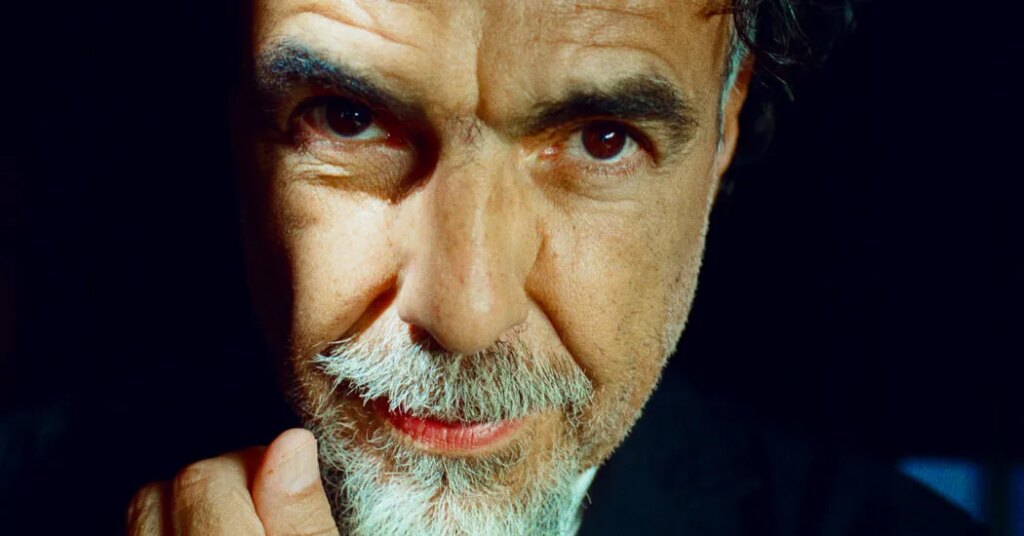
“We have confused, in my point of view, reality with truth,” the filmmaker Alejandro G. Iñárritu said last week, a few days before his new movie, “Digger,” opened.
A roiling satire about climate change, corporate overlords and propaganda that stars Tom Cruise as an unrepentant, larger-than-life oilman, “Digger” does not offer any easy clarity. Conceptually and stylistically, the film is a big swing, especially with a twist that deliberately frames the action somewhere between truth and reality.
The acting is high-pitched. “Everything is just to get attention, to get likes, to be uncomfortable, to be annoying — the culture that we are living in,” Iñárritu said.
Reviews have been largely negative (and the opening box office was dismal), but Iñárritu said he was comfortable with the movie being polarizing. “I prefer that to the lukewarm reception,” he said in a recent video interview.
The Mexican-born writer-director, 63, got the idea for “Digger” after filming his wintry, Oscar-winning drama, “The Revenant,” in 2015, and “Digger” has been gestating since 2017, with four co-writers through various industry and production ups and downs. “Three times the film collapsed; I lost three years of my life,” Iñárritu said.
He kept returning to it, he said, because it reflects something urgent about the world as it is now. “The movie is not perfect,” he volunteered. But “I like taking risks.”
He also spoke, in slightly accented English, about scouting locations in the Arctic, why he chose a meta-narrative to capture the story, and what Cruise — who had Iñárritu read the script out loud to him before he signed on — brought to it.
“I was stunned about the presence that he had,” Iñárritu said of Cruise. He’s “a wordsmith,” evident especially in one long monologue scene. “There were 300 extras, and all of them were completely swallowed by his performance.”
These are edited excerpts from the conversation.
What was the spark for this movie?
At the end of “The Revenant,” we were scrambling with some locations supposed to have [snowy] conditions. We end up in Ushuaia [in Argentina, the world’s southernmost city] in the summer, chasing ice. Because we lost the ice in these locations — that never had happened in the history of the region. So that was the starting point: this idea of the changes that were happening, and that what we are told about it does not necessarily project reality. Even when our bodies are feeling it, the confusion is planted.
So it’s about spin. That’s sort of how totalitarian governments have operated from the beginning of time: Don’t believe your own eyes.
It’s about greed and power and irresponsibility and responsibility and how whoever controlled the narrative [dictated] what reality should be, not what it is.
Originally, this script was called “Blah, Blah, Blah.” The film was conceptually about the most dangerous weapon that we human beings have: this little organ that is called the tongue. Language can be a bridge to reality, but it can [also] be a weapon to destroy it.
We thought that a character embracing that deliberately could be interesting: very human, very absurd, at the same time terrifying — and funny, hopefully.
How did the satire evolve?
The first drafts were very different. I was approaching the disaster scenes in real scenarios, real locations. It was very, very expensive — I went [scouting] to the Arctic two times with scientists.
And the script was not ready. We were stretching our imagination to get the satire and the commentary. But as we were exploring, fiction was basically being chased by reality, and the reality was sometimes even passing it. Because the things that we imagined nine years ago start happening.
At that time, there was no ice shelf being detached. And suddenly it happened. Greenland was not in the conversation; methane was not in the mainstream language of the media. Now, methane is one of the biggest monsters ever. The pandemic arrived. When we were shooting, with the fires in L.A., I almost lose my home. All of us were struggling with several events; it has been so scary. So we were like, wait a minute — there is no more stretching. There was no more room for satire.
So the tone is not a satire. The feeling was almost like writing a documentary about the future.
Did you have nightmares about where this film would lead you?
Yes. [Climate change, and the state of the world], it’s something that is so big and so complex. It’s uncomfortable; it paralyzes us.
For good or bad, my only way to see this was to put that in the center [of the film], and these persons [the characters] question how to approach this. In the theater, we can understand ourselves, make the mirror. That is a tradition in Latin America, from Quixote to [Ernesto] Sabato. It’s Brechtian theater too, to question and provoke questions.
If I succeed or not depends on what people will see or perceive, but that was at least my attempt to open the process. Because we all are in this play together.
Do you worry that people are not going to get it?
I think definitely it’s an uncommon film. It’s a provoking film. That’s the role of a film for me — let’s start the conversation. My personal taste is films that try to tell me something in a different way. There’s people that want more certainty in the storytelling, and that’s OK too. This is not like an ice cream. So, yeah, we expected that, to be honest.
Tom has said he’s been a fan of your work for a long time. How did you first meet?
He was very generous, when I did my first film, “Amores Perros” [2001]. He was screening [it], and people were saying, Tom Cruise is promoting your film. I said, wow. But we never met until 2011. He was super nice — and he knew every cut and angle of every shot of my films, more than me.
In “Birdman,” you played with Michael Keaton’s history as Batman — he’s pursued by a masked, winged figure. In casting Tom in this role, are you thinking about what audiences might bring in their understanding of him?
I need somebody who — you cannot stop watching him. And I think he has that power. He’s the antihero. I call it a lovable catastrophe because even when he does despicable things, it’s hard to stop watching him. It’s an archetype of humanity. He represents that power is something that you get addicted to, and he’s so afraid to lose power that — the profit [motive] will be the problem of all of us. That’s the way I think the world is playing now.
The film brings to mind other dystopian stories like “Brazil” and “Dr. Strangelove.” What were your references?
We were trying to find the tone, which was very difficult. In rehearsal, I show “His Girl Friday,” with Cary Grant talking like crazy. I was fascinated by how he really managed the fast-paced dialogue, which is very musical. So for [the cast] to understand that speed doesn’t mean that you have to lose subtext or the power of the word. But it’s something that you need to practice.
Visually, there’s a [Danish] painter, Vilhelm Hammershoi — all the palettes that he used are so desaturated, just these very few elements of color that really make a dream kind of thing.
This movie has a fairly dark worldview. Does that represent your own outlook? Are you hopeful?
This film is a disaster movie, but the disaster is us. The world is so beautiful and so incredible. There are so many resources, and the balance of the ecosystem is just insanely beautiful. If we can get together in the same room, in the same reality, and understand where we are in the narrative, I think it’s hopeful.
The post He Made the Year’s Most Divisive Movie. That’s the Point. appeared first on New York Times.