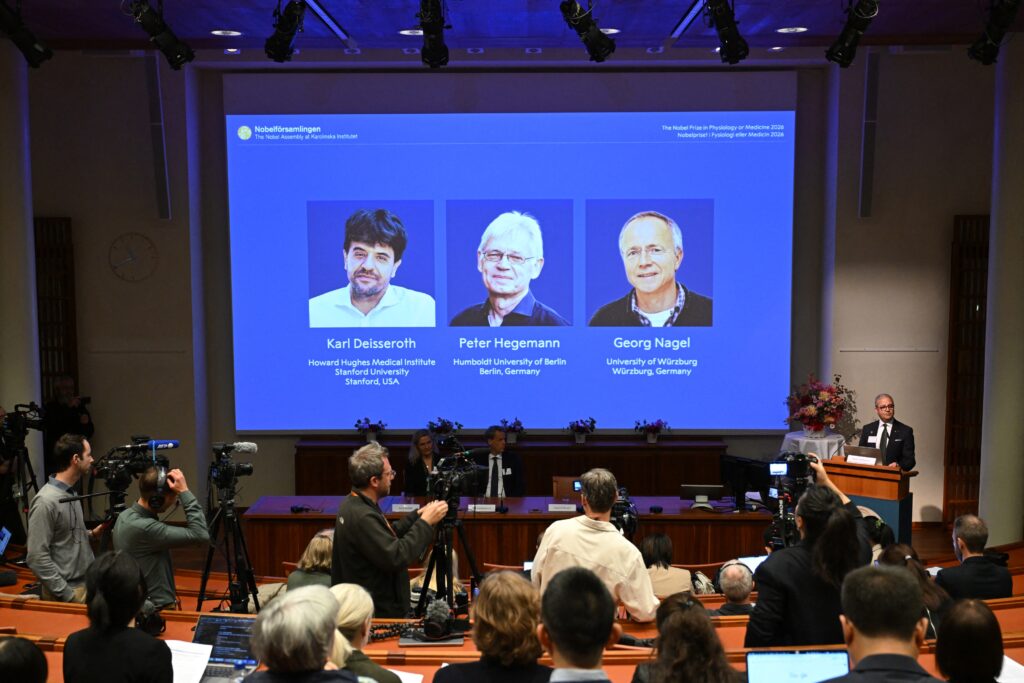
An American neuroscientist and his two German colleagues have been awarded the Nobel Prize in physiology or medicine for their discoveries that have revealed more about how the brain functions.
The laureates are Karl Deisseroth, 54, a professor at Stanford University; Peter Hegemann, 71, from Humboldt University; and Georg Nagel, 73, at the University of Würzburg.
The Nobel Assembly said the scientists were selected for their research into light-gated ion channels to develop optogenetics — a method of controlling nerve signals with light.
The technique has given researchers a greater understanding of disorders such as depression, anxiety, schizophrenia, Alzheimer’s disease and Parkinson’s disease. Researchers are also using the method in efforts to restore sight in people with visual impairment, the assembly said.
Deisseroth said the award was “unexpected” but “an incredible honor.”
In the early 2000s, Hegemann and Nagel discovered a type of protein that, when exposed to light, opens a channel that allows ions to rush in and create an electrical signal. They found that any cell they put the protein into became light sensitive.
Two years later, Deisseroth demonstrated the method in rat nerve cells, and the technique was called optogenetics.
“Optogenetics provides opportunities for mapping the brain in a way that we could once only dream of,” said Per Svenningsson, chair of the Nobel Committee for Physiology or Medicine.
Anna Wedell, of the Nobel Committee for Physiology or Medicine, said their discoveries created a “light sensitive switch” that allows researchers to “map which cells are responsible for which functions, and also which cells communicate with each other.”
Deisseroth, Hegemann and Nagel will receive a prize of roughly $1.2 million, to be shared equally among them.
Last year, the prize was awarded to Mary E. Brunkow, Fred Ramsdell and Shimon Sakaguchi for their work revealing how the immune system prevents itself from attacking and destroying the body’s cells.
The post Nobel for medicine awarded to 3 scientists for work that helps map the brain appeared first on Washington Post.