SHEERNESS, England — In the mouth of the River Thames, just downstream from London, a team of elite marine salvors has been busy trying to stabilize one of the world’s most dangerous shipwrecks.
The SS Richard Montgomery, a U.S. military cargo ship, dragged anchor, broke her back on a sandbar, flooded and sank in late summer 1944, a few months after D-Day, with 1,500 tons of explosives still in the holds.
The Monty, as the locals call her, has been disintegrating, slowly but surely, on the shallow seafloor for the last 82 years.
Though a precise manifest is elusive, there are still thousands of World War II munitions inside the Montgomery’s broken hull, including 2,000-pound blockbusters, fragmentation bombs, white phosphorus smoke ordnance and crates of pressure fuzes.
Old bombs, even underwater, can still detonate under the right conditions and one thing certain about the Monty is that her conditions constantly change in the fast-moving tides and shifting sands of the estuary.
“It’s not just the explosives on the wreck that we’re worried about,” said Nolan Conway, who is leading the salvage operation from a high-tech Dutch barge that sits, ever so gently, alongside the wreck.
“It’s the stuff around the barge that we want to be careful about,” Conway said. “Things could create a sympathetic detonation at the wreck.”
The wreck has stood for all these years as a kind of war memorial, its three masts visible above the waterline, and clearly marked on nautical charts. You can see it from land. Tour operators take day-trippers out to circle it. Local communities remember the sacrifices — the bravery and the terror — of the earlier generations.
The wreck serves as a reminder, too, that the lethal detritus of war often lingers on, whether those ships and bombs are sunk off seaside towns on the English coast or in the Persian Gulf.
The Montgomery is a time capsule and a potential time bomb. And, after much delay, the British government decided that it was time to do something to prevent a catastrophic collapse of the ship’s degrading steel hull.
On a recent afternoon, Conway, the project leader for Resolve Marine, a company based out of Fort Lauderdale, Florida, was aboard a launch vessel that shuttles crew out to the barge.
His team members are masters of disaster. A recent assignment had them dealing with a fire in a torpedo room of a submarine operated by the Indian navy. In 2024, they were hired to disentangle the container ship that struck the Francis Scott Key Bridge in Baltimore Harbor. They routinely deal with groundings, capsizes, cargo losses, spills and fires.
The trip from the dock to the wreck takes just 20 minutes.
A first impression? How crowded the scene. The wreck lies a couple miles from shore and just a few hundred meters from active shipping lanes. Thousands of vessels pass by each year, including bulk freighters, container ships, tugboats, liquefied natural gas carriers and cruise ship bound for London, plus all many of fishing craft and pleasure boat.
The wreck is marked by buoys denoting an off-limits exclusion zone. The masts were the remains of the derrick cranes that once were used to load and unload its lethal cargo.
The British government initiated the $12 million project to remove the three masts after experts concluded the steel structures might collapse onto the decomposing decks below — and that could be very bad.
Asked if the work on the Montgomery was dangerous, Conway explained how carefully they approached their task — the extensive surveys using radar, magnetometers and sonar to form a deep understanding of the wreck and seafloor around it, which is littered with UXO and PXO, terms of art for unexploded ordnance and potential unexploded ordnance.
Over the years, the wreck has collected additional dangers. The seafloor around it is dotted with half-buried objects, possibly defensive mines and antiaircraft ordnance left by the British navy and unexploded offensive mines and bombs dropped by the Germans.
To put it very simply, the salvors really don’t want to bump into anything.
A shock wave could set off an explosion, which could be lethal to a diver, or could spark a larger conflagration.
Though some British government assessments remain classified, experts with the Royal Military College of Science estimated in 1970 that a “top event” — meaning essentially the worst case, in which the whole cargo goes kaboom! — could produce a blast of water and debris 3,000 meters high and set off a five-meter tsunami-style wave that could threaten local towns and industry, including nearby oil and gas facilities.
The British government, in its reports, has calculated the risk of a top event as “remote.”
Remote, however, does not mean unfathomable, let alone completely safe.
In 1967, salvors attempted to stabilize munitions inside the wreck of another American-built ship, the SS Kielce, that was being used by the Polish navy, which had sunk soon after the war near the English port of Folkestone.
Using mines, the salvors somehow ignited the hold, sparking an explosion equaling a 4.5-magnitude earthquake.
“If the Montgomery were typical salvage job, we would simply rig to the mast, cut the mast using traditional techniques and pull it free — simple and done,” Conway said. “But because of the sensitive nature of the wreck, we went with special tools.”
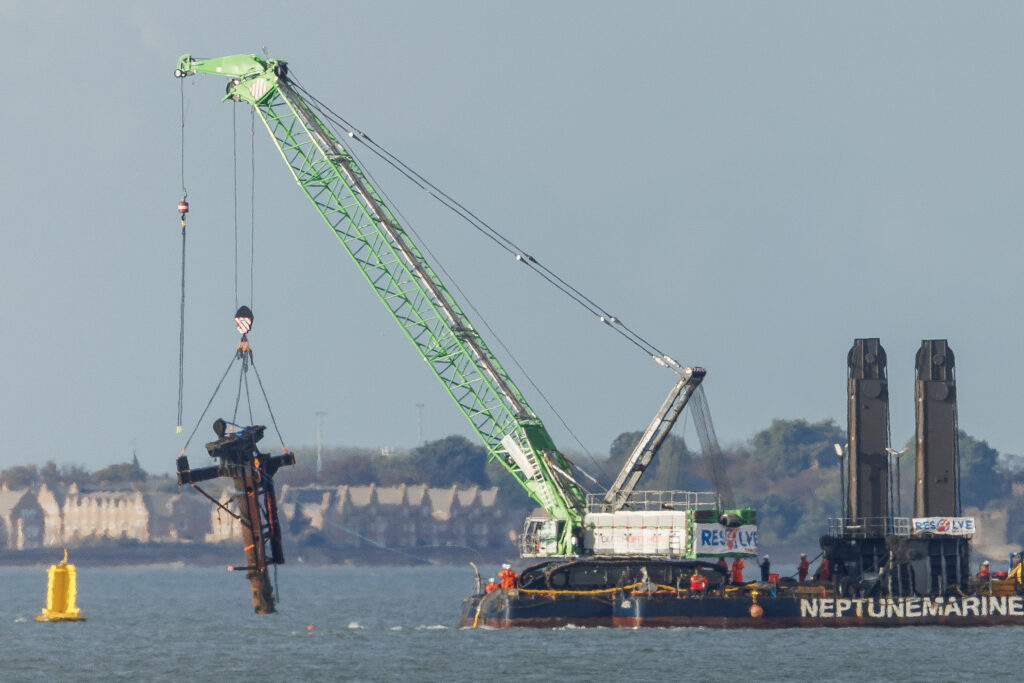
Those special tools include a barge that dropped three legs into the silty sand to position itself in place, just inches above the waterline and inches from the wreck. Divers enter the water one at a time, careful not to step onto the fragile deck below.
“Visibility is measured in inches,” said Jeff Cornish, one of the divers. “We work by feel.”
To cut the mast, the salvors deployed a diamond wire saw, “because it produces lower vibrations, with a lower potential for something to go wrong,” Conway said.
“We don’t do anything that would upset our mothers,” he added, meaning they plan to come home from work.
The Montgomery was a Liberty ship, designed for convoy duty in the North Atlantic. She was built at the U.S. Navy’s direction by the St. John’s River Shipbuilding Company in Jacksonville, Florida, and took on her last load of high explosives at Hog Island, today the site of Philadelphia International Airport.
After surviving the ocean crossing and German U-boats, she was destined for an American air base in newly liberated Cherbourg, France. The Montgomery arrived at what became her grave in late August 1944, two months after the Allied landing on the beaches of Normandy.
People in nearby towns — and those following a live stream online — watched as the masts were removed this week.
The cut masts, covered in rust and sea growth, now lie aboard the salvage barge. They were in surprisingly robust shape. But the structures around them were not. Some of the steel could be knocked apart with a single bang by a hand scrapper. “It’s paper thin,” Conway said.
David Alexander, an emeritus professor of emergency planning at University College London, has studied the wreck and its cargo.
“It is a rare case,” Alexander told The Washington Post. In a research paper he wrote that the Montgomery “exemplified a very visible, alarming risk, but one which cannot be analyzed with any degree of sophistication and accuracy because there are simply not enough reliable, accurate data.”
“It’s impossible to say with any certainty what the explosion risk is,” he said, but that the risk is far from zero.
Alexander worried aloud that the wreck lies close to active shipping, that windsurfers have been recorded in the exclusion zone, that divers likely have sneaked out to the site and in years past, fishermen were photographed on the wreck at low tides.
Locals have reported seeing strange lights on the water above the wreck at night, likely phosphorous munitions that shook loose from their crates and ignited on the surface, he said.
In a debate in the House of Lords, and in the London newspapers, fears also have been raised that terrorists or saboteurs, using drones or simple explosives, could target the wreck.
But removing 1,500 tons of explosives might require emptying out local towns or building seawall defenses just in case. So far, the British government appears satisfied that cutting down the masts — and watching and waiting — are enough.
The masts are now headed to a nearby museum and conservatory at the Historic Dockyard in Chatham, where the structures will be restored and displayed to the public, and the story of the Monty will continue.
“There’s a lot of interest in that ship,” said Paul Barnard, deputy CEO of Chatham Historic Dockyard Trust. “A lot of history, and lore, and speculation, and to be honest, rumor, about what could happen next.”
The post U.S. shipwreck, laden with World War II munitions, is a time bomb near London appeared first on Washington Post.