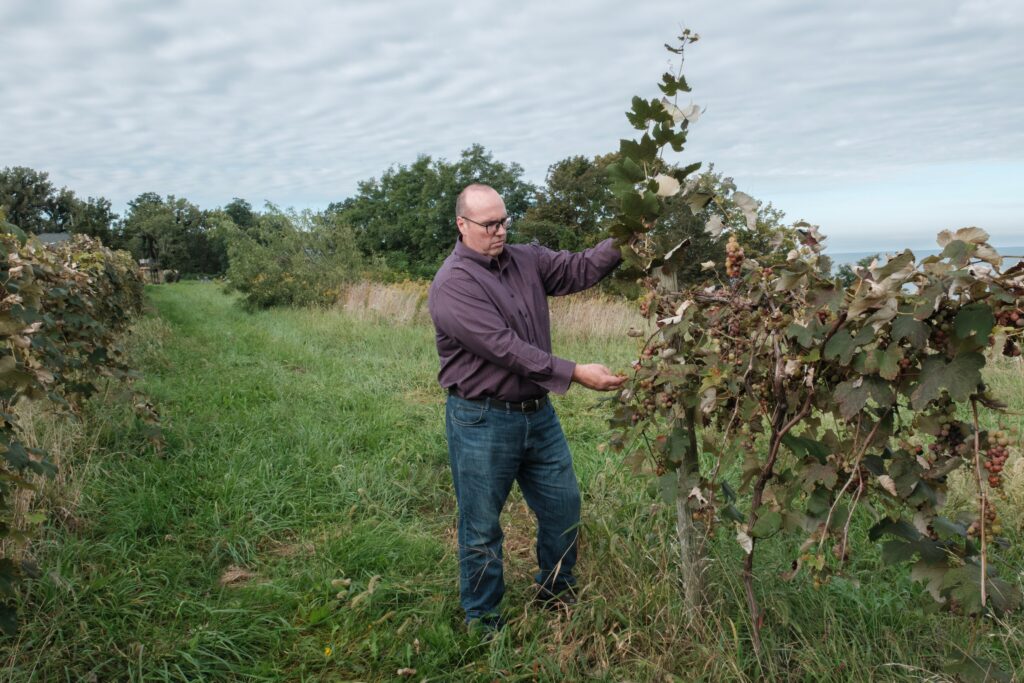
NORTH EAST, Pa. — Mark Terrell knows when it’s time to harvest because the air starts to smell like a freshly opened jar of grape jelly.
That’s usually when Terrell drives his harvesting tractor through his 200-acre vineyard on the shores of Lake Erie, shaking millions of concord grapes from the vines to be processed into juice.
But after a juice company abruptly canceled its contract with Terrell and about 125 other grape farmers in northwest Pennsylvania and western New York, Terrell’s farm vehicles remain parked.
“It’s stressful because I’ve put everything I had into this,” Terrell said as he scanned his 120,000 grapevines. “Now, it’s dying on the vine.”
After months of frantically trying to find a new buyer, Terrell and other farmers in one of the nation’s most abundant fruit-growing regions are preparing to let their grapes fall to the ground. The crisis threatens to reshape local economies in two states as grape farmers come to terms with shifting consumer behavior, including sharp declines in fruit juice and wine consumption.
“If we don’t get demand back up, there is a chance we have to start taking [the vineyards] out,” said Anna-Marie Labowski, a grape farmer and a Pennsylvania Farm Bureau board member. “Some farmers are already putting their land up for sale.”
Terrell has about 1,600 tons of product — at least 200 million individual grapes — that will soon rot. Farmers are scrambling to limit the waste. Some are considering inviting the public to pick their own grapes, though they stress that residents won’t be able to help them eat their way out of this.
“Even if 50 people came here and handpicked grapes, they might get rid of one ton or two tons,” Terrell said. “That is still way short of the scale at which these concord grapes are being produced.”
Grape farmers across the world are experiencing similar problems. Both wine and fruit juice sales have declined by about 25 percent in recent years, a trend driven by healthier habits including consuming less sugar. Some farmers in California are ripping out their vineyards as they search for new crops. Others are selling their land to developers.
The troubles around Lake Erie, the nation’s second-largest grape-growing region behind California, started this spring when Refresco, a Netherlands-based beverage company, canceled its contract with farmers.
Farmers said they were blindsided by the decision after they’d spent tens of thousands of dollars to prune and fertilize their vines over the winter.
“Everything came screeching to a halt,” said Terrell, who was forced to lay off two of his farmhands.
Antonella Sacconi, Refresco’s communications manager, said the cancellations followed “a comprehensive assessment” of “current inventory levels, market demand and long‑term supply needs.”
“We deeply value the relationships we have built with our growers, many of whom we have partnered with for more than two decades, and we recognize the significance of this change for them and their local communities,” Sacconi said. “This decision is the result of sustained grape market challenges and supply imbalances that we do not expect will recover in the foreseeable future.”
The company said concord grape juice sales have declined by 30 percent over the past decade.
Besides being livid with Refresco, grape farmers are divided over who is to blame for their faltering industry.
Several Pennsylvania farmers say the decline in grape juice sales began after first lady Michelle Obama began her campaign to fight childhood obesity, which led some parents and school systems to limit juice products.
But juice, jelly and wine sales subsequently spiked during the pandemic, causing some farmers to expand their vineyards. Juice and wine sales then rapidly started declining as schools reopened and parents returned to work, leading to oversupply.
Near the Canadian border, farmers had hoped some of the surplus could be sold abroad. But that has been complicated by President Donald Trump’s tariff policies, farmers and industry experts said.
“This has been building,” said Russell Redding, Pennsylvania’s agriculture secretary, who added that grape farmers are now being forced to ask what else they can do if demand does not rebound.
There are about 500 grape farms between Erie, Pennsylvania, and Buffalo. The first vineyards in North East, where Terrell lives, were planted by immigrant families around 1850, according to local historians.
Grapes flourish here because Lake Erie’s relatively warm waters help fend off frost in the fall. In spring, the icy lake plays the opposite role by chilling the air so grape buds don’t open too early. The region’s sandy and gravelly soil, left behind after the Ice Age, helps anchor the vines.
North East’s roughly 10,000 residents consider the concord grape to be a major part of their identity. A sign in the municipal building states North East is “a grape place on a great lake” and the high school’s mascot is a grape picker.
“This has always been a place where people have found a way to sell their grapes,” said Tom Allessie, a retired mechanic who at times has worked at vineyards in the area. “We need to do more to sell people on the benefits of grape juice.”
For now, the economic blow of Refresco’s canceled contracts is softened because another major grape buyer, Welch’s, has kept its contract with farmers and maintains a manufacturing plant in town.
But some farmers fear Welch’s could eventually cut back, too, which they said would further stress vineyard owners facing rising diesel, fertilizer and labor costs.
“People are not drinking as much juice … so I don’t think it’s sustainable,” said David Maynard, 83, a second-generation Pennsylvanian grape farmer who sells his crop to Welch’s. “But what else are you going to do with your grapes?”
Pennsylvania and New York officials have tried to protect the industry. In July, Pennsylvania Gov. Josh Shapiro (D) announced the state would spend $500,000 to buy 350 tons of grapes from about a dozen growers, including Terrell. The grapes will be turned into juice concentrate and given to food banks.
Though they appreciate the help, Terrell and other growers said the state plan — which amounts to about 40 tons per grower — is just a tiny percentage of their overall crop.
Meanwhile, Senate Minority Leader Chuck Schumer (D-New York) and members of his state’s delegation announced in August that the U.S. Department of Agriculture had agreed to purchase $20 million in surplus concord grape juice supply.
But buying existing juice doesn’t address the grapes that are about to die on farmers’ vines this fall, said Sam Valone, 67, who produces about 400 tons of grapes annually and lost his contract with Refresco.
Aude Watrelot, an assistant professor of food science and nutrition at Iowa State University, said grape growers realize they need to find other uses for their crop. Researchers are studying whether grapes or grape waste could be used for compost, animal feed or even as an ingredient in meat products, she said.
Redding, the state agriculture secretary, agrees that farmers are going to have “to get creative about where do they put their grapes in terms of flavors and ingredients.”
“You have to find out what parts of that product are as valuable as the fruit itself,” said Redding, comparing it to innovations that took place in the milk industry about 15 years ago.
Terrell said he’s constantly agonizing over how he can salvage his crop.
He grew up around grapes in western New York, where he worked at his cousin’s vineyard.
After leaving graduate school and moving to the Erie region, Terrell bought his farm for about $1 million in 2012 and spent another $500,000 on a 16,000-pound grape harvester and other equipment.
He said he typically turned a profit despite an annual $100,000 mortgage payment and other bills. Two years ago, Terrell noted, Refresco was paying him $430 a ton for grapes.
Terrell said finding an alternative use for his concord grapes poses a challenge because they have a relatively short shelf life. Once picked, he said, they should be processed within eight hours.
He worries that switching to another crop would not be practical. First, he’d have to pay someone to remove the grapevines. There aren’t a lot of crops that thrive in the region’s rocky soil as grapes do.
And selling his land in a region where the population continues to get smaller and older could prove difficult.
Terrell, who has a 2-year-old daughter and 2-week-old son, said he’ll try to cover this year’s mortgage payment with his savings. But another lost harvest could leave his family in financial ruin.
“You are just watching money and a way of life fall to the ground,” he said.
There is still one solution, Terrell said as his redtick coonhound, Rusty, pranced among the vines alongside him.
“This problem would go away if people would just buy a jug of grape juice.”
The post ‘Dying on the vine’: How a farmer ended up with 1,600 tons of unwanted grapes appeared first on Washington Post.