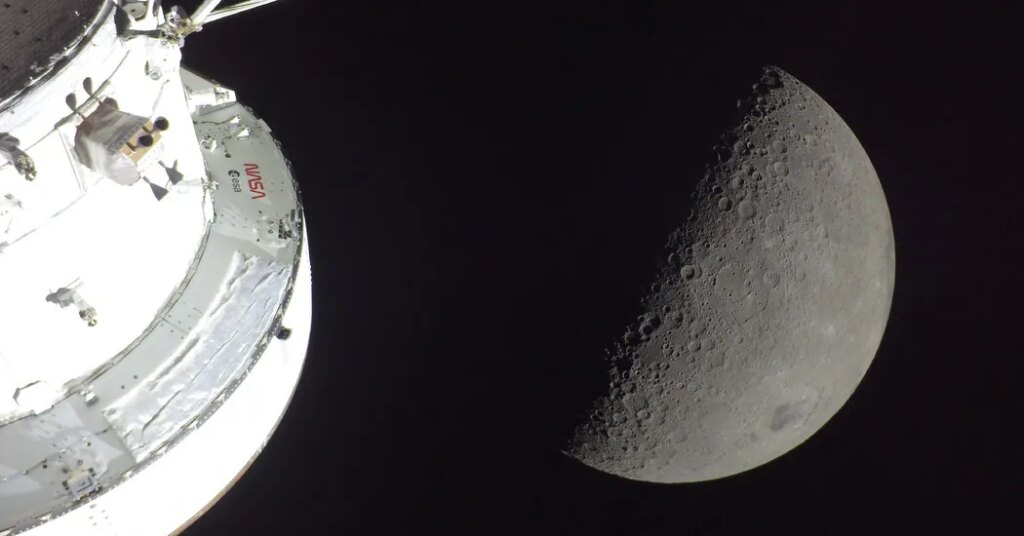
In Robert Heinlein’s 1950 novella “The Man Who Sold the Moon,” a tycoon embarks on a quest to be the first human on the moon, and proceeds to auction off title rights to the lunar surface.
“There is going to be one hell of a fight one of these days over who owns the moon,” he tells his fellow businessmen. “I want the deck stacked so that we win.”
In that era, as the United States and the Soviet Union raced to the moon, the future that Mr. Heinlein envisioned looked like it might come true. To head off this concern, the superpowers made an agreement, the Outer Space Treaty of 1967.
The moon, more than 100 countries agreed, belonged to no one.
These days, the matter appears less settled.
The world’s superpowers are now racing to build nuclear-powered lunar bases, and corporate leaders have their own moon dreams. Elon Musk, a fan of Mr. Heinlein’s work, envisions “trillion-dollar markets” including lunar data centers and a catapult for launching satellites deeper into space. Jeff Bezos wants to move heavy industry to the moon and leave Earth a “garden planet.”
The United States government is eyeing the helium, frozen water and other resources near the moon’s south pole. China has done its own prospecting and, in partnership with Russia, wants to build its base near the very same pole.
This era hinges on the belief that first is best and that whoever sets up on the moon quickest can set the rules. Everyone else will just have to follow.
The Outer Space Treaty declared that countries could not claim outer space “by means of use or occupation.” Space exploration, the treaty said, should benefit all countries. (The treaty was focused on arms control, and it barred nuclear weapons in space.)
But nearly 60 years after the treaty was ratified, some questions still need answers. What jurisdiction can a state claim on a moon base? Can a company profit from the moon’s wealth? Can a nation or a company set up a perimeter and keep others out?
Past attempts to answer some of these questions have largely failed. In the late 1970s, the Moon Treaty declared lunar resources a common heritage of humankind and insisted upon international governance of their exploitation.
Only 17 countries agreed to the treaty. The United States, the Soviet Union and China did not. The biggest powers did not want to share technology or split some future bounty to be found on the moon.
With an uncertain amount of resources on the moon, and no cost-effective way to extract them, the stakes have not been high enough to hammer out a resolution, according to Bleddyn Bowen, a professor of astropolitics at Durham University in England.
“It’s a gray area everybody’s happy with right now,” Dr. Bowen said.
One argument is gaining traction in the world of space law: States can own what they extract even if they can’t own the moon itself.
Some legal scholars draw analogies from the Law of the Sea, which addresses resource extraction in the deep sea, another common heritage of humankind. If nations can mine the deep sea, the argument goes, then they can mine in outer space, said Hussein Badreddine, a lecturer at the University of Sydney who specializes in space law.
Many countries have set their own laws governing state and private activities in space. A United States law from 2015, for example, allows companies to mine in space. The Artemis Accords, a set of nonbinding principles established by the United States and signed by 76 nations, declare that extracting resources from the moon, Mars, comets or asteroids does not violate the Outer Space Treaty.
China and at least 12 other nations have reached a similar agreement for an international lunar research station.
When NASA accelerated its plan to put a nuclear reactor on the moon, it based its decision on fears that if China and Russia were to build a reactor first, they could declare a keep-out zone that would limit where American astronauts and their rovers could go.
Such a perimeter, even for safety purposes, would go against the first article of the Outer Space Treaty, which commands free access to space for all, space lawyers and scholars said. Some diplomats argue that any reading of the treaty that allows first comers to set the rule could create de facto monopolies on the moon.
A United Nations working group is expected to finalize principles addressing some of these questions by next year.
As a practical matter, though, only a few countries have the deep pockets and advanced technology to explore and develop the moon. And there is enough wiggle room in the treaty for one of them to plop down a nuclear reactor or for an enterprising tycoon to start a mining operation.
“If China and America are the two countries doing everything on the moon,” Dr. Bowen said, “they can basically sort out the rules between them.”
The post Who Owns the Moon? appeared first on New York Times.