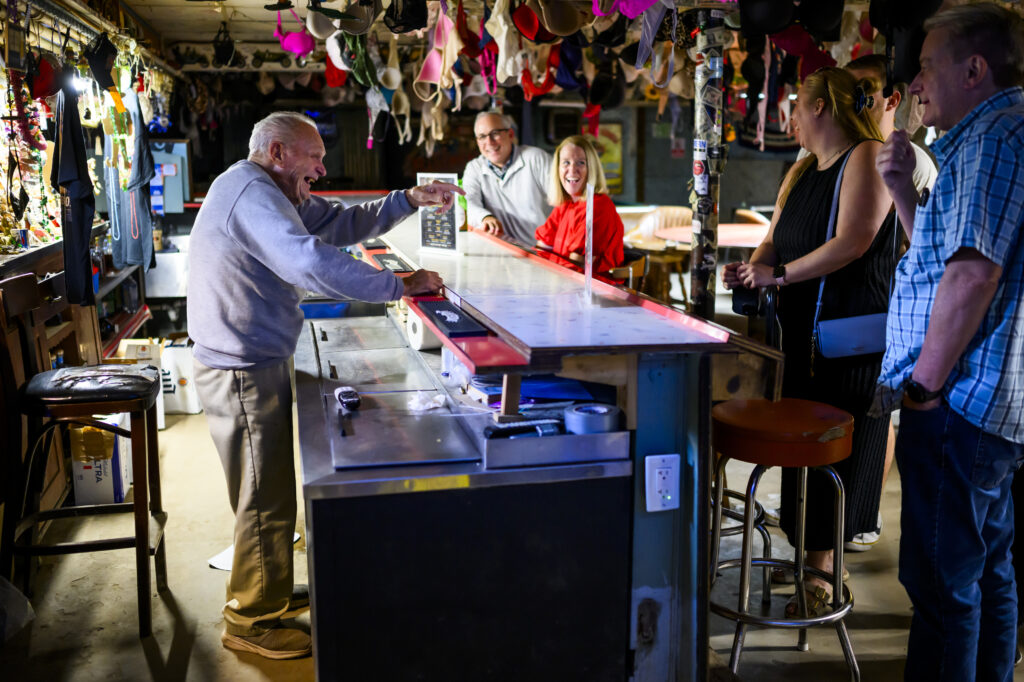
Irvin E. Koch, at 103, has been perfecting his one-liners for decades. He deals them out quickly, with a half smile that reveals the four remaining teeth on his top gums and a flash of mischief in his clear blue eyes.
After 63 years tending bar, he has his setup-pause-punchline down to a science. When a patron on a recent evening asks him whether he is the oldest bartender in the world, he doesn’t miss a beat.
“Don’t ask me,” he says. “I haven’t been around the world yet.”
By many unofficial accounts, Irv (as he is widely known) is indeed the world’s oldest bartender. And since 1963, he has been bartending at Club Sunset Knoll, a dive in a Baltimore suburb that is better known as Irv’s Basement Bar because, well, it’s in Irv’s basement.
The waterfront house that Irv bought when John F. Kennedy was president sits at the end of a gravel driveway in Pasadena, Maryland. It has plastic-wrapped windows and a sliver of red above the gray exterior siding, as if the painter had gone off to fetch a ladder and never came back.
When we, two Post reporters, pull into a small, otherwise empty lot on a September afternoon, Irv’s stepgrandson Jason Cook walks outside and ushers us down a concrete staircase. We step through a nondescript door.
It’s a leap back in time.
Irv’s Basement Bar looks today as it has for decades — a retro redoubt from the rest of the world above. The drinks are cheap, the lights are dim and the jukebox is playing.
Scrawled messages cover every surface at Irv’s, from its cracked bathroom walls to its tiled ceilings to its leathery chairs. (“Raise Hell, Praise Irv” reads one note not far from a haphazardly inked phallus. But mostly, people just write their names.) The bar’s round card tables are scuffed. Underneath one, a stray cheetah-print slipper lies forgotten.
There are nude Polaroid photos hung next to police department patches from across the country. The pool table takes quarters, and the Smith Corona cash register is about as old as Irv himself.
A large banner with his smiling face on it lords above his subterranean kingdom: “Drinking where the sun don’t shine,” it reads.
The bar’s most notable feature, however, is the ever-growing collection of bras — padded, underwire, lace — that hang from the ceiling tiles like a tree canopy. They’re mostly graffitied, too, with the names of the women who left them there. The first of them, decades ago, was named Amy.
“She did it, I didn’t do it,” Irv says. “Most of the girls want to do it. You probably want to do it yourself.”
We politely decline.
Cook, who is sitting nearby, has come to expect these sorts of comments. “He don’t hold back anything,” Cook, 43, says later. “That’s for sure.”
Nothing here is formal, and the bar only operates on Irv time.
“The hours are very simple,” he tells us later. “When the first one gets here, that’s when it opens up.”
He closes whenever patrons leave, or when he gets tired.
The house with the basement bar
Over a few hours at Irv’s, we learn about many of his dislikes: tattoos, bar covers, the church, babies, naps (“wasting your life away”), cities (“too many people”), and credit cards (“the government can trace everything you do”). He hasn’t had a dog since he was a kid and never bought a cellphone.
Irv’s penchant for “telling everybody what he thinks,” Cook says, is one of two qualities that generations of regulars appreciate most about him. The other, according to Cook, is that Irv is a genuinely kind man. When he was a toddler, Cook says, his mother became unable to care for him, and Irv and his wife took him in.
Cook recently moved back to the house (with his wife and four children) to care for Irv.
Born in 1923, Irv grew up poor in a south Baltimore neighborhood, largely during the Great Depression. As a teenager, he joined the Navy and served in the Philippines during World War II. His younger brother Harry followed him into the armed forces. After the war, Irv worked as a builder for Sears and as a plumber with Harry.
Going in to the bar business just sort of happened. The house he now lives in was built in 1912 as a summer home for a prominent Baltimore meatpacking family and later became an inn before Irv bought it in 1963.
“This was up for sale,” Irv says unsentimentally. “We needed a house. So we bought the house, and guess what? The bar came with it.”
Not everyone who discovers their new digs come with a fully functioning tavern would opt to leave their careers for bartending. Irv did.
“Well, I was gifted it, so I took it,” he says. “When I was born and all, everything was pennies, nickels and dimes. Now it’s twenties, fifties, hundreds. So that’s why I opened up the bar. For the money!”
He says this line with a well-rehearsed flourish that shows he has delivered it countless times. Cook doubts its veracity. For one, the cash-only bar makes just enough for Irv to live off. He’s pretty sure Irv doesn’t just do it for the profit.
“He loves the interaction, socializing with people,” Cook says. “He likes the attention, too. It definitely seems to keep him alive.”
‘Once it’s gone, it’s gone’
Around 6 p.m., people begin trickling in, a lone regular here, a group of four police officers there. They order bottles of Coors Light from Irv and flip through the jukebox offerings — Buddy Holly, Dean Martin, Billboard’s Top Country Hits of 1960.
People used to come to Irv’s just for its cold beer and low prices. Many come now to reach back in time to before the digital age. When patrons line up for photos with Irv, their cellphones look out of place.
Kathleen Hooper, 48, is there celebrating her 17th wedding anniversary with her husband, Robert.
“It’s almost like Ripley’s Believe it Or Not meets ‘Coyote Ugly’ meets your neighbor,” she remarks about the space.
She’s lived in the area for years but never before made the trip. “This is a thing that people put on their bucket list,” she says. “We just felt like we had to do it before we didn’t have the chance. … Once it’s gone, it’s gone.”
Hooper was nervous before her visit because of the lack of information available about Irv’s. No website, no phone number, no firm business hours. But the adventure, the not knowing, is the fun of it, she says. She grabs a Sharpie and scrawls on a doorframe “Love! Rob + Katie 4evah,” leaving her small mark on this storied place the same scribbling way thousands of others have before.
Since starting his bar, Irv never worked another job, and never thought about quitting his basement tavern.
And after Irv’s wife and brother died, “he never stopped,” Cook says. “He is very good at taking emotions and feelings and somehow either getting rid of them or just pushing them down and hiding them away.”
Like his bar, Irv is a product of a different era. He doesn’t spend much time thinking about the past, and second-guessing isn’t in his makeup. “If I could go backwards?” He considers the question. “There ain’t too much I would change.”
Once a party ends, Irv is looking to the next one, he says. Right now, he’s excited for his 104th birthday party in August.
“Who knows if this place will exist once he goes,” Cook says. “But everybody should come on down and check us out while they still can. And meet the famous Irv.”
The post Last call? Not for this 103-year-old bartender. appeared first on Washington Post.