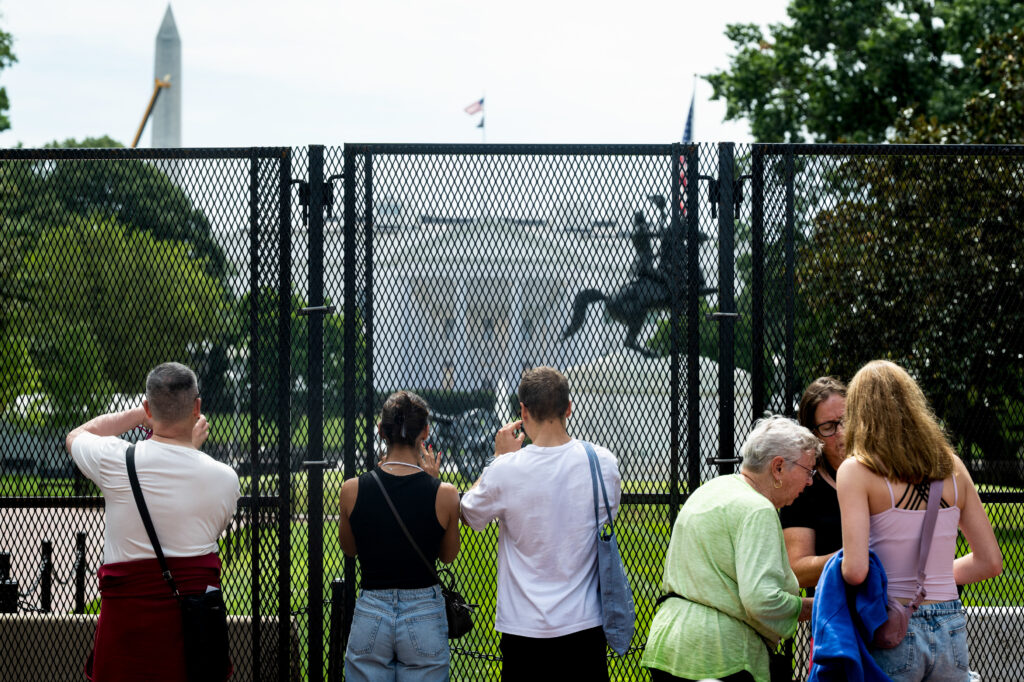
President Donald Trump has imposed sweeping changes to the White House and its campus, many of them controversial.
But on Thursday he won unanimous approval for a project with bipartisan appeal: a new White House visitors screening center, which would end the long-derided process of accessing the mansion’s grounds through temporary trailers and tents.
The National Capital Planning Commission, which reviews federal construction projects, said at a meeting Thursday afternoon that the visitors center could go forward.
Some Trump appointees on the commission tied the project to the president’s broader construction portfolio.
The center is “another incredible part of this White House reimagining we’ve been seeing,” said Paul Ingrassia, a senior General Services Administration official.
Administration officials are already planning to break ground on the center this month, according to two people with knowledge of the project who spoke on the condition of anonymity to discuss forthcoming construction.
The visitors center, which would be located by Sherman Park, on the east side of the White House grounds, has been sought by the Secret Service. Trump has backed the agency’s efforts to fortify the White House grounds in addition to his own changes, such as his planned ballroom.
The Secret Service said in a statement that the proposed visitor center would improve the campus’s security “by integrating the latest in protective technology.”
White House spokesman Davis Ingle said in a statement that “President Trump is committed to giving all visitors to the White House the best experience possible.”
Administration officials did not respond to questions about the planned cost of the project.
The new screening center would include design elements — such as Corinthian columns — deliberately chosen to pair with Trump’s ballroom. It also has a timeline consistent with that project: Officials want to complete the visitors center by July 2028, in hopes that it will support the stream of guests expected for events at the ballroom, which Trump hopes to complete by late 2028.
Unlike the ballroom, which was rushed through federal reviews, the screening center has undergone extensive changes in response to more than six months of feedback. Gone is a plan for visitors to enter the screening center under Sherman Park. Instead, visitors would enter an aboveground pavilion, be screened underground and exit from a second building near the ballroom.
The center’s planned size, shape and other design features have also been repeatedly adjusted in response to feedback from members of the National Capital Planning Commission and the Commission of Fine Arts, which also reviews federal construction projects.
“Can this building please be made shorter in length? And shorter in height?” James McCrery II, who was Trump’s first ballroom architect and who sits on the Commission of Fine Arts, said at a hearing in March. “It’s such a prominent thing. And its prominence, then, obligates it to be beautiful.”
The Commission of Fine Arts gave preliminary approval to the project in July, and the commission’s staff gave final approval on Sept. 24.
The project could undergo further changes. Washington’s historic preservation office, which the administration has consulted as part of a required process to address and mitigate potential harms of construction, had raised concerns about the planned exit pavilion. Under an agreement, the administration committed to continuing a design review of the building, with a deadline of Nov. 19.
Evan Cash, a staff member on the D.C. Council who sits on the National Capital Planning Commission, has criticized other Trump projects like the ballroom and a new permanent fence for Lafayette Square, saying that they were rushed. But he has praised the approach to the visitors center.
“It’s a great example of the regular order of things coming through here and how the project becomes better, actually probably cheaper and a little bit more effective in how it’s going to work,” Cash said at a commission meeting last month.
Cash and other officials said Thursday that they hoped the new visitors center would reduce the frequent lines of White House guests that stretch onto nearby sidewalks.
Mark Paoletta, a White House official who leads the commission, has also said the project is needed.
The center will be a “beautiful” way to welcome visitors to the White House campus, Paoletta said Thursday.
The post Trump wins approval for new White House visitor screening center appeared first on Washington Post.