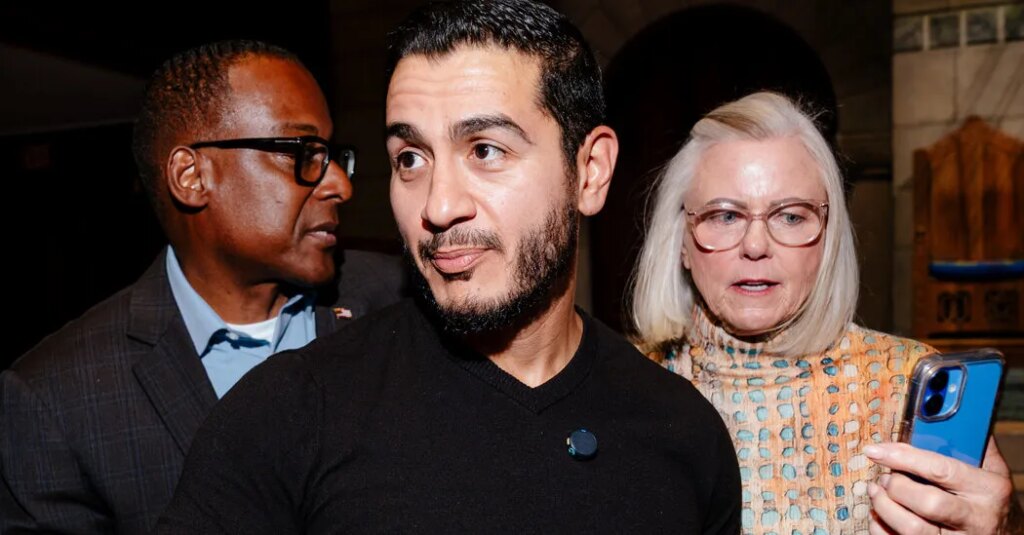
Dr. Abdul El-Sayed, the Democratic candidate for U.S. Senate in Michigan, recently found himself in an all-too-familiar predicament: Attempting to appeal to one section of the state’s divided Democratic base while avoiding alienating another.
This time, he was courting Black voters, who have shown skepticism for far-left candidates this year — as Dr. El-Sayed himself experienced in the Michigan Democratic primary. Before appearing with former Vice President Kamala Harris at an event last week, he grew testy when a reporter asked him at a news conference if the boost might backfire with Arab American voters, many of whom did not vote for Ms. Harris in 2024 because they objected to the Biden administration’s stance on the war in Gaza. Days later, at an N.A.A.C.P. dinner in Detroit, he told a roomful of Black voters that answering questions from reporters about his foreign policy views felt like a “non-consensual colonoscopy.”
The tension highlighted the difficult task Dr. El-Sayed, a former public health official, faces as he tries to become the first Muslim-American to serve in the Senate — and hold a crucial Democratic seat that will help determine control of the chamber.
Dr. El-Sayed narrowly won a bruising primary over the summer against Representative Haley Stevens, a moderate Democrat. But along the way, he alienated Jewish voters with his criticism of Israel. He lost older Black voters to Ms. Stevens. And he drove off independents with his left-wing policy views.
Now, he is working to mend fences and convince the party’s wary establishment that he is capable of winning a general election. It’s something of an about-face for a candidate whose earlier political identity — he ran for governor in 2018 as a left-wing agitator, and was a vocal surrogate for Senator Bernie Sanders in the 2020 presidential election — was combative outsider.
After primary victories, candidates in battleground races often downplay their more partisan ties, scrub their websites of unhelpful endorsements and distance themselves from policy ideas that appeal to their zealous party bases but could alienate swing voters.
Dr. El-Sayed has insisted he is not doing any of that. He said he had not softened his tone or altered his message, instead arguing that his populist rhetoric and focus on the economy were resonating across demographics.
“The nice thing about my message is it is speaking to the needs of all people in this country,” he said in an interview. “My message hasn’t changed.”
Some Michiganders have sensed otherwise. One example: While Dr. El-Sayed has declined to condemn Hasan Piker, the provocative progressive influencer who campaigned with Dr. El-Sayed during the primary, he has distanced himself somewhat from him.
And while he has not changed his stance on Israel, he is doing more to listen to Jewish voters.
Decky Alexander, the chair of the Michigan Jewish Democratic Caucus, who is supporting Dr. El-Sayed after voting for Ms. Haley in the primary, said it seemed like he had spent less time lately targeting the American Israel Public Affairs Committee — a pro-Israel super PAC — after hearing complaints from Jewish voters about his frequent references to the group.
“If somebody is listening and adjusts that,” Ms. Alexander said, “to me, that’s hope.”
Dr. El-Sayed also told the progressive Working Families Party that he would skip the group’s chapter launch in Detroit next weekend to campaign in northern Michigan, a more rural region with conservative white voters whom Democrats believe can be swayed, according to Branden Snyder, the group’s state director.
The candidate has highlighted his overtures to the Jewish community, which have picked up since the primary and include closed-door meetings with state leaders, including Senator Elissa Slotkin, and participating in celebrations of Jewish holidays like Rosh Hashana.
“Dr. Martin Luther King said: ‘If your coalition is not uncomfortable, it’s not big enough,’” Dr. El-Sayed said in the interview. “We feel really strong about the fact that we are consolidating in the community.”
There are some signs he may be right. Dr. El-Sayed recently earned the backing of Dana Nessel, the Michigan attorney general, who is Jewish and had been deeply skeptical of his candidacy during primary season. A recent New York Times poll of the race found Dr. El-Sayed with a five-point edge over his Republican opponent, Mike Rogers, and with sizable support — 76 percent — from Black voters, which he said was a sign of progress. (The poll result was within the margin of error.)
Perhaps the candidate’s biggest challenge is dispelling unflattering and in some cases bigoted stereotypes blasted out by his opponents. During the primary, AIPAC spent millions of dollars directed not just at Jewish votes but also at Black voters. Now, Republicans are seizing on those same lines of attack.
Just after Dr. El-Sayed’s primary victory, President Trump posted an image of himself and his wife Melania next to an image of the Democrat, who was born to Egyptian parents, and his wife, who was wearing a hijab.
“Two VERY DIFFERENT America’s,” Mr. Trump wrote on Truth Social, in a remark widely condemned as Islamophobic and racist. He used Dr. El-Sayed’s full name, Abdulrahman Mohamed El-Sayed.
Aware of those attacks, Dr. El-Sayed has taken pains to present his campaign as an “all-American” effort. At the N.A.A.C.P. event, he joked that his name was “tailor-made for U.S. politics,” comparing the challenge to former President Barack Obama, the son of a Kenyan father, whose opponents tried to portray him as un-American by reminding voters that his middle name was Hussein.
Osama Siblani, the publisher of The Arab American News in Dearborn, Mich, and the president of an Arab American super PAC, said Republicans were also trying to capitalize on what he described as long-simmering tensions between Arab Americans and Black people.
“If there’s a flat tire in the African American community, the Arab community ought to be blamed,” and vice versa, was the message the right was trying to send, Mr. Siblani said.
“They’re using it to drive wedges between communities,” he added. “And fortunately, they are failing.”
Ahead of the N.A.A.C.P. event, Dr. El-Sayed said he had a longstanding relationship with Black voters dating back to his time as county health director. But he also acknowledged that there was “scar tissue” with that group.
Dr. El-Sayed offered several explanations for why Black voters had reservations. His ambitious progressive goals, he suggested, might feel unattainable for people he described as having learned that when plans go awry, the worst consequences often fall on them.
“Folks are sometimes like, ‘Look, it’s already so tough — they’re taking away our Medicaid and you want Medicare for All?’ I say, ‘Yes, I do want Medicare for All. That doesn’t mean we can’t make Medicaid whole on the way,’” he said. “If we’re just preventing the worst things from happening, we’re always just playing defense.”
He said he has also had to correct what he called a misconception among Black voters that he opposed Ms. Harris’s presidential campaign in 2024, because he endorsed the “Uncommitted” movement’s protest against former President Joseph R. Biden Jr. over the war in Gaza. Dr. El-Sayed endorsed Ms. Harris when she replaced Mr. Biden on the presidential ticket.
Addressing the N.A.A.C.P. event, Dr. El-Sayed tied his opposition to U.S. military aid for Israel to his support for underprivileged groups in Michigan, particularly the Black community. “Every dollar that we ship abroad to kill somebody else’s kid is a dollar we are not spending to save our own,” he said.
The Rev. Wendell Anthony, the president of Detroit’s branch of the N.A.A.C.P., said he appreciated Dr. El-Sayed’s outreach, even if it failed to win over everyone.
“Jesus couldn’t bring everybody together. Allah couldn’t bring everybody together. And Abdul ain’t either one of them,” he said. “So the question resides in the effort. He appears to be attempting to bring everybody together. He’ll be successful with some, and some he will not be successful with.”
Mr. Rogers, a former congressman, also tried to sway the N.A.A.C.P. crowd by portraying Dr. El-Sayed as so unacceptable that they should take the rare step of voting for a Republican.
“We receive new outreach every single day from Democrats who don’t believe Abdul El-Sayed represents their beliefs,” Mr. Rogers’s campaign said in a statement. “We hear on the trail that he spreads hate and doesn’t see the best of Michigan.”
Many of Michigan’s Jewish Democrats remain on the fence or are outright opposed to Dr. El-Sayed, with more than a dozen of them on Tuesday joining the “Nonnegotiable” movement, an effort to push him to condemn threats to Jews in the U.S. and commit to “Jewish sovereignty” in Israel.
One of the new “Nonnegotiable” members was Mark Bernstein, a Jewish Democrat who serves on the University of Michigan’s board of regents. Mr. Bernstein said he was a lifelong Democrat who was nonetheless considering voting for Mr. Rogers. He said Dr. El-Sayed’s position on Israel had not evolved to his liking.
“Right now I think Jews face a grim choice in Michigan,” Mr. Bernstein said. “We either compromise our commitment to democracy, or we compromise our commitment to Zionism.”
The post Long After Divisive Primary, El-Sayed Is Still Working to Unite Michigan Democrats appeared first on New York Times.