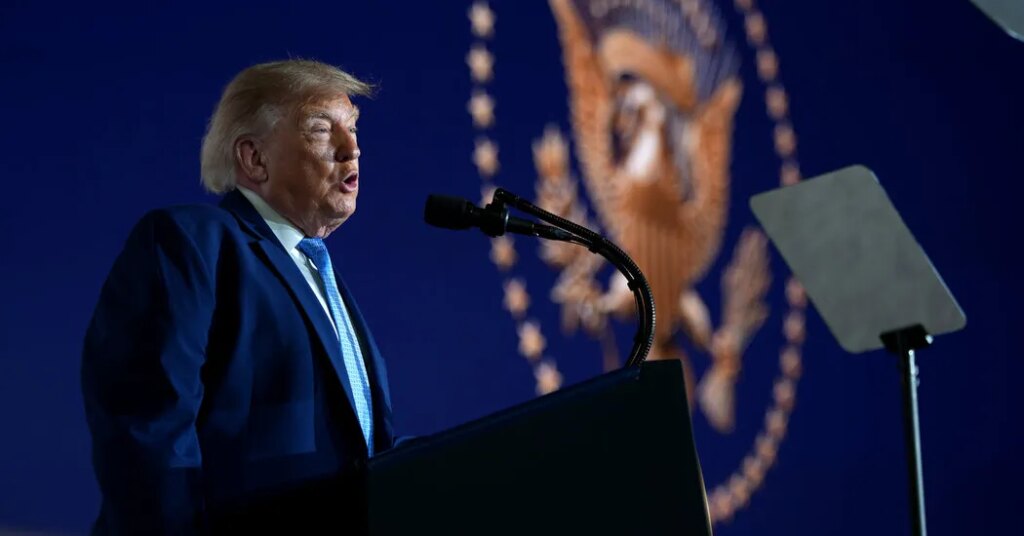
Just hours after the Supreme Court struck down President Trump’s original roster of punishing global tariffs, he defiantly proclaimed that he would stop at nothing to somehow bring them back.
Seven months later, the work to revive those duties is well underway. But their return is about to land the administration back in the federal courthouse in New York where its legal troubles first began.
The latest phase of Mr. Trump’s ever-evolving trade war rests in the familiar hands of a panel of federal judges, who on Wednesday will hear the third major case in less than two years challenging the president’s ability to tax imports from around the world. Each of the fights has centered on different legal justifications, but the root cause is the same: Mr. Trump’s reliance on decades-old laws to issue duties that opponents see as a harmful overreach.
This time, the cases concern the use of Section 301 of the Trade Act of 1974, which allows the administration to investigate unfair trade practices and impose tariffs if it finds that American businesses were harmed. In July, the government relied on the statute to impose tariffs on 86 countries at once, claiming that they had failed to stamp out “forced labor” and had put U.S. firms that better protect workers at a competitive disadvantage.
The expansive nature of the tariffs prompted state officials and small businesses to file a series of lawsuits, arguing that the Trump administration failed to marshal the evidence required to issue the duties. Instead, they framed the process as one motivated by politics and pretense, citing past statements from Mr. Trump and his deputies promising to resurrect a set of policies that had been declared illegal.
The administration has vigorously contested the claims, setting the stage for another complicated hearing in front of the Court of International Trade in downtown Manhattan. Judges on that specialized circuit have twice ruled against Mr. Trump in major tariff cases. Another defeat could again force the administration to surrender any money it has collected, though the administration appears to be hoping that the third time is the charm.
“Changing the statute, when you lose on a previous statute, doesn’t change the law,” said Sara Albrecht, the chairman of the Liberty Justice Center, a legal group representing two of the suing small businesses. The center helped to lead successful challenges against the president’s past tariffs.
“As long as they continue to file and abuse the statutes on the books, we’re going to continue to challenge them,” Ms. Albrecht said.
The White House did not respond to a request for comment.
The legal onslaught has hardly impeded Mr. Trump’s trade brinkmanship. Despite two years of economic shocks and uncertainty, the president still sees sky-high tariffs as the most potent tools for courting U.S. investment, protecting domestic industries, extracting new revenue and pressuring allies and adversaries into making concessions.
At every turn, however, Mr. Trump has faced stiff opposition and defeat.
Originally, Mr. Trump tried to impose steep, country-by-country tariffs using the International Emergency Economic Powers Act, or IEEPA. But the trade court last year found those duties to be unconstitutional, a decision upheld by the Supreme Court in February. That decision required the Trump administration to refund more than $160 billion in illegally collected tariffs while forcing the president to return to the drawing board.
Mr. Trump then tried to impose a temporary 10 percent tariff on nearly all goods arriving in the United States. That, too, faced lawsuits — and similarly was struck down by judges on the Court of International Trade. The tariffs eventually expired, but the case itself remains on appeal.
For its third try, the Trump administration turned to Section 301, the provision of law targeting unfair trade practices. In contrast to Mr. Trump’s previous efforts, there is “no doubt that Section 301 gives the president power to impose tariffs due to foreign practices that are unreasonable or burden or restrict U.S. commerce,” said Timothy C. Brightbill, a top trade lawyer at the law firm Wiley Rein.
In fact, presidents of both parties successfully invoked Section 301 in the past to target trade practices by individual countries, including China. But the expansive way in which Mr. Trump applied the law this summer triggered swift lawsuits from groups of small businesses and state officials, many of which had been involved in those past fights against the president’s earlier duties.
In their newest filings, each of the opponents proffered a similar set of arguments. While condemning forced labor, the lawsuits claimed that the administration had failed to conduct rigorous investigations and had not amassed sufficient evidence about the abuses in question in each country and the harms caused to American industry.
Under Mr. Trump’s approach, the 86 targeted countries faced tariffs ranging from 10 to 12.5 percent. But there was little differentiation in the rates that applied across a wide range of U.S. trading partners that have vastly different laws and human rights records. In the eyes of state officials, led by the attorney general of Oregon, there was “no rational fit” between Mr. Trump’s concerns and the “blanket global tariffs” he ultimately imposed.
The disconnect led many of Mr. Trump’s opponents to conclude that the tariffs were not supported by the facts — but, instead, served only to recreate the rates struck down by the Supreme Court. As evidence, they pointed to a series of past statements from top administration officials. One example included Treasury Secretary Scott Bessent, who previously proclaimed on CNBC that the “the tariff rates are going to go back to exactly where they were.”
Lawyers for the Justice Department vigorously disputed each of those characterizations as they sought to convince the court that its tariffs are legal. The arguments underscored the extent to which the administration hoped to use Section 301 as its primary trade tool, with work underway to issue a second battery of tariffs targeting dozens of additional countries for engaging in “excess capacity” and flooding markets with cheap goods in the coming weeks.
In a filing submitted in early September, the government framed its tariffs as a “moral and economic imperative.” The administration also defended its investigative process and argued the court had no right to review its determinations about forced labor, while dismissing the notion that past comments from public officials suggested anything untoward.
“Even if they could be considered, the cited statements would merely reflect that the Trump administration believes that tariffs are an effective tool for protecting American businesses against unfair trade practices,” the Justice Department wrote in one of its filings. “This is no revelation.”
The post Trump’s New Tariffs Face a Familiar Court Challenge appeared first on New York Times.