A controversial new coal export facility in California backed by President Trump may be far dirtier than locals have been led to believe, new documents show.
Widespread opposition has prevented any new coal export facility on the West Coast until now.
If built, more than 13 million tons of coal will be shipped each year from interior states to the West Gateway terminal in Oakland and stored in enormous open-air piles before being sent overseas, according to a recent report prepared for potential investors. That’s despite previous promises by project developers to build a modern, fully enclosed facility that will limit dangerous dust exposure to the surrounding community.
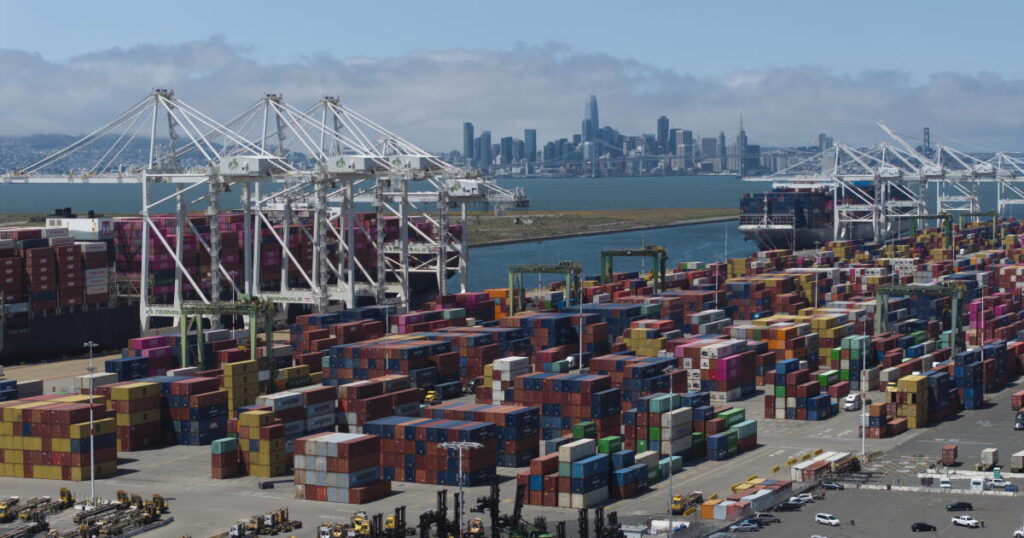
The site is the Oakland Bulk and Oversized Terminal, a decommissioned Army base near the Port of Oakland run by developer Phil Tagami, who has been trying for years to turn it into a marine shipping terminal. Tagami did not respond to multiple requests for comment.
It would be the largest coal export site on the U.S. West Coast, transporting coal to Japan, South Korea, Taiwan, Vietnam and Malaysia, according to the Trump administration. The president announced a $75-million investment in the project in June, about a third of its estimated cost, although some figures are much higher.
California spent decades moving away from coal, and no longer burns it or buys any electricity generated by it. Opponents say the new terminal would undermine years of progress cleaning up the air in the neighboring area, which has long experienced disproportionate pollution due to its proximity to the port and other industry.
Their concerns may have been warranted, according to revelations from the report, which was compiled by consulting groups Norda Stelo and Wood Mackenzie in July and released publicly this month. It was commissioned by the Rural Utah Infrastructure Coalition, a group composed of of eight Utah counties considering investing about $43 million into the terminal to receive Utah coal.
Its findings were based on a site visit to Oakland, engineering documentation and discussions with Savage Cos., a Utah-based transport and logistics company selected to operate the facility, the report says. Savage Cos. also did not respond to a request for comment.
Perhaps the most surprising disclosure from the report is that the coal would be stored in “two open-air bunkers” with approximately 150,000 tons of coal per stockpile.
That’s despite years of assurances from project representatives and supporters that it would be a covered terminal — including in court documents tied to years-long litigation involving environmental groups, city officials and the developers.
The finding was a “shocker,” said Ted Franklin, an organizer with the grassroots group No Coal in Oakland.
“This is a windy area, and the wind blows into the city from that area,” Franklin said. “And the West Gateway is not a remote site. It’s near a densely populated neighborhood with schoolyards and playgrounds and a minor league baseball stadium.”
Research has shown that coal terminal operations can threaten air quality and public health. A 2023 UC Davis study funded by the California Air Resources Board found serious increases in air pollution associated with operations at the Levin-Richmond Terminal, a smaller California facility that has since agreed to stop all exports of coal and petroleum coke by the end of this year.
The transport, storage and handling of coal at the terminal all increased community exposure to PM 2.5, or fine particulate matter, the study found. PM 2.5 can cause cardiovascular issues, respiratory disease, adverse birth outcomes, cognitive and developmental impairments and premature death.
The ports of Los Angeles and Long Beach transitioned away from open-air coal and petroleum coke storage three decades ago.
The report also reveals that the site would see a maximum annual throughput of 12 million metric tons, or 13.2 million tons, of coal each year — three times more than the terminal’s approved environmental impact report from 2002 and its 2012 addendum. Neither mentions coal specifically, but rather bulk commodities.
Coal use has broadly fallen in the U.S. since the early 2000s, although it saw a bump in 2025 amid growing electricity demand and changing policies from President Trump. But the use of coal globally reached a record 8.8 billion tons in 2024, with much of the growth in Asia, according to the International Energy Agency.
“We have plenty of coal in the ground and we just need a reason to take it out,” said Keith Heaton, director of the Rural Utah Infrastructure Coalition, during a meeting this month with the Utah Community Impact Board. “And the Asian markets are interested in continuing to burn thermal coal for the next at least 20 to 50 years.”
The U.S. Department of Energy’s stated initial target for the Oakland terminal is 9 million to 10 million tons of coal per year.
The coal arriving in Oakland may also be dirtier than realized, according to the Norda Stelo report. Project officials previously stated the terminal would handle only high-grade western bituminous coal from Utah, yet the report says it will also handle Powder River Basin coal from Wyoming and Montana, which is known to be much dustier.
The report also makes no mention of plans to cover the rail cars to prevent pollution. Project officials previously said they would only accept coal transported in covered rail cars.
Another operator that has long been linked to the project, Insight Terminal Solutions, could not be reached for comment.
Opponents are furious about the findings.
“It appears the developers want to build something much bigger and more polluting than anything they previously revealed, either in court or to the West Oakland community,” said Colin O’Brien, deputy managing attorney at the nonprofit Earthjustice. “Any plan to put coal in our communities must be fully vetted and subject to robust requirements to address toxic coal dust.”
In a letter, he urged officials at the Bay Area Air Quality Management District to mandate modern design and pollution control technologies, as the developers “promised the public.”
The project is far from a done deal. Trump invoked the Defense Production Act in his decision to fund the terminal, along with about $625 million for a dozen other U.S. coal projects. The act grants the president emergency authority over domestic industries deemed crucial to national security.
“By investing in both coal generation and critical export infrastructure, including the West Gateway Terminal Project, the Energy Department is strengthening U.S. energy security, reinforcing strategic supply chains, and advancing American energy dominance,” Energy Secretary Chris Wright said at the time.
The project also aligns with Trump’s January 2025 executive order declaring a national energy emergency, which is aimed at boosting domestic fossil fuel production, the Energy Department said.
Local groups said they intend to fight the project in court, including by challenging whether coal export infrastructure qualifies as vital to national defense under the Defense Production Act.
Franklin, of No Coal in Oakland, also questioned whether investors will buy in. Although the Energy Department estimates the terminal will cost about $231 million, the Norda Stelo report puts the number between $430 million and $625 million.
It also says it will take 53 months to get the terminal up and running, pushing it way past Trump’s promise of exports beginning in 2028. And by 2031, the market for seaborne coal could be deteriorating. The IEA says global coal use is plateauing, with its share of power generation expected to decline slowly in the years ahead as renewables scale up.
The facility may also run into stumbling blocks at the state level. Last month, California lawmakers passed a bill that would require a new environmental impact report before a public agency may approve a large-volume bulk coal facility.
The legislation, Assembly Bill 40 from Assemblymember Mia Bonta (D-Alameda), was largely a response to concerns about increased coal pollution from the Oakland terminal. It is now on Gov. Gavin Newsom’s desk for his signature.
The post Trump-backed Oakland coal terminal would be far bigger and dirtier than promised, report says appeared first on Los Angeles Times.