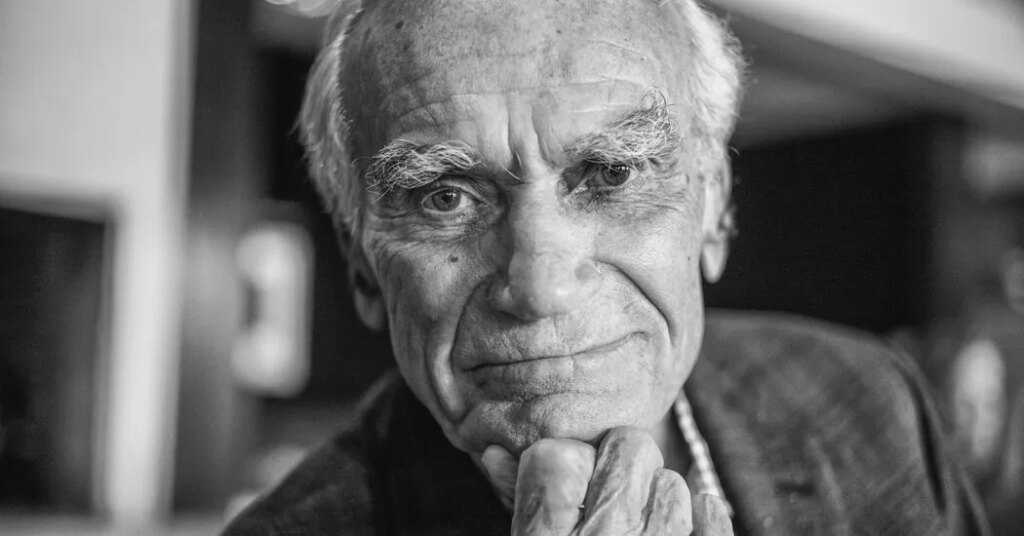
Bill Draper, who started his pioneering career as a Silicon Valley investor by steering a rented Pontiac through the orchard-dotted Santa Clara Valley of Northern California in the early 1960s, drumming up business in an era when few entrepreneurs had even heard the term “venture capital,” died on Sept. 8 at his home in Atherton, Calif. He was 98.
His death was confirmed by his daughter Polly Draper.
The “man who saw Silicon Valley before it existed,” as the magazine BW Businessworld recently called him, Mr. Draper began his career more than a decade before Silicon Valley acquired its name in the early 1970s, at a time when computer coding was still done using punched paper cards.
As a founder or managing director of a string of trailblazing venture capital companies, including Sutter Hill Ventures and Draper Richards, he helped start an industry worth hundreds of billions of dollars, alongside titans like Arthur Rock, Eugene Kleiner, Thomas J. Perkins and Don Valentine.
Known for his glass-half-full mentality, he was called Dr. Yes by his colleagues at Draper Richards because “he loved to say, ‘We’re in!’ to a deal at an initial meeting before we could do the due diligence,” Robin Richards Donohoe, the company’s co-founder, said in an interview.
His long list of wins over the decades included placing early bets on the video game maker Activision, as well as Skype, OpenTable, the printer company Qume and Corbin-Farnsworth, a pioneering maker of defibrillators, pacemakers and heart monitors.
Armed with a Harvard M.B.A., Mr. Draper arrived in California in 1959 to join Draper, Gaither and Anderson, which was co-founded by his father, William H. Draper Jr., a prominent New York investment banker, and was called the first venture capital firm west of the Mississippi River.
“It was the only game in town,” the younger Mr. Draper recalled in a 2011 oral history with the Computer History Museum in Mountain View, Calif.
The tech industry was still in its infancy, and so was its business infrastructure. In those days, the investment community “didn’t know a semiconductor from a piece of Swiss cheese,” said Jay Last, a celebrated founder of Fairchild Semiconductor who helped develop the chips that propelled the computer revolution.
In 1962, Mr. Draper partnered with his friend Franklin Pitcher Johnson Jr., known as Pitch, to start their own firm, Draper & Johnson Investment Company. At the time, the sun-dappled Santa Clara Valley, south of San Francisco, was one of the largest fruit-growing regions in the world, nicknamed the Valley of Heart’s Delight.
“It was a lot of fruit orchards in Sunnyvale, in Santa Clara and so on, and we’d go look for doors to knock on that looked like they had to do with some kind of technology or electronics,” Mr. Draper recalled in the oral history.
“We’d ask for the president,” he said, “and he’d come out, typically about our age, and he’d ask, ‘Well, what do you guys do?’ And we’d say, ‘Venture capital.’ And he’d say, ‘What?’ And then we’d explain what it was. And then he’d say, ‘Well, come on in and hear about my company.’”
Mr. Draper continued, “We became the go-to guys in the Valley,” adding, “We were the kind of people that friends of friends of friends would call to ask about these various deals.”
Around 1965, he and Mr. Johnson went their separate ways. Mr. Draper joined Sutter Hill, a real estate company that, under his direction and that of Paul Wythes, another industry trailblazer, branched off into venture capital.
During those early days, the business culture in Silicon Valley was often breezily informal. One of Sutter Hill’s successful investments in disk-drive companies, Quantum Corporation, began when four engineers dropped in.
“They didn’t come in with a business plan and a PowerPoint demonstration or anything,” Mr. Draper said in 2011. “They came in to just say: ‘Hey, we’re thinking of starting a company. We need some money, maybe a couple million dollars to get it going.’”
William Henry Draper III was born on Jan. 1, 1928, in White Plains, N.Y., the youngest of three children of Katherine (Baum) Draper and the elder Mr. Draper, an executive at Dillon, Read & Co., a premier New York investment banking house. A major general during World War II, his father also served as an under secretary of the Army and helped coordinate the Marshall Plan.
After graduating in 1946 from Scarsdale High School, where he was the student body president, Bill enrolled at Yale. “I thought Harvard was a little too intellectual for me, and Princeton was a little too social,” he said. “Yale sounded right in the middle.”
He became a member of the elite Skull and Bones society and studied economics, history and political science, earning his bachelor’s degree in 1950. During the Korean War, he served on the front lines as a second lieutenant.
He went on to attend Harvard Business School, where he studied under the influential professor Georges Doriot, who advised him — as Mr. Draper recalled in a 2010 Harvard oral history — to “get out of Boston” after graduating and “get into something that’s got some muscle.”
Mr. Draper heeded the advice and took a management training position at the Chicago-based Inland Steel Company, where he met Mr. Johnson, a Palo Alto native who eventually persuaded him to move to California.
During the 1980s, Mr. Draper realized that his “learning curve was flattened out” in venture capital and detoured into public service, serving as president and chairman of the Export-Import Bank of the United States, where he oversaw efforts to stoke exports, in part by providing financing and loans to foreign buyers of American goods.
Five years later, he took over the United Nations Development Program, overseeing about 8,000 aid workers around the world, fighting poverty, funding environmental and health programs and promoting democracy.
During his seven years there, the agency’s programs grew in value to $1.5 billion, from $890 million. By the end, he said, “I’d been to 101 developing countries and raised money from the rich countries to give to poor countries.”
“I felt like Robin Hood,” he continued.
His experience abroad inspired him to return to venture capital, but with an international focus. In the mid-1990s, he joined Ms. Richards Donohoe in founding Draper International, one of the first American venture capital funds to focus on companies in India.
A related domestic fund, Draper Richards, has invested in companies like Skype, OpenTable, Selectica and Athenahealth.
Mr. Draper later decided to apply his business experience to the nonprofit world — “venture philanthropy,” as he called it — and helped establish what became the Draper Richards Kaplan Foundation, which has funded more than 280 nonprofit and for-profit social enterprises serving some 700 million people around the world.
Over the decades, the industry that he helped create evolved almost beyond recognition as it lurched toward the era of trillion-dollar I.P.O.s.
At Sutter Hill, “we had a lot of doubles and triples, and not many strikeouts,” Mr. Draper said in the Harvard interview. “That has changed because the size of the typical venture firm is so great now that they want to move the needle” — which changed the risk-reward ratio.
Firms came to believe, he said, that “if this company’s worth $7 billion, we don’t need to make too many other good decisions.”
Mr. Draper’s wife of more than 60 years, Phyllis (Culbertson) Draper, died in 2018. In addition to their daughter Polly, he is survived by another daughter, Rebecca Draper; a son, Timothy; eight grandchildren; and 13 great-grandchildren.
Venture capitalists are basically fishermen, Mr. Draper said, dropping in countless lines and never knowing when they might reel in a whopper.
For him, there was one very big fish that got away. At Sutter Hill in the 1970s, he sent a younger colleague to check out yet another tech start-up.
Upon his return, the colleague told him, “Well, you know, they kept me waiting for a half an hour, and the people were pretty arrogant, and after all it’s an $18 million valuation.”
Mr. Draper recalled his reply: “‘OK,’ I said, ‘If you don’t like it, let’s turn it down.’”
“That company,” he added, “was Apple Computer.”
The post He Was a Tech Investor Before There Was a Silicon Valley appeared first on New York Times.