To the Yellowstone visitor who lost their Invisalign retainer, please report to the national park’s geology team. They found your orthodontic gear.
Several times a week, the Yellowstone Volcano Observatory’s geology staff swap out their seismometers and strainmeters for fishing rods, strainers, slotted spoons and grabber poles as long as a Winnebago that sleeps six. Equipped with trash-collecting tools, they fan out among the hydrothermal attractions, picking up litter thrown or dropped dangerously close to — or in — the park’s famous hot springs, geysers, mudpots and fumaroles. The interpretive rangers also remove refuse, but without thermal-area training, they must stay on the boardwalks and trails.
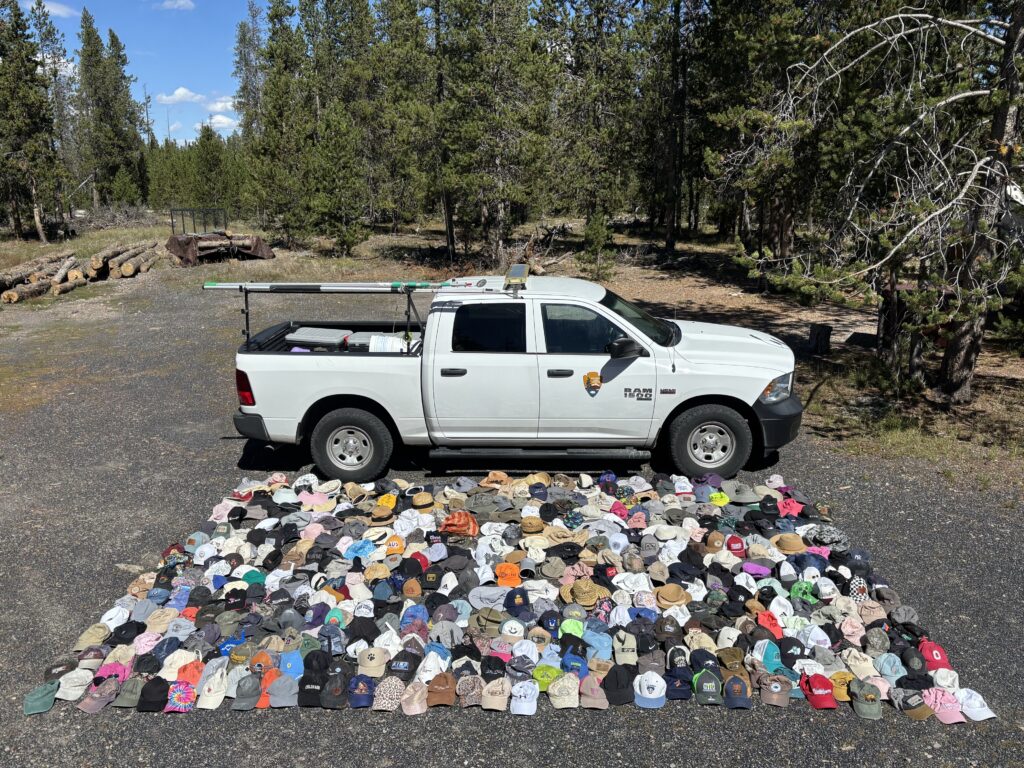
This year’s bounty set a record in rubbish. From January to September of this year, the cleaning crew has removed 20,100 pieces of trash (plastic bottles, tissues, candy wrappers and the like), 5,600 rocks and sticks, and more than 280 hats. By comparison, during the same nine-month period last year, they retrieved more than 13,000 pieces of trash and 300 hats, plus 4,000 rocks and sticks.
“The more we can do to prevent these sorts of accidents then the less work the geology team will have to do in this regard,” said Michael Poland, scientist-in-charge at Yellowstone Volcano Observatory. “And the more time they can spend studying these hydrothermal features, better understanding how they work and making sure they are well cared for for future generations.”
Objects commonly carried by day park visitors made up a bulk of the collection. There were all styles of sunglasses and hair accessories, camera lens caps, baby pacifiers, jewelry (including a bead bracelet that spelled out “Illinois”), hotel key cards, single AirPods and more than $18 in U.S. and foreign currencies including pesos, yen, euros and Canadian coins.
The geology team also amassed items that are puzzling without context: 42 pencils (an SAT prep field trip?), 15 fake nails (did the heat melt the nail glue?), one Uno card (hopefully not the Wild Draw Four) and six Invisalign retainers.
“I like to think that somebody’s jaw hit the floor when they saw one of these amazing features,” Poland said, and resulted in the retainer flying right out of their mouth.
In the children’s toy department, the haul contained mini racecars, bouncy balls, a rainbow fidget spinner, rubber ducks, a vintage McDonald’s toy (from 2010) and a Guardians of the Galaxy-esque team of figurines featuring a stormtrooper, twin Jesuses, Pokémon characters and the disembodied head of Sonny Angel Strawberry. The staff also extracted a lump of glittery pink slime resembling Barbie’s pet slug from pieces of geyserite sinter. A half-dozen Junior Rangers exited Yellowstone as civilians, after losing their badges.
Under “staff favorites,” the winners included a Lilliputian copy of “The Vampire Diaries” and instant photos of the hydrothermal features that claimed the snapshots like sacrifices at an altar. Last year’s highlights were a Birkenstock sandal and a pizza box with leftover slices.
Poland said most of the trash was accidental, not intentional. “Hats and sunglasses get blown off, a baby drops a pacifier and it lands off the boardwalk and you can’t reach out and get it,” he said. “But the coins, the sticks and the rocks are probably tossed in.”
Poland said people may assume the items are harmless and will dissolve in the natural elements. However, a critical mass of foreign objects can permanently change a feature’s appearance. Before and after photos of Morning Glory Pool are proof.
More than a half-century ago, the Upper Geyser Basin hot spring was a dreamy shade of blue. However, visitors treated it like Rome’s Trevi Fountain, plunking in coins. The metal pieces, combined with other detritus, clogged the vents, causing the temperature to drop, bacteria to bloom and the vibrant color to fade. The park tried cleaning the pool, even partially draining it in the 1970s.
“They got a giant vacuum that was capable of handling really hot water and tried to vacuum out all the change,” Poland said. “It’s sort of a multicolored pool instead of being that really pure, bright, morning glory blue.”
The geology staff, who are trained to work in extreme environments, can go where tourists and interpretative rangers cannot — on the precipice of steaming vents, spitting mud and shooting geysers. They wear muck boots or gaiters and stand upwind of the Earth’s exhalations.
After documenting the objects, they will chuck the unsalvageable items and clean and donate the rest — hats, sunglasses, lens caps, toys, etc. — to local charities.
Poland said the chronicler of the cleanups, Margery Price, hopes to one day create a Hatalogue. This year’s inductees — a FIFA 2026 men’s World Cup hat, a baseball cap emblazoned with “COWBOY HAT” and a Roblox bucket hat from Saint Kitts and Nevis — would join a knockoff Louis Vuitton bucket hat and a cap declaring “I Pee in the Lake.”
Ultimately, the geologists hope their findings will remind Yellowstone guests to be more vigilant with their belongings.
“Cinch your hat on tight,” Poland said. “If you’ve got some loose tissues or other items, jam them into your pockets or in a buttonable pocket or shove them in your pack. Or leave all of that back in the car.”
The public service message applies to retainers, too.
The post The weird trash that Yellowstone geologists retrieve from geysers appeared first on Washington Post.