Cinematic Rorschach test? Essence of primordial ooze? Recovered Stone Age ritual? Message the space gods left behind? E. Elias Merhige’s legendary “Begotten,” first shown in 1989, is one of American independent cinema’s great head-scratchers.
“Begotten,” once available mainly via bootleg VHS tapes and poor-quality YouTube uploads, has been digitally restored by the filmmaker and has its first New York theatrical run in some 30 years at the IFC Center, its power undiminished.
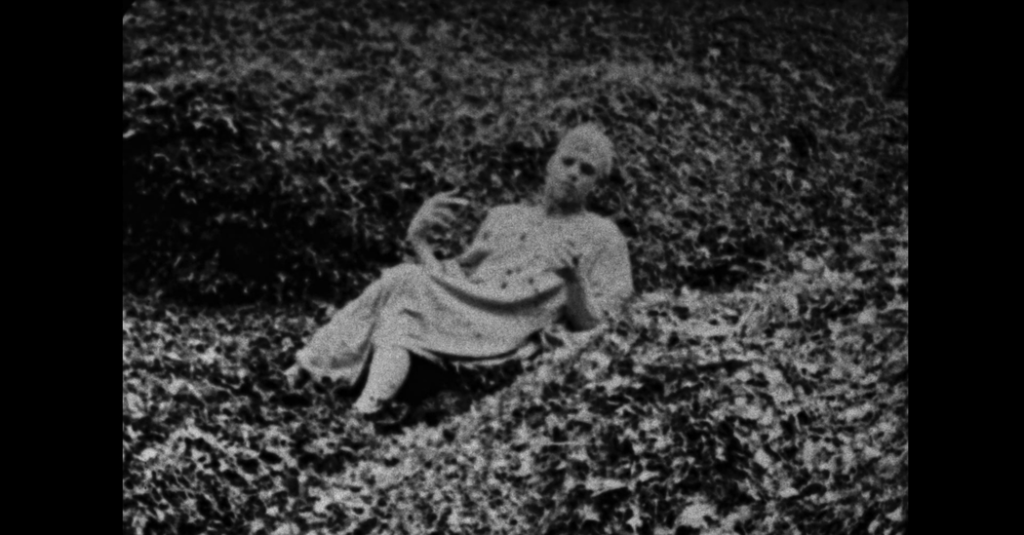
The film is at once ethereal and visceral. One cannot quite grasp or even believe what seems to be happening onscreen. Filmed (and refilmed) on super-grainy, high-contrast, black-and-white, 16-millimeter stock, largely at a New Jersey construction site, it is not easy to synopsize and even harder to forget. That the images are difficult to decipher encourages projecting the worst.
End credits identify the principles, but any description of the action is necessarily provisional. A masked, cowled, self-eviscerating figure — identified in the credits as God Killing Himself — sits alone in a rustic cabin, rocking back and forth, covered with blood and vomiting bile. A female entity, Mother Earth, emerges from his remains and fertilizes herself (in tight close-up), giving birth to a writhing humanoid, Son of Earth – Flesh on Bone.
Mother Earth trundles her son, spastic and retching, through a rocky wasteland where they are captured by a nomadic tribe of creatures who suggest animated potato sacks. Mother Earth appears to be raped. Son of Earth is trussed up and, after much poking and dragging, bludgeoned to death.
There is no dialogue, let alone discussion, but the growling, buzzing, sometimes thunderous noise symphony by Evan Albam is as impressive as the disturbing visuals. According to the filmmaker, “Begotten” was four years in the making. The original footage was rephotographed on a homemade optical bench, one frame at a time — an arduous process that, according to the filmmaker, made the ratio of bench to screen time approximately 10 to one.
Son of Earth’s sacrifice serves to activate lonely sprouts that, animated by time-lapse photography, push their way up from the barren earth. A cleansing rain reveals a full moon and the ocean. Rebirth or cosmic cycle? The creatures continue to lumber around even as flowers droop and die, perhaps to germinate elsewhere in the universe.
“Begotten” concludes with Mother Earth dragging her son back through the now empty woods. Janet Maslin ended her 1991 New York Times review by noting that “the experience of watching ‘Begotten’ can best be characterized as intense.” My own first impression was that it’s like “Night of the Living Dead” as it might have been interpreted by the religious painter Georges Rouault.
Few movies have ever taken themselves so seriously. Still, “Begotten” is impervious to ridicule. Like David Lynch’s “Eraserhead,” which may have been a source of inspiration, or the Polish director Andrzej Zulawski’s “On the Silver Globe,” a sci-fi fantasia in which marooned astronauts contend with rival species and their own mutated descendants, “Begotten” is unique — not just nightmarish, but something beyond.
More inexorable than kinetic, “Begotten” creates its own genre. A metaphysical splatter film, it inspires both disgust and awe.
Begotten
Opens Oct. 1, IFC Center, Manhattan; ifccenter.com.
The post ‘Begotten’: Rubbing Your Eyes in Disbelief appeared first on New York Times.