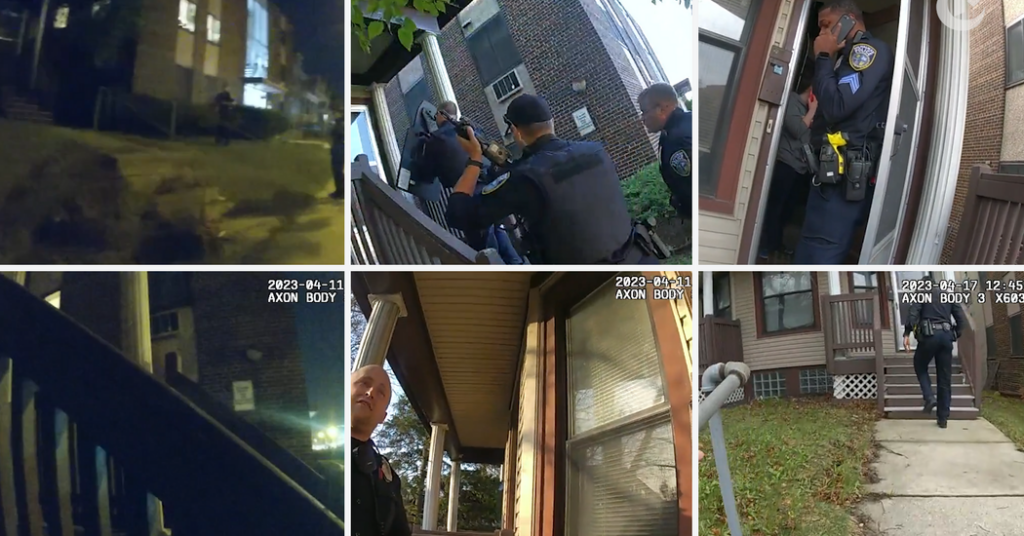
At 1 a.m. on a July night in 2022, police officers arrived and handcuffed Patrick Tomlinson, who was naked, and ordered him out of his home at gunpoint.
Two weeks later, his wife, Niki Robinson, was ordered outside at gunpoint while officers searched their home without a warrant, according to a federal civil rights lawsuit that they filed against the city of Milwaukee and 20 members of its Police Department.
Those episodes were among 55 times the police were called to their home over three years. Each was a false emergency call placed by hoaxers.
The calls included reports of violent crimes — murders, hostage situations, domestic abuse and drive-by shootings — to provoke a heavily armed police response, a practice known as swatting.
Mr. Tomlinson and Ms. Robinson were the victims of a malicious cyberstalking and doxxing campaign that started in September 2018, according to the suit, which Milwaukee recently settled for $575,000.
It all began after Mr. Tomlinson, a science fiction author and a stand-up comic (who has written three essays in the Opinion section of The New York Times, the last of which was in 2020), posted on social media: “Hot take: I’ve never found Norm Macdonald funny and was pretty sure all my comedy friends who did were either nuts or screwing with me.”
What followed was an anonymous, yearslong campaign of harassment targeting the couple that escalated in mid-2022 into what they described as a terrifying swatting campaign.
Trolls bombarded online reviews of Mr. Tomlinson’s books with one-star critiques. They called in bomb threats to a Milwaukee Brewers home game that the couple attended. They put ads on Craigslist inviting the public to take the couple’s grill and patio furniture. They made assassination threats against politicians in the names of Mr. Tomlinson and Ms. Robinson, or used their address.
In an interview, Mr. Tomlinson and Ms. Robinson described the exhausting toll the swatting campaign exacted on them.
“Every single day or night, at any time, the police could come to our door and could break into our house,” said Ms. Robinson, who runs a marketing agency from home. “So it was this constant heightened state of alert because you never knew.”
Early in the harassment campaign, a stalker paid Mr. Macdonald via Cameo, an app where people can buy personalized videos from celebrities, to record a custom video message, the couple said.
In the video, Mr. Macdonald — unaware of the harassment campaign and simply reading a paid script — called on “Patrick’s friends” to “please continue insulting that fat loser.”
Mr. Tomlinson noted that while Mr. Macdonald, who died in 2021, had no idea what he was being used for, the video acted as a catalyst that validated the harassers and ramped up their efforts.
Within this online ecosystem, people gain social cachet and status in the form of followers by outdoing one another in escalating acts of harassment, defamation and potential violence.
“It was their publicly stated goal to drive me to kill myself,” Mr. Tomlinson said, referring to the online trolls. “When they were unable to do it, and when they were unable to convince Niki to divorce me, which was also one of their publicly stated goals, then they shifted tactics to try to get us both murdered by the cops.”
The couple installed a fence and upgraded to an advanced security system. They taped a handwritten note to their door, telling emergency responders to call their cellphones because they were the victims of repeated swatting.
Internal police emails and dispatch logs confirm that the Milwaukee Police Department was aware that their home address was a frequent target of swatting, according to court records.
But all 911 calls must be treated as bona fide emergencies, even if the location of a call was a known swatting target, according to city officials.
In 2022, the Milwaukee Police Department briefed officers about the couple’s history of being targeted, and department leaders spread the word about the frequent false reports, the lawsuit said.
However, the department decided not to flag their home out of concerns of “complacency” among responding officers, according to an email written by a police lieutenant that was included in the court record.
The couple sued the city for what they said was a failure to create anti-swatting policies, safeguards or officer training.
That inaction, they said, was the “moving force” behind repeated violations of their Fourth Amendment protections against unlawful searches and seizures, which sometimes happened at gunpoint or through threats of force.
The city and its officers admitted to responding to a high number of calls to the couple’s home, according to court records, but they denied allegations of constitutional violations, training failures or excessive responses.
The Police Department declined to comment and referred questions to the city attorney, Evan Goyke.
“The people and organizations who make these calls turn Milwaukee’s emergency response system into a weapon aimed at residents and the officers who are sent to help,” Mr. Goyke said.
He noted that the settlement was not an admission of liability by the city or individual officers. Nevertheless, a federal judge during pretrial motions found that the police repeatedly violated the couple’s constitutional rights.
The trolls used voice over internet protocol, or VoIP, which is often routed through multiple virtual private networks, or VPNs, to make swatting calls. This disguises the caller’s identity, and makes it difficult for law enforcement officers to trace the origin of a call.
In a separate lawsuit, the couple named approximately 60 “John Doe” defendants in an effort to force an internet hosting company to disclose IP addresses, server logs and user account records so they could identify the trolls and pursue criminal charges or defamation suits against them.
The court held that the site’s operator could not be compelled to reveal user identities.
The judge ruled that such a disclosure was barred under Section 230 of the Communications Decency Act, a federal law that grants broad immunity to website operators and internet intermediaries and shields them from liability for third-party content posted on their platforms.
“What we found with the stalking, with the swatting, with everything, is that we are too small for the F.B.I., and we’re far too big for any local police department,” Ms. Robinson said.
The F.B.I. opened an investigation in 2022. The agency declined to comment but one day after The New York Times contacted the bureau, it notified the couple that its investigation would be handled by a new agent.
No one has been charged in connection with the swatting calls and harassment against the couple. The calls eased considerably in early 2024, around the time the couple filed their lawsuit against Milwaukee.
No unified federal law specifically criminalizes swatting. Federal prosecutors must rely on a patchwork of existing statutes, like interstate threats, false hoaxes and conspiracy.
Laws have been proposed or enacted in some states to stiffen penalties, but federal legislation consistently stalls in Congress because of concerns over First and Fourth Amendment protections, said Lauren Shapiro, a professor at the John Jay College of Criminal Justice and author of the book “Cyberpredators and Their Prey.”
Because swatters operate anonymously across internet proxies and multiple legal jurisdictions, she said, identifying them requires a complex digital investigation that can take anywhere from one to four years.
Sharlen P. Moore, a member of the Milwaukee Common Council, which approved the city’s $575,000 settlement in June, said that she had not heard much about swatting before this case.
“The details were extremely shocking and very disturbing to me,” said Ms. Moore, a member of the council’s Public Safety and Health Committee, which will have a public hearing on Thursday about the Police Department’s handling of swatting cases.
Mr. Tomlinson said that when he and his wife proved too resilient, the trolls escalated their tactics.
“You can’t fathom the amount of clinical obsession that grips these people,” he said. “Trying to destroy my world is their full-time lives.”
Georgia Gee contributed research.
The post 55 Swatting Calls: A Couple’s Fight Against Online Stalkers and the Police appeared first on New York Times.