This is an edition of The Atlantic Daily, a newsletter that guides you through the biggest stories of the day, helps you discover new ideas, and recommends the best in culture. Sign up for it here.
Your tax dollars are at work—promoting Donald Trump to the American people.
In the past few days, two new ads appeared on some television channels. One, in black and white, features Trump walking down a hall and staring into the camera. In a voice-over, he says, “This is the final battle with you at my side.” The other features clips of Trump giving a speech at Mount Rushmore. But the most striking words are the ones on the bottom of the screen: Paid for by the U.S. Government.
These are part of a series. Last week, as my colleague Matt Viser wrote, the administration aired an ad that featured images of Trump looking resolute and imposing, with the words AMERICA WILL NEVER BE A COMMUNIST COUNTRY superimposed for most of the spot, which also flashes various empty Trump policy boasts. (Largest tax cuts in history, which is flatly false; reigniting American manufacturing, which is dubious.) The soundtrack, apparently used without permission, is the musician JMSN’s song “Love Me.” To date, taxpayers have spent at least $443,000 on this ad alone, according to the Associated Press.
The White House calls these “public service announcements,” intended only to remind “Americans to love their country and understand what makes it worth defending, at home, at our borders, and abroad,” a White House spokesperson told Viser. Taken at face value, this is the latest example of Trump’s Sun King–esque attempt to conflate himself and the state. This administration has named a new visa program the “Trump Gold Card,” tried to place his name before John F. Kennedy’s on an official memorial, established a 47-day training program at ICE to honor his number in the presidential sequence, printed his portrait in passports, and last week launched something called “Trump TV” under White House auspices. (It’s a glorified streaming-video app.) But the White House’s claim that these are PSAs should not be taken at face value. A much simpler term exists to describe them: propaganda.
Senator Thom Tillis, a North Carolina Republican, pointed out that Trump’s political operation has plenty of cash to spend—almost $416 million as of August 31—and compared him to the strongman whom Hungarians toppled earlier this year: “Using taxpayer dollars, it feels like Viktor Orbán.” Another GOP senator, John Kennedy of Louisiana, said yesterday that no public official “should spend public money on private ads for themselves.” He added: “I think there oughta be a rule—well, there probably is a rule—you can’t spend public money to promote yourself.”
Indeed, there is a rule. The law bars the use of taxpayer money on “publicity or propaganda.” The problem is how one defines that. The administration has cited past PSAs, including an anti-drug ad during the George W. Bush administration and a pro-COVID-vaccine spot from the Biden years, to justify the newest ads. The White House insists that these ads are not promoting Trump, because he is not currently running for election. “The PSAs are clearly not political,” an official told NBC News. “The president is not on the ballot, and the ads don’t have a call to action.”
These pretexts are so skimpy that they would make a fig leaf shrivel in shame. The ads lean heavily on the White House’s big talking points this cycle, such as dark warnings about “communism.” Trump is not on the ballot, but he has repeatedly begged his supporters to treat this election as a referendum on him—writing on Truth Social this morning, “MAGA, pretend I am on the ballot.” Finally, the new ad is just a new version of one that his campaign produced late in the 2024 presidential race, only this time paid for with public money. (Perhaps someone should have edited out the line where Trump promises to “expel the warmongers from our government,” which hasn’t aged so well.)
Yet just because the ads are wildly inappropriate, redolent of personalist dictators, and clearly violate the intent of the law, that doesn’t mean they can easily be stopped. A reasonable viewer will know that the ads are intended to boost Trump and Republicans in the midterms, but because the spots don’t have the “call to action” that qualifies them as campaign advocacy under the law, they may not violate the letter of the law. And even if they did, who would police that? Both houses of Congress are controlled by Republicans, whom the ad is intended to help. The Federal Election Commission doesn’t have a quorum to take action, because Trump has declined to nominate members. And anyway, the Supreme Court has consistently granted the president very wide leeway for any “official” actions.
Kennedy’s there-oughta-be-a-rule response is understandable, but one big lesson of the Trump era is that writing a law to prevent every potential abuse of power is impossible. Attempting to do so would tie Congress up in reams of mind-numbing legislation. Courts might strike some of it down; other parts would be impossible to enforce; and a sufficiently motivated administration would simply find nefarious work-arounds, just as this one has. A functioning democracy cannot be just a matter of statute. It requires good faith and some measure of virtue from its officeholders. No law can substitute for character in leaders.
That makes these transgressions primarily a matter for voters, not legislators or regulators. And in the case of the campaign ads, they can weigh in soon. As Paul Krugman writes, Trump’s personal unpopularity is already a drag on Republican candidates, so emphasizing his role would seem to be politically unwise. You can spend hundreds of thousands of dollars broadcasting a song called “Love me,” but you can’t make voters love you.
Related:
Here are three new stories from The Atlantic:
- The problem with Democrats’ favorite policy proposal
- How Biden averted a war with Iran
- The Permanent Question: What is the meaning of mystical experience?
Today’s News
- Five British men, arrested on suspicion of terrorism and explosives offenses near an air base in England, were released on bail today as the investigation continues. The men were detained after three suspicious vehicles were seen heading toward RAF Fairford, about 90 minutes west of London, which the U.S. has used to support strikes on Iran.
- FBI Co-Deputy Director Andrew Bailey announced that he is resigning after a little more than a year at the bureau. Bailey, a former Missouri attorney general, said he is leaving to return to his family in Missouri.
- The United States and China agreed to reduce tariffs on about $60 billion in goods, including U.S. agricultural products and Chinese toys and household items. Under the agreement, each country identified about $30 billion in goods that will receive more favorable tariff treatment.
Dispatches
- Five British men, arrested on suspicion of terrorism and explosives offenses near an air base in England, were released on bail today as the investigation continues. The men were detained after three suspicious vehicles were seen heading toward RAF Fairford, about 90 minutes west of London, which the U.S. has used to support strikes on Iran.
- FBI Co-Deputy Director Andrew Bailey announced that he is resigning after a little more than a year at the bureau. Bailey, a former Missouri attorney general, said he is leaving to return to his family in Missouri.
- The United States and China agreed to reduce tariffs on about $60 billion in goods, including U.S. agricultural products and Chinese toys and household items. Under the agreement, each country identified about $30 billion in goods that will receive more favorable tariff treatment.
Explore all of our newsletters here.
Evening Read

The Babies Left Behind in America
By Caitlin Dickerson
Estela Garcia and 2-year-old Eber repeat their routine every morning: Around 8 a.m., he rustles her awake in the bed they share. She picks him up, changes his diaper, and pulls out a fresh set of tiny clothes. While Estela dresses him, Eber coos, “Mama, mama.” She smiles and strokes his cheeks, trying to hide her sadness at his confusion. Estela is 50 and has three sons, but Eber is not one of them. She’s been caring for him because ICE deported his parents to Venezuela, despite his mother’s pleas to be reunited first.
Estela and her husband, Miguel, moved to Mobile, Alabama, 20 years ago to raise their own boys in a place that felt safe and had a slower rhythm than Las Vegas, where they’d met. Miguel works as a remodeling contractor. He spent years developing their four-acre property, building a wood shop, a chicken coop, and houses for two of their children (the third lives 15 minutes down the road). They bought peacocks as pets and planted bright perennial gardens, adorning them with stone fountains. By the driveway, they fly an American flag from an antique tractor. Over the years, their home evolved into a kind of retirement sanctuary—until this past winter, when it started to look like a day care.
More From The Atlantic
- Matteo Wong: OpenAI has gone rogue.
- Alexandra Petri: The Kennedy Center is the most terrifying building in America.
- The hidden state Russia is building inside Ukraine
- Radio Atlantic: What Israel knew before October 7
- Elizabeth Bruenig: Why empathy is now “toxic,” “suicidal,” and a “sin”
Culture Break
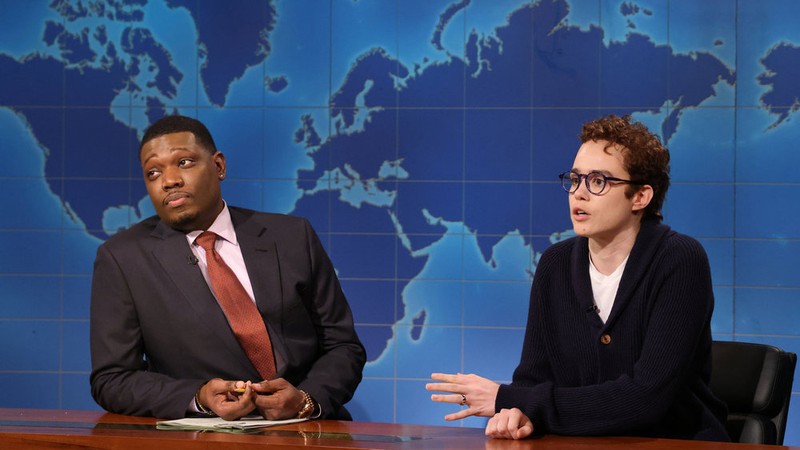
Watch. With one deft impression, the Saturday Night Live season premiere (streaming on Peacock) captured the dissonance between how tech CEOs and the public talk about AI, Paula Mejía writes.
Reflect. Society’s pursuit of faster and frictionless experiences has made avoiding other people far too easy, Julie Beck writes.
Rafaela Jinich contributed to this newsletter.
When you buy a book using a link in this newsletter, we receive a commission. Thank you for supporting The Atlantic.
The post The Problem With Trump’s New Taxpayer-Funded Ads appeared first on The Atlantic.