

Would you let an AI do all your shopping for you?
Do you want an AI to do all of your shopping for you?
I’m asking because the answers are going to be key to the success or failure of a new class of AI Agents: services like Meta’s Muse, or the super-hot Instinct startup that didn’t exist a few weeks ago, and is now valued at $10 billion.
The industry behind the agents promises they’ll do all kinds of things for you — but the primary one seems to be “our agent will go find and buy the things you want, and you never have to worry about shopping again.”
That premise is also why investors are so interested: They imagine a world where lots of the value of e-commerce sites — and specifically Amazon — goes away, replaced by ruthless agents that comb the internet for the best deals, and have zero loyalty to any retailer. Meta boss Mark Zuckerberg says Meta will make money in that scenario by taking a small fee from transactions.
But it’s also possible that Amazon and other retailers have less to worry about than the pro-agent crowd thinks. Even if lots of people trust an AI to buy something on their behalf — let alone trust AI to handle the bulk of their shopping — there just may not be that many opportunities to put it to work.
That’s the argument from a new report from analysts at MoffettNathanson, who argue that “we do not expect personal agents to be the disruptive forces to ecommerce” that some investors think.
Their key argument (in my mind) is illustrated by this chart, which assumes the average consumer makes 47 payments a month (per the Atlanta Fed), and tries to imagine which of those payments would be relevant to a Muse-like agent:
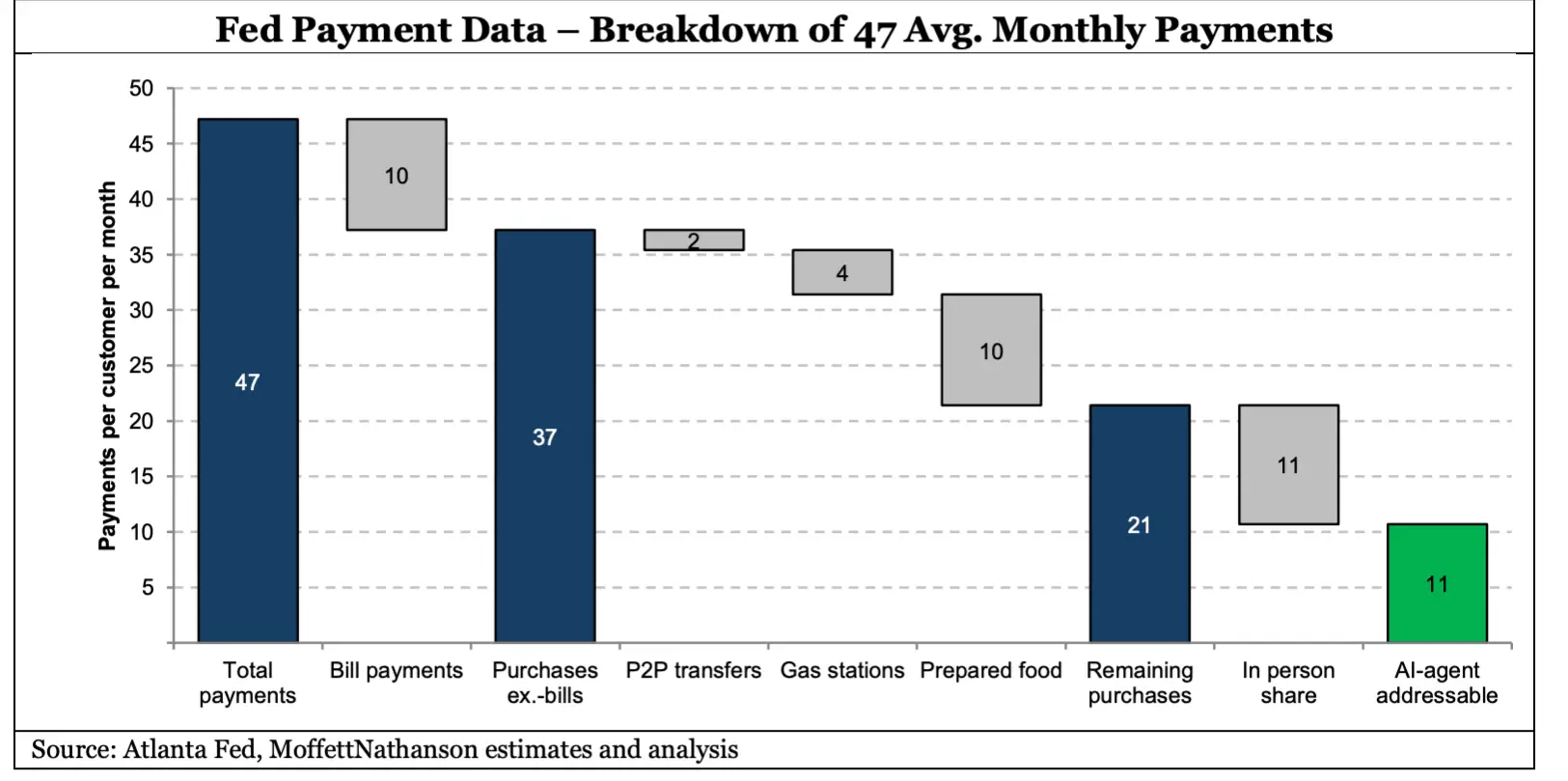
The takeaway: Once you strip out things agents wouldn’t be useful for — like automated bill payments, gas stations, and shopping in real-life stores — you’re left with 11 payments a month that an agent might want to handle.
And it’s possible that you may very well want Muse, or Instinct, or whatever Google agent eventually appears, etc., to handle those 11 payments for you.
(I’ve been playing with Muse and Instinct for a couple weeks, and I’ve already gone from “I’ll never give a bot my credit card” to “Turns out Stripe’s Link service already has my credit card, and I’m OK with Stripe, so I’m OK doing an Instinct transaction using Link.” Which is how I ended up spending $17 on Bounce, a luggage storage service I’ve never heard of before, when I traveled to San Francisco last week. Instinct helped me plan my itinerary, suggested Bounce, and paid for the service, all without me taking my Visa out of my pocket. Worked just fine. I think my information is safe?)
But taking a slice of 11 agent-aided transactions (which have to be quite small if consumers agree to pay them) makes it very, very hard for a Muse or Instinct or any service to make real money, unless there’s truly wide adoption.
Which is why the MoffettNathanson folks think Muse ultimately becomes another place for Meta to sell ads, even if Meta hasn’t expressed any interest in that right now. Another theory: Muse or Instinct or whoever will eventually become so useful that you’ll pay a subscription fee to use them.
As long as these things are free, I’m going to spend a lot of time playing with them. After that, I have no idea.
Read the original article on Business Insider
The post Muse is supposed to make money when you use it to shop. What happens if you just don’t shop that much? appeared first on Business Insider.