Humans have sophisticated language abilities that could be unique to our species — but dogs, it turns out, may have learned some of our tricks.
In new research out of Hungary published this week in the journal Science, scientists found that dogs use the same strategy to pick out words in streams of speech that human infants do: They listen for consonants to figure out when one word ends and another begins.
“This is what we call the consonant bias,” explained Attila Andics, a cognitive neuroscientist at Eotvos Lorand University in Budapest and author of the new study. “Basically, what we show now here is evidence that unlike other mammals, dogs do the same. They also process speech with a consonant bias.”
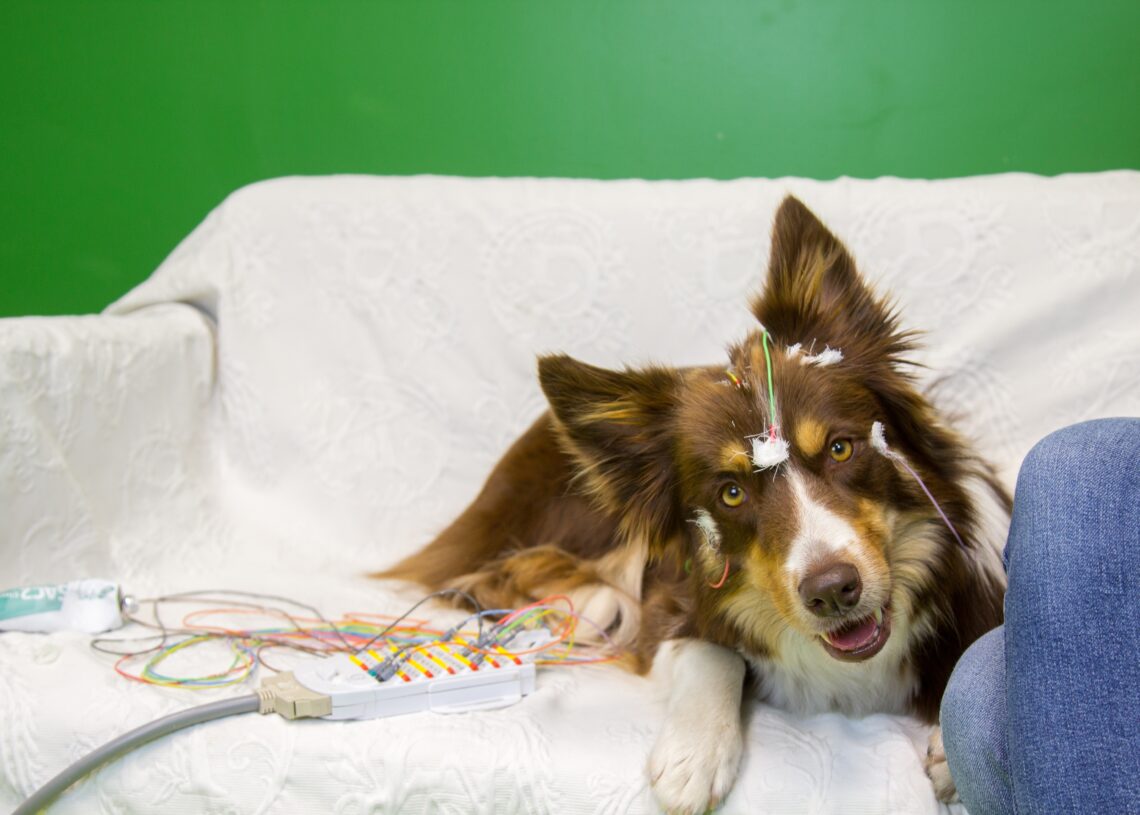
To study this, the researchers brought 20 dogs and 20 humans into a lab and played streams of nonsense words for them, some with consonant patterns, some with vowel patterns and some with no pattern at all. The scientists collected electroencephalographic (EEG) data to measure brain activity.
Some of the dogs had been with families their whole lives, while others had been in shelters or on the streets as puppies, which allowed the researchers to test whether early exposure to language is critical for dogs to develop the ability to segment out words by listening for consonants.
The researchers found that both the dogs and the humans had increased brain activity with the consonant patterns — including the dogs who weren’t exposed to speech until later.
“It sheds new light on what we know about language evolution,” said Andics. “It suggests that speech can also shape the brains of animals that don’t have those special human complex language abilities.”
A humanlike ability to identify words
This study contributes to a growing body of research that has found that dogs are attuned to language in a way that seems similar to young humans.
“Babies have a unique problem,” said Francys Subiaul, a cognitive scientist and associate professor at George Washington University who wasn’t involved in the study. “They have to learn this super complicated signal. I mean, just think about the speech signal. It’s super messy. Men and women sound differently, older and younger people sound differently, and yet we have to cut through all of that noise and get to the heart of the matter: identify words and then identify their meanings.”
Subiaul said the fact that dogs have also developed the ability to do this points to how attuned they are to us.
“They’re listening, they’re paying attention,” Subiaul said. “And those experiences are shaping their brains in ways that are quite similar to how those experiences shape the brains of our babies.”
One big question is whether this is because of how dogs evolved through domestication over the last 15,000 years or so, or if this is something that was always in their abilities.
“But to answer that question, there’s a key control group that you need,” Subiaul said. “You need wolves.” He explained that researchers could do a study where they raise wolves in speech-rich environments to see if they develop the same abilities. But Subiaul suspects they wouldn’t, because other research shows what a powerful force domestication has been in making dogs and humans attuned to one another.
In previous studies, scientists have found that contact between dogs and humans gives both a boost of oxytocin, the bonding hormone that surges in parents and babies.
“That could only be explained through domestication,” Subiaul said.
Subiaul has worked extensively with primates, and he suspects that despite their intelligence, they wouldn’t perform as well on these tests as dogs do either.
“Dogs seem to be more emotionally attuned with humans. Dogs are also much more sensitive to human social cues,” he said. “Dogs are more sensitive to eye gaze. They’re more sensitive to pointing cues than primates are. And all of that we believe is a product of domestication.”
This new study was relatively small, and more research is needed to confirm the finding and fully understand how dogs might have developed this ability. But researchers said that it adds to our understanding of how humans and dogs have become inextricably linked over millennia.
“It shows what a long, important history we have together,” said Amritha Mallikarjun, a postdoctoral research associate at Harvard University who wasn’t involved in the study. “Our experiences as dogs have been domesticated have both shaped their brains and our brains, and it’s showing up in all of the research about dog language and dog social behavior. I think this is adding to this story about dogs and their relationship with us.”
Sign up for The Optimist newsletter
Get inspiring stories delivered to your inbox every Sunday.
The post Dogs use a surprising method to understand human language, new study suggests appeared first on Washington Post.