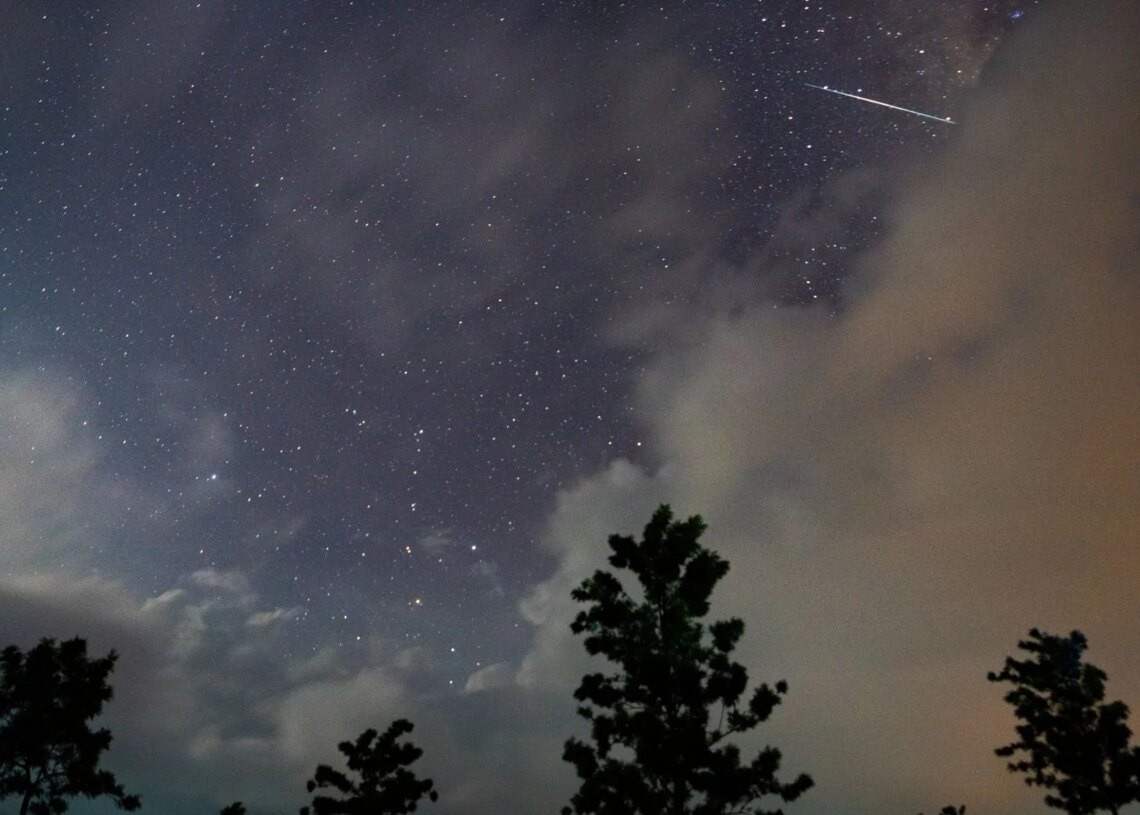
The Southern Taurids aren’t the meteor shower you watch if you want to be mind-blown by the sky firing every 30 seconds. You might get five or 10 meteors an hour. But every once in a while, one of them absolutely goes off.
According to the American Meteor Society, the Southern Taurids began September 20 and run through November 20, with two periods worth watching. Regular shooting-star activity picks up around October 13-14, while the main fireball peak comes November 4-5.
The timing is pretty good this year. October 13-14 comes with a moonless sky, and on November 5, only a faint waning crescent will be visible in the early morning hours.
How to See the Southern Taurid Meteor Shower This Fall
The Taurids are known for fireballs partly because they move relatively slowly. They hit Earth’s atmosphere at around 17 miles per second, which sounds insane until you learn that, by meteor standards, it’s actually quite leisurely. That slower speed gives them more time to streak across the sky, sometimes leaving a long glowing trail or producing a flash bright enough to qualify as a fireball.
You won’t see dozens of them. But you might see one that makes the waiting feel justified.
The shower comes from debris left behind by Comet 2P/Encke as Earth moves through its path around the Sun. Most of that material is tiny. But some researchers think the stream also contains a smaller group of much larger fragments known as the Taurid resonant swarm.
This is where the nice fall meteor-shower story takes a hard turn. Researchers think the stream may also contain much larger objects. One theory links objects in that swarm to the 1908 Tunguska event, when a space rock exploded over Siberia and flattened roughly 80 million trees.
Physicist Mark Boslough at the University of New Mexico has pointed to a couple of clues that larger objects may be mixed into the stream, including unusually bright Taurid fireballs and seismic signals recorded on the Moon by Apollo instruments. If that swarm is real, it’s expected to pass closer to Earth in 2032 and 2036.
For this year, watching is super easy and low-tech. Find somewhere dark, give your eyes about 20 minutes to adjust, and look up. The constellation Taurus marks the shower’s radiant, but the meteors can show up anywhere across the sky, so scan your eyes across the sky. Binoculars and telescopes can stay home.
The Northern Taurids also overlap later in the fall, carrying the season into early December. So there are several weeks to try your luck.
And luck is really what you’re waiting on. The Taurids are sparse, unpredictable, and sometimes uneventful. Then one fireball tears across the sky, and it was all worth it.
The post Here’s How to See the Southern Taurid Meteor Shower Without a Telescope appeared first on VICE.