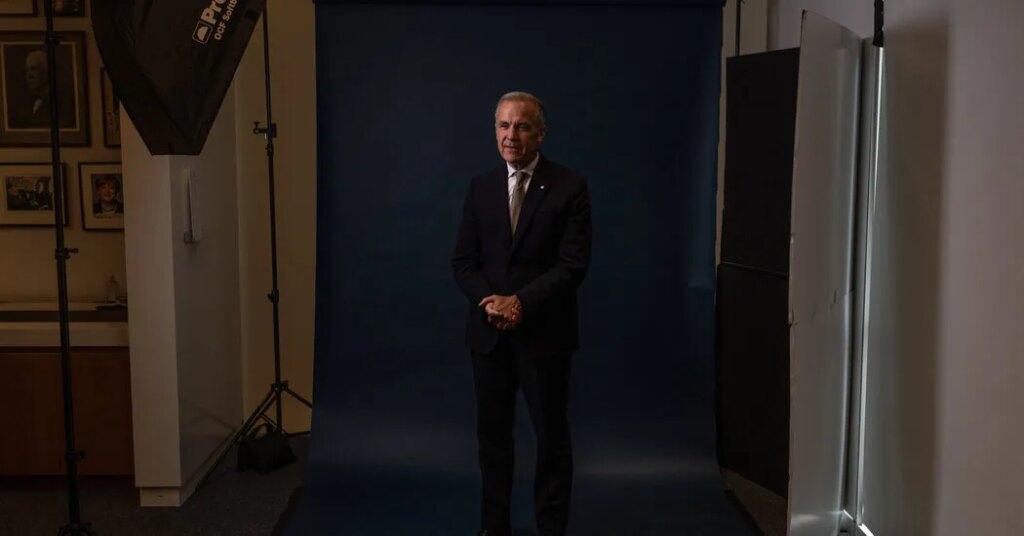
On Wednesday, Prime Minister Mark Carney of Canada visited the New York Times headquarters in Midtown Manhattan after his engagements at the United Nations General Assembly, sitting for an hourlong interview with 10 reporters and editors.
I was one of them, and in this week’s Canada Letter, I want to share some important moments and takeaways from the interview.
In a wide-ranging conversation, Mr. Carney delved into new details about a number of issues vital to Canadians. Foremost among them was, perhaps, his own perception of the risk of the United States taking military action against Canada.
The Times’s question to Mr. Carney on this topic was: “At any point in the last 18 months, were you ever seriously concerned that President Trump, as these threats escalated, would seriously use military force against Canada?”
Mr. Carney paused for nine seconds, twice interrupting the silence to clear his throat.
Then he said: “I think you have a responsibility in these roles to look at extreme tail risk.” He added: “That’s just that’s risk management. That’s not a base case, but it would be irresponsible not to.”
The stunning, if narrow and carefully worded statement by Mr. Carney, has generated a strong response in Canada.
Times reporters asked Mr. Carney to elaborate on the types of actions he had taken to mitigate this “extreme tail risk” — a term borrowed from finance to describe an event that is highly unlikely to happen but would be significant if it did- — but he declined to elaborate.
It was a tense moment that stood out in an otherwise fluid conversation that touched on a number of issues.
Key takeaways from the interview include:
-
Mr. Carney said that Canada would move away from using Starlink, the Elon Musk-owned satellite communications program.
-
He also said his government was closely reviewing the decision to order 88 Lockheed Martin F-35s, with a counterproposal from the Swedish aerospace and defense company Saab for Gripen fighter jets. Mr. Carney stressed that “It is a real decision because of differing capabilities, because of strategic dependencies and because of the economic return.”
-
He did not rule out running for a second term in office, elaborating on his thinking on the matter.
-
He spoke in depth about how he perceives opportunities and risks in the most important non-U.S. relationships he is pursuing: with the European Union, China and India.
-
On the matter of India, with the visit of Prime Minister Narendra Modi planned for December, Mr. Carney said that increased cooperation on security issues was positive, but that he could not rule out further India-linked crime on Canadian soil.
-
Mr. Carney went into some depth about A.I.-related risks, saying that his “P-doom score” — or his perception of the probability of a catastrophic event related to artificial intelligence — was “above zero.”
The Times will publish a transcript of the interview in the coming days.
Matina Stevis-Gridneff is the Canada bureau chief at The Times. She lives in Toronto.
More on Canada-U.S. relations
-
At the United Nations General Assembly on Tuesday, Mr. Carney expanded on his vision for international cooperation, outlining how nations could safeguard their mutual interests following a “rupture” to the world order by the United States and China.
-
Mr. Carney and President Emmanuel Macron of France met on Sunday in St. Pierre and Miquelon, the tiny French territory off the coast of Newfoundland. They discussed interests that France and Canada share, and which the Trump administration rejects.
-
Ottawa’s City Council decided that a street should no longer be named for President Trump, who recently signed an executive order to change the name of Lake Ontario to Lake America.
-
Coats, jackets and parkas made in Canada are becoming caught in the middle of the trade war with the United States, as some of the biggest players in outerwear, including Canada Goose, try to endure the latest tariff shock.
-
Why do the trade wars keep coming for your whiskey?
-
While the Canada-U.S. relationship has suffered, at the other, typically more contentious American border, a partnership is blooming.
-
Americans who attended the recent Toronto International Film Festival might have wondered what reception they would receive, with the ongoing trade war and an American president who has taken a hostile posture toward one of his country’s closest allies.
Trans Canada
-
“It Was Either That Or Die,” by the Haitian-Canadian author Thélyson Orélien, was the hit of the French literary season. Now it’s been pulled from the shortlist for a prestigious prize.
-
A man with a shotgun shot and critically wounded a police officer stationed outside a synagogue in Belleville, Ontario, as congregants gathered on Sunday for Yom Kippur, the holiest day on the Jewish calendar.
-
British Columbia has sued OpenAI in U.S. federal court, claiming that the company failed to report to the police the violent comments made by a user of its chatbot, who went on to kill nine people and injure two, Vjosa Isai reported.
-
Paris really, really loves Celine Dion. Her arrival, for a 16-date residency through October, has been greeted with a citywide frenzy, spurring singalongs, Céline-themed Seine cruises and no fewer than eight tribute bands traveling the country to perform her songs.
-
In Opinion, the author Robert Moor, of British Columbia, writes about how wildfires turned him from a tree-hugger into a tree-worshipper.
How are we doing? We’re eager to have your thoughts about this newsletter and events in Canada in general. Please send them to [email protected].
Like this email? Forward it to your friends, and let them know they can sign up here.
The post Special Edition: Our Interview With Mark Carney appeared first on New York Times.