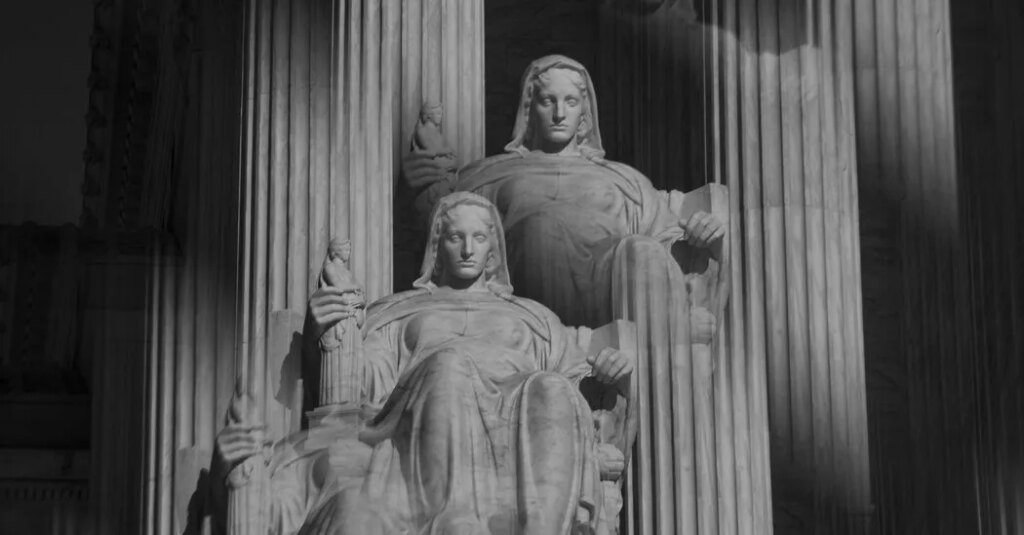
Last week, the Supreme Court upheld a preliminary injunction to block a proposed plan from the United States Postal Service to overhaul the way Americans are allowed to vote by mail, rejecting President Trump’s attempt to restrict mail-in voting ahead of the midterm elections. Trump blames mail-in voting for his 2020 defeat, which he attributes to fraud and illegal voting by noncitizens. “ELECTIONS CAN NEVER BE HONEST WITH MAIL IN BALLOTS/VOTING,” he wrote on his Truth Social platform last year.
Whenever the Supreme Court hands Trump a defeat, there is a debate over the court’s relationship to the president. Is it as deferential as critics charge? Has it actually empowered Trump, as his opponents allege?
Defenders of the court say no, and point to the president’s attacks on the Supreme Court as evidence that the justices have frustrated his aims and aspirations. If the Supreme Court has been an obstacle to the president’s executive overreach, then how could you accuse the court of any pro-Trump bias?
The answer is that you can’t analyze the court’s decisions in a political vacuum. Specifically, you have to take account of how the justices have shaped Trump’s own decision-making.
Trump’s authoritarian exercise of executive power is only partly a function of his sense of himself as a strongman. The rest comes from the Supreme Court’s jurisprudence, specifically its decision in Trump v. United States in 2024, when he was running for president a third time. In that ruling, the court shielded the executive from criminal prosecution for “official acts.” Defenders of Chief Justice John Roberts and the conservative majority say that the ruling is quite narrow — that immunity covers only the executive’s “core duties” and that outside of those, the president can still be held legally accountable. But this parsing ignores how court decisions play out in the real world.
Political life is not a legal seminar. What might have been issued as a narrow, limited decision was read — by one soon-to-be president — as a mandate to act on his most authoritarian impulses. This is from “Regime Change: Inside the Imperial Presidency of Donald Trump,” by my news-side colleagues Maggie Haberman and Jonathan Swan.
Trump had learned vital lessons during his years in and out of power. And his second term in office would be nothing like a second term he might have commenced in 2021. In 2025, he wouldn’t have to worry about investigations; the Supreme Court that he himself had transformed had granted the President of the United States broad immunity from prosecution for actions taken while in office.
Trump’s reliance on unilateral executive power, and his aggressive attempts to expand it, play out against the backdrop of Trump v. United States.
In turn, to the extent that the court has put the brakes on the president’s assertions of executive power, it is arguably cleaning up its own mess. The justices are responding to the predictable consequences of decisions they made in service of their own political, legal and ideological project. And whenever the court upholds Trump’s broad assertions of executive power, it both reinforces his belief that he holds something close to sovereign authority and hardens his expectation that he can wield such authority without obstacle or interruption.
Consequently, when Trump attacks the Supreme Court for blocking his most aggressive and lawless actions, he is reacting as much from frustration as from pique. As he sees it, the court is contradicting itself. It told him he is criminally immune and has far-reaching authority to exercise his powers, but then it wants to limit those powers. His anger is understandable, since this court is very much trying to have it both ways. The conservative justices want to write their vision of unitary executive power into the Constitution and somehow limit this particular president’s ability to use that power for his personal and political ends.
Put a bit differently, when Trump’s assertions of executive authority serve the ideological and institutional interests of the Roberts court, the conservative justices are happy to affirm them. When those assertions cut against those interests, the justices are more inclined to reject them.
This dynamic is why I think it is shortsighted to clap for this Supreme Court for its occasional moves against Trump. Those judgments exist in a context where the court has all but blessed an autocratic, imperial presidency, and where several justices have entertained extreme claims of executive authority, such as the power to unilaterally rewrite the Constitution.
Crediting this court for checking the president’s excesses is a bit like hailing the guard who caught the thief after leaving the store unlocked. The difference is that the guard made a mistake. The court, by contrast, is playing a deliberate game of chicken with American democracy.
What I Wrote
I wrote about the ways that we can learn from past efforts to regulate huge, disruptive industries as we tackle a new one: artificial intelligence.
But novel technologies do not actually require novel political solutions, especially when those technologies either evoke, replicate or recapitulate age-old problems of political and economic life.
There is, in fact, an American tradition of fighting to bring collective and democratic authority to bear on disruptive technologies — of using politics to try to shape and direct the impact of major economic transformations.
I interviewed Judy Woodruff on the free press and American democracy for an event at Thomas Jefferson’s Monticello. You can check out the full recording here.
Now Reading
Ari Berman and Pema Levy on the return of Jim Crow jurisprudence for Mother Jones.
Drew Gilpin Faust on recent innovations in studying the history of slavery for The New York Review of Books.
Noura Erakat on Trump’s Board of Peace for Boston Review.
Laura Jedeed on the rise of apocalyptic thinking for The New Republic.
Rogé Karma on the various A.I. doomsday scenarios for The Atlantic.
Photo of the Week
I took this during my last visit to Cambridge University. Between the sunset and the film stock, it came out looking like a painting to me.
Now Eating: Tahini Chocolate-Chip Cookies
This is my go-to chocolate-chip cookie recipe. It makes an incredibly chewy cookie with a hint of nuttiness from the tahini. It also does not use any butter and can be made vegan with nothing more than an egg substitute. The recipe calls for chocolate chunks, but I prefer to buy a few bars of nice chocolate and chop them up for a cookie with chocolate in every bite. Recipe comes from Food52.
Ingredients
-
8 ounces (227 grams) tahini (1 scant cup)
-
1 cup (200 grams) sugar
-
⅔ cup (142 grams) brown sugar
-
2 large eggs
-
3 tablespoons cold water
-
2 teaspoons vanilla extract
-
1 ¼ teaspoons kosher salt
-
¾ teaspoon baking soda
-
2 cups (256 grams) all-purpose flour
-
12 ounces (340 grams) bittersweet chocolate chunks (about 2 cups)
Directions
Heat the oven to 375 degrees. Line a couple of sheet pans with parchment or silicone mats.
Combine the tahini, sugar and brown sugar in the bowl of a standing mixer fitted with the paddle attachment. Mix on medium for a couple of minutes, scraping down with a rubber spatula once or twice. It will be crumbly, not creamy.
Add the eggs, water and vanilla extract. Continue to mix on medium for another couple of minutes, again scraping every so often. The mixture will look glossy and fudgy. Add the salt and baking soda. Mix on low just to combine. Add the flour and mix until almost combined. Now add the chocolate chips and mix again.
Scoop rounded tablespoons of dough onto the prepared sheet pans. Fill a glass with water, dip your fingers in, then use them to flatten the cookie dough blobs — figure to a little over ½-inch thick.
Bake for 9 to 11 minutes until the edges are turning golden brown but the centers are still tender. Let cool on the tray for a few minutes before using a spatula to transfer to a cooling rack. Repeat the above with the remaining dough.
The post Why Does Trump Think He Can Act Like a King? appeared first on New York Times.