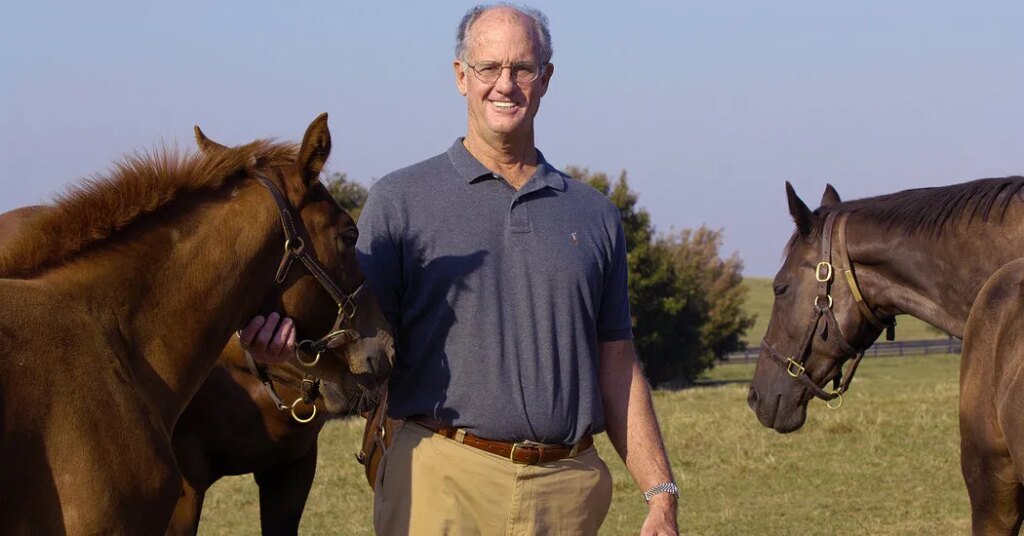
Arthur B. Hancock III, who was born into a celebrated family of Kentucky horse breeders and spent his life pursuing dual passions — for thoroughbreds and bluegrass music — raising more than one Kentucky Derby winner, founding an organization dedicated to protecting horses from doping and writing classic country songs in the process, died on Sept. 18 at his home in Paris, Ky. He was 83.
The cause of death was pancreatic cancer, his wife, Staci Hancock, said.
Mr. Hancock owned Stone Farm, a 2,300-acre Kentucky horse breeding operation, and was the first in his family to raise a Kentucky Derby winner. His farm produced three Derby winners, in fact, and more than 225 stakes winners overall.
He and Ms. Hancock founded the Water Hay Oats Alliance, an advocacy group dedicated to banning performance-enhancing drugs from horse racing. Thanks in part to the attention they brought to bear on the issue, in 2020 Congress passed the Horseracing Integrity and Safety Act, creating national oversight of racing.
Along the way, Mr. Hancock found time to release several albums of original country music, and his songs were covered by Willie Nelson, Ray Price and others.
But his path toward this rich future had looked far from certain.
At 29, he lost his father to pancreatic cancer, and the leadership of his family’s thoroughbred breeding operation, Claiborne Farm, passed not to him — as he had expected, because he was the eldest son — but to his younger brother, Seth.
“I wondered, ‘What in the world am I going to do with my life?’” he told Paulick Report, an online horse racing publication, in 2025. “I thought running Claiborne was what I’d been groomed for.”
The problem, it seemed, was that the advisers appointed by his father’s will didn’t consider him serious enough to oversee the farm. In his early 20s, he had spent time in Nashville, composing and recording country music, and he had a reputation for drinking too much.
“I just can’t drink like normal people,” he recounted in his book, “Dark Horses: A Memoir of Redemption” (2025), also recalling how he had dealt with sobriety: “I always say I’m allergic to alcohol.”
So he set out to make his own way in the world. “I just felt that I had to do my own thing in life,” he recalled in the 2025 interview. “I had to run things like I wanted to.”
Arthur B. Hancock III was born on Feb. 22, 1943, in Nashville, Tenn.
His grandfather, the first Arthur B. Hancock, was a thoroughbred breeder who founded Claiborne Farm in Paris, Ky., in 1910. His father, Arthur B. Hancock Jr., a taciturn and imposing man known as Bull, built it into one of the most successful breeding operations in the country. His mother, Waddell (Walker) Hancock, also played an active role in the business.
Young Arthur grew up on the family’s horse farm, on a slab of mineral-rich limestone carpeted with thick, lush bluegrass that is to horse racing what Yankee Stadium is to baseball: the bedrock of champions. It was the land where the legendary Secretariat stood as a stallion, breeding other winning horses in his post-racing days.
As a young man, Arthur was something of a hellion — a drinker and brawler who had what his family regarded as an incomprehensible interest in country music. His father couldn’t fathom why he wanted to dye his hair black to resemble Elvis or why he spent so much time with his guitar when there were horses to tend.
After earning a bachelor’s degree in history from Vanderbilt University in 1966, Mr. Hancock pursued a music career in Nashville, where he was signed by Fred Foster at Monument Records the following year.
He released four albums of original music, and his songs were covered by big names in country music. Mr. Price’s 1972 version of “Time (Old Faithful Friend of Mine)” is considered by many to be a bluegrass classic. Other covers include “Nashville on My Mind,” recorded by Grandpa Jones in 1974, and “Country Boy,” recorded by Bobby Osborne in 2017.
For his contributions to country music, which continued throughout his life, Mr. Hancock will be inducted posthumously into the Kentucky Music Hall of Fame next month.
But in 1970, the pull of family and horses brought him back to Claiborne, where he served as the assistant broodmare and yearling manager, fulfilling his father’s wish to see the family working “shirtsleeves to shirtsleeves through three generations,” he wrote in his memoir.
After his father died in 1972, he began buying land nearby for his own breeding operation. He called it Stone Farm.
Mr. Hancock’s first big success was breeding a gray colt named Gato Del Sol who won the 1982 Kentucky Derby.
The following day, he was feted by John Y. Brown Jr., then the governor of Kentucky. A few weeks later, he invited the governor and his wife, Phyllis George, a sportscaster and former Miss America, to Stone Farm for dinner. He and the governor drank and played backgammon, gambling late into the night. Mr. Hancock figured that he had lost a couple thousand dollars; he was shocked to realize that he was in the hole for $375,000, he wrote in “Dark Horses.”
He had already racked up debt from buying land for the horse farm. Now he was racking up more from gambling, and falling deeper into the bottle.
“I grew up thinking that whiskey was a great friend, comforter, helper,” he wrote. “It took a long time for me to finally realize that alcohol was not my friend but my worst enemy.”
In his memoir, he recounted how his eventual sobriety was bolstered by Sunday Silence, a colt with a crooked leg that he bought for $17,000. On Jan. 1, 1989, the day the colt turned 3, Mr. Hancock quit drinking. The colt that no one else wanted would win the Kentucky Derby and Preakness Stakes that year.
During three years on the track, Sunday Silence won nine of his 14 races, earning nearly $5 million. But to Mr. Hancock’s disappointment, no American breeder wanted to stand him as a stallion, convinced that neither his pedigree nor his conformation warranted breeding him with mares. So he sold the horse for $10 million to Zenya Yoshida, who owned the Shadai thoroughbred farm in Japan, and Sunday Silence became a foundational sire for Japanese racing.
The sale got him out of debt and saved Stone Farm, but it was a bittersweet parting, and he cried when he put the horse on the plane to Japan. Sunday Silence, he wrote, “saved me, our family and our farm.”
Mr. Hancock also bred the 2000 Kentucky Derby winner Fusaichi Pegasus and raised eight champion horses, including Risen Star, who won the 1988 Preakness Stakes and Belmont Stakes, and Bricks and Mortar, the 2019 Horse of the Year.
As a fellow breeder, Helen Alexander of Middlebrook Farm in Lexington, Ky., told Paulick Report in 2022, “He just has an uncanny knack for seeing what’s best in a horse that’s often missed by others.”
Mr. Hancock had long been aware of horse racing’s many problems, including the use of illegal drugs and the overuse of legal ones.
At a University of Arizona symposium in 1991, he gave voice to racing’s dirty little secret: Too many horses were running on performance-enhancing drugs or were so doped up on anti-inflammatories and painkillers that they were running unnaturally fast and injuring themselves, often fatally.
And it was not only the horses who were suffering, he pointed out, but also the people who made a living breeding them. Horse racing, one of America’s oldest pastimes, was losing market share to other sports.
“How are we going to compete,” he asked the audience, “if we are perceived by the masses of fans and potential fans as being dishonest and riddled by drugs and thugs?”
It was not a popular message.
Still, he pressed on. After he and his wife started the Water Hay Oats Alliance, an antidrug, anti-slaughter coalition, Mr. Hancock testified before Congress and lobbied Senator Mitch McConnell, Republican of Kentucky. The group was instrumental in establishing federal oversight of thoroughbred racing.
In addition to his wife, Mr. Hancock is survived by a son, Arthur Hancock IV; five daughters, Hutchi, Walker, Kate, Alex and Lynn Hancock; six grandchildren; his brother, Seth; and a sister, Dell Hancock.
Last year, after being inducted into the National Museum of Racing and Hall of Fame, he talked about the importance of putting horses first.
“How we treat the horse is a reflection on our industry and on each one of us,” he said. “If it is perceived that he is treated badly, the public will lose interest and walk away. Integrity with dignity is everything in our sport.”
The post Arthur Hancock III, Derby Breeder With a Flair for Bluegrass, Dies at 83 appeared first on New York Times.