On Sept. 15, CBS News published a truly meaningful scoop. It obtained pictures of the extraordinary damage done to American aircraft and American bases by Iranian drones and missiles.
The photographs were astonishing. During my own deployment, I spent many days at Camp Buehring in Kuwait, and now parts of that sprawling base are in ruins. Places I recognized have been blown to pieces. And it’s particularly jolting to see the destroyed remains of American aircraft at Prince Sultan Air Base in Saudi Arabia.
It’s an image that would have been unthinkable during the previous phases of our long war on terror.
While we’ve undoubtedly inflicted tremendous damage on Iran’s conventional military (its air force and navy barely exist, for example), the war has not been as one-sided as the administration has claimed. This was not supposed to happen because we are not supposed to be that vulnerable. I strongly recommend reading my colleague W.J. Hennigan’s piece on the military impact of Iran’s attacks to better understand how much Iran has exposed American military weakness — a weakness that’s based on perhaps an outdated understanding of the nature of modern war.
I’m wanting, however, to talk about something else — something revealed in the second paragraph of the CBS story: “The images were sent to CBS News by active service members on condition of anonymity because of rigid media restrictions within the military.”
As one deployed service member told CBS News: “This is major damage to our bases that hasn’t been communicated to the American public. We’re standing there with our eyes closed getting punched in the face.”
The fact that these pictures were leaked by active service members is significant — more significant than many readers might realize.
First, it’s important to note a few things. The Trump administration has waged this war differently from the patterns established by previous presidents. Not only did it attack Iran without any real public debate, without congressional authorization and without a U.N. Security Council resolution, it went to war in the midst of a campaign against the media unlike anything we’ve seen in recent American history.
As The Columbia Journalism Review reported this past summer, “Press conferences are rare. Pete Hegseth, the so-called secretary of war, takes questions only from friendly outlets. No mainstream news organizations have reporters embedded with U.S. military units in the Middle East. Pentagon sources are increasingly reluctant to talk to journalists for fear of retaliation from the administration.”
As a result, during the opening weeks of the war, Americans were robbed of any way of assessing its progress apart from the dueling news releases and statements from the two combatants. And given the administration’s propensity to lie, we had no way of discerning the course of combat.
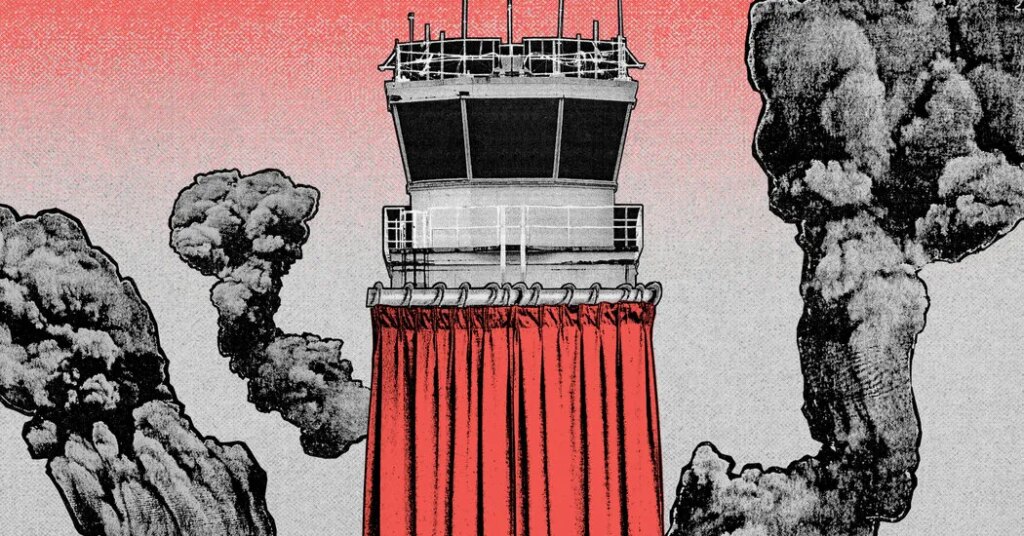
The fog of war is always thick, and it’s made thicker by the need for secrecy to disguise combat operations. In this conflict, however, we’ve seen a level of secrecy, deception and outright propaganda that has made knowing the truth virtually impossible — until, at long last, the combination of leaks and commercial satellite photos made it impossible for the administration to maintain its spin.
At times it felt like both sides were employing “Baghdad Bob,” the infamous spokesman for Saddam Hussein’s dying regime who would brag about fictional military victories even as the American military was racing through Iraq.
Americans who were dissatisfied with government news releases and Hegseth’s boasts were reduced to chasing rumors and watching snippets of video on social media. You’d see clips and wonder: Is our naval base in Bahrain on fire? Did Iran destroy a number of American planes on the ground? Are its missiles and drones really getting through? And why is it continuing to fire so many missiles and launch so many drones if our military efforts have been so successful?
An administration that violated the Constitution and evaded democratic accountability in launching the war was now evading democratic accountability for its conduct of the war. Even if you support military action against Iran, it’s hard to argue that either its decision to start the war without Congress or its extreme deception and secrecy has benefited the war effort.
It’s a simple matter of common sense — and something that President Trump may soon learn this November — that beginning a war without public support (much less conducting it behind a veil of secrecy and lies) makes it much less likely that the nation will possess the will to prevail.
Winning wars requires sacrifice, and when you don’t prepare the people to make sacrifices (much less win them over to the idea that the sacrifices are necessary), then you can make the war impossible to win.
But Hegseth’s secrecy betrays a bigger problem — he’s breaking faith with the men and women who’ve volunteered to serve. By robbing them of the ability to tell their stories to the nation and the world, he’s not just silencing them, he’s further separating the military from the civilian population it serves.
I have direct experience with media coverage of the military. I’ve been in war, and I’ve covered war, and I know the relationship between good journalists and soldiers is far more symbiotic than it is adversarial. The good reporters want to report the truth, and — crucially — good soldiers want the public to know the truth. In fact, it matters a great deal to them that other people know the truth and know their stories.
Transparency has to occur within boundaries, of course. In 2003, Geraldo Rivera came under much-justified criticism when he discussed a coming attack in Iraq on live television, disclosing details that could have put American lives at risk.
During my own deployment, we didn’t allow soldiers to publish photos of their bomb-damaged Humvees on social media (even though they very much wanted to) because the precise details of the damage would help Al Qaeda better calibrate the placement and strength of its roadside bombs. We certainly didn’t hide the fact that vehicles were destroyed or that service members were injured.
But reporters were embedded with us during many major operations, and we could tell our stories. In fact, one of my jobs was shepherding members of the media across the battlefield. I was the only officer who had any experience with the press, so I got the job. That meant spending hour after hour watching young soldiers interact with reporters from news outlets from across the world. Our small bases hosted reporters from The Los Angeles Times, Reuters, Agence France-Presse, The Times of London and Stars and Stripes.
Let me pause for a moment and talk a bit more about American soldiers. To hear Pete Hegseth describe the ideal soldier, you’d think of a special forces operator (think of a SEAL or member of Delta Force) in a MAGA hat. He’s a “high-T” bearded man who’s wearing cargo pants and a T-shirt that’s a size too small, all the better to show off his ink and his biceps. And this guy absolutely hates the media. To him, it’s weak and woke.
There are certainly people like that in the military, but in my experience they’re a minority even in the special forces community. When you meet regular soldiers, sailors, airmen and Marines, you’re mostly surprised by how entirely normal everyone is. We come in every ethnicity, many shapes and sizes, and with countless different personality types.
The best way to think of American service members is to think of ordinary people who are asked to do extraordinary things. Even if they often don’t want to brag about their own personal accomplishments, they do want America to know what they’re doing. They want their fellow citizens to know what it’s like to serve.
This meant that the soldiers I served with loved to share their stories. Our principal problem wasn’t suspicion but rather oversharing (including of rather, umm, colorful details about their personal lives).
And as citizens we need to hear soldiers’ stories. We need to know, as much as possible, what it is like to be on a patrol, wondering if and when the next blast is going to come. Or what it’s like to be under missile fire, hoping and praying that the interceptors can hit their marks or that the bunkers are strong enough to withstand a direct hit.
I am concerned that one side effect of the 25-year war on terror is the further creation of a warrior class of Americans, people who live largely separate from the rest of us, increasingly as disconnected from civilian life as civilians are from the military experience. Fewer than 1 percent of Americans have deployed to Iraq and Afghanistan, and many of those people were so consumed by the conflict that they spent years and years “downrange,” as soldiers say, almost completely cut off from American life.
The side effect of this separation is that — for all the respect and honor we give them — we’re not cognizant of their sacrifices because we simply can’t grasp their experience.
That’s why good reporters matter, not simply because they can tell us the truth about military campaigns free from government propaganda but also because they connect soldiers and civilians. They allow us to understand one another. And when Hegseth cuts off soldiers from reporters, he isn’t just silencing reporters, he’s silencing soldiers. He’s suppressing the stories of the most meaningful and dangerous and traumatic moments of their lives.
In the Army, there’s a saying: “Amateurs talk about tactics. Professionals study logistics.” In other words, while tactics — the deployment of forces in a fight — might get the most attention, wars are often won by the much less glamorous process of getting the most men and the most equipment onto the battlefield, or “getting their firstest with the mostest,” as another saying goes.
In politics, there should be a similar saying: “Amateurs talk about outcomes. Professionals study processes.” In that formulation, how we do something can be more important than what we hope to accomplish, and the how can determine the success of the what.
This lesson is lost on Trump, a man who does his dead-level best to end-run process and attempt to simply decree the result. In his mind, process is woke. Why compromise with Congress when you can simply write an executive order? Why go to Congress (much less NATO or the U.N.) when you can just order troops to war? To use the language of the new right, why not just “do things”?
But as we watch Trump flounder and fail, the flaws of rule by decree are obvious. He has no lasting legislative legacy. Many of his most important policy priorities are the legal equivalent of vaporware — they’ll be repealed the instant a new president is in office.
His war is floundering and failing as well, at least in part precisely because he skipped the constitutional process (the war would be difficult under any circumstances; Trump made it more difficult). A disgruntled nation (and disgruntled allies) are unwilling to bear the burden of a fight they didn’t ask for and that was imposed on them without their consent.
Transparency is part of the process of democratic governance. It’s irritating for leaders, but indispensable for democracies, and it’s indispensable for citizen armies. It’s what permits the electorate — our nation’s actual rulers — to understand the truth about the wars they’re asked to support and to fight.
And it’s what binds the people to the armies that serve them.
I’m reminded of the final song of the Broadway musical “Hamilton,” which asks, “Who tells your story?” When I saw that CBS report, I heard the voices of men and women in uniform who wanted their stories known. They wanted us to see and know what they’ve endured, even if it doesn’t reflect well on the administration that sent them to war, or even on themselves.
We’ve seen some good stories. Last week, “60 Minutes” broadcast the story of the downed American airmen who were rescued from the heart of Iran. It’s an extraordinary tale of courage and professional excellence.
But that’s far from the only story of the Iran war, and when I see pictures of ruined bases and destroyed aircraft, I know that other Americans had far different experiences, and we need to hear those as well. It should matter deeply to us, and it matters to those who serve more than we can know.
Some other things I did
My Sunday column was about a trend on the MAGA right to measure American citizens by their lineage. According to this line of thinking — which JD Vance has amplified — the longer a person’s family has lived here, the more his or her voice should be heard. My family has a long history in this country, but that shouldn’t give me a sense of entitlement, but rather a sense of duty and gratitude:
But with great blessings come great responsibilities. At their best, my ancestors gave me an example to aspire to. I can learn from their mistakes and failures as well. Learning about my Confederate ancestors was important to my own moral development. That uncomfortable history has led me to remind myself that my community is not always right and that sometimes it is necessary to disagree with and potentially defy the culture and even the church from which you came.
If I have enjoyed the fruits of sacrifices I did not make, don’t I have my own obligation to — forgive the cliché — pay it forward myself? I often think about the powerful conclusion to the movie “Saving Private Ryan,” when a dying Capt. John Miller tells Ryan to “earn this” — earn the sacrifice made on his behalf. We aren’t called simply to enjoy the bounties of this country, but to continue the struggle to uphold its ideals.
On Saturday we published my latest round table with my colleagues Michelle Cottle and Michelle Goldberg. We talked about Trump’s grasp on reality and the, well, strangeness of some of our nation’s tech overlords:
French: You listen to Peter Thiel talk about the Antichrist, and as a Christian who’s, I’ll confess, I’ve read more than one book about the ——
Cottle: As have I, seen so many movies.
French: Interpretations of the Antichrist. You’re just like, “What are you talking about? What is this?” And you really realize that it is something that is very deeply embedded in human nature. It is when people achieve enormous amounts of power, it is never enough. They want to create something that makes them echo throughout history. It’s like Maximus, in the opening of “Gladiator”: “What we do in life echoes in eternity.”
And that takes low forms and tawdry forms — like Trump’s obsession with the ballroom and his arch, and the Kennedy Center is going to go to the ground unless he can have his name on it — turns into other areas where you see people actually trying to imagine a way to extend life into the indefinite future.
And so, you just have these visions of grandeur, combined with this very weird and eccentric worldview that’s often one dash of something Christianity-adjacent — another sprinkling of weird interpretations of “The Lord of the Rings,” a few sci-fi books that they’ve read and some philosophy they picked up on the way, and more than a little bit of reading of Curtis Yarvin tweets. And next thing you know, you have some sort of bold, provocative, new worldview out there, and it’s just so weird. Can we just say it’s so weird?
Thanks for reading. You will soon start to get my columns emailed to you too.
If you’re enjoying what you’re reading, please consider recommending it to others. They can sign up here.
Have feedback? Send me a note at [email protected].
You can also follow me on Threads (@davidfrenchjag).
The post What Hegseth Is Hiding appeared first on New York Times.