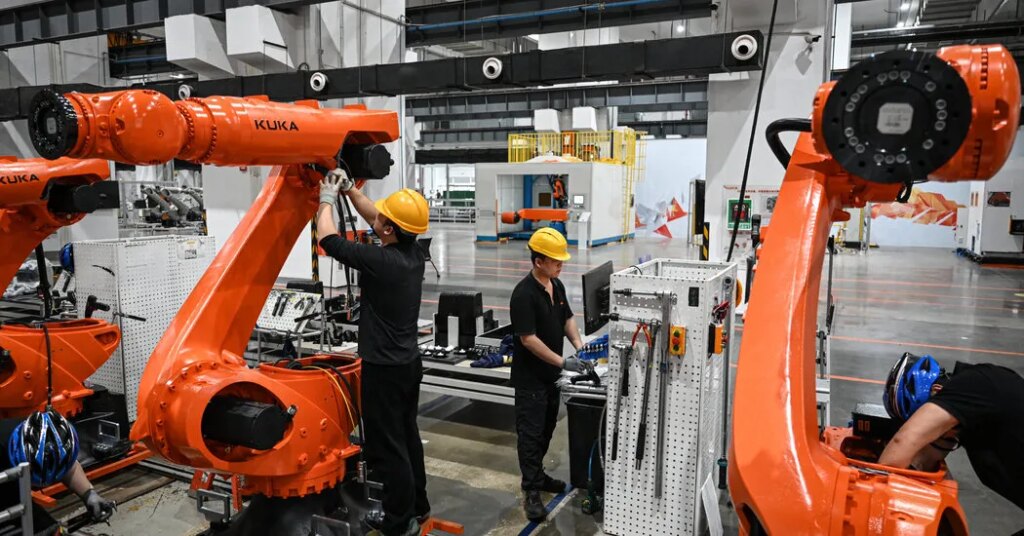
Once a symbol of German industrial innovation, the robot maker Kuka is now a source of regret.
A decade ago, European regulators gave a Chinese appliance manufacturer, Midea, the green light to acquire Kuka, one of Germany’s leading robotics companies. Today Germany is failing to keep pace in the global race to deploy factory robots, which have been crucial to China’s transformation into the world’s manufacturing powerhouse. The number of robot installations in German factories is forecast to fall for the third straight year, while China’s rollout intensifies, according to the International Federation of Robotics, a trade group.
The widening gap exemplifies the growing economic threat that China poses to Germany and Europe as a whole.
A flood of low-cost cars, chemicals and machinery from China has hollowed out Europe’s factories, contributing to the loss of about 14,000 industrial jobs a month in Germany and fueling calls for tougher trade measures on Beijing. The European Union’s trade deficit with China is tolling at 1 billion euros ($1.1 billion) a day, its largest ever.
China’s push into robotics and artificial intelligence is adding to the pressure.
China’s robotics sector “has accelerated incredibly rapidly,” said Rebecca Arcesati, a technology and innovation policy specialist at the Mercator Institute for China Studies in Brussels. “We hear from European firms in this space that they are quite concerned about the growing competition.”
Since calling for a robot revolution in 2014, China has embarked on an ambitious campaign to disrupt manufacturing and dominate the field. Today, almost half of the five million robots working in factories worldwide are in China, the trade group estimated in a report released on Thursday.
One worry is that China’s bets on those technologies could further strengthen its manufacturing sector, accelerating the trade imbalance between China and the European Union, Ms. Arcesati said. As Ursula von der Leyen, the president of the European Commission, said in a speech last week, the trade deficit has already reached a “tipping point.”
Although China still relies on high-end components from European and Japanese companies and A.I. chips from Nvidia, the country is becoming more self-sufficient, Ms. Arcesati said. Homegrown suppliers made up more than half of China’s domestic installations, compared with one-third a decade earlier, the trade group said.
“Looking back it was all about getting a higher share of the domestic market,” said Susanne Bieller, general secretary of the robotics federation. “The next strategy is basically to expand in other markets — for instance, exporting Chinese robots to Europe.”
Last year, China accounted for almost three out of five robots deployed globally, boosting installations to more than 350,000. Installations in Germany declined to about 25,000, with another decrease expected this year. A decade ago, China’s installations outnumbered Germany’s by 3 to 1. Today, it’s 14 to 1.
“If you look at the last 10 years or so, it’s impressive,” said Arnaud Robert, the president of Hexagon Robotics, a Zurich-based company working on a pilot project with BMW, the German automaker, at one of its plants in Leipzig. “What they’ve done remarkably well is scale, which hasn’t been done anywhere else.”
Still, he said, Europe has technological prowess that the region can build on in the shift to A.I.-powered robotics. BMW and Hexagon plan to move humanoid robots into production in Leipzig by the first quarter of next year, before expanding to other plants, Mr. Robert said. By another measure, Germany ranked third in the world, behind South Korea and Singapore, with about 450 robots for every 10,000 employees in 2024.
Pavlo Zvenyhorodskyi, a senior research analyst at the Carnegie Endowment for International Peace, said Europe should take concrete steps, including improving the industry’s access to private capital, to maintain its edge in hardware, including components such as actuators that enable robots to move.
“The stakes are huge,” Mr. Zvenyhorodskyi said. “We’re talking about the technologies of the future. This is a test of whether Europe can remain relevant in this emerging global race.”
The United States, which added more than 38,000 robots last year, is also scrambling to respond to increased Chinese competition. Citing national security concerns, the Federal Communications Commission in July announced a ban on the import of new models of foreign-made humanoid robots.
For the first time, the robotics federation released data on humanoid robots, which are still largely experimental. The organization estimated that 7,000 “full-size” humanoids — those at least 1.4 meters tall, or 4-foot-6 — were sold globally. More than half of the manufacturers of those machines are in China.
Spurred by state support, China could outpace Europe in combining A.I. and robotics, just as it did in the development of electric vehicles, according to Mercator research. The country’s huge manufacturing base provides the “perfect test bed” for the next generation of robotics, Ms. Arcesati said.
Still, China faces hurdles as its economy becomes increasingly driven by manufacturing amid a shrinking population and aging work force. Humanoids are far from becoming fully autonomous machines that can perceive and respond in real time in the physical world, and China’s costs, already lower than those of Western competitors, would need to fall by at least half for humanoid robots to be commercially viable, Mercator found.
“This is still an open game,” Ms. Bieller said, adding that countries including Germany must have coordinated strategies to compete. “Europe has an opportunity to succeed.”
The 2016 sale of Kuka, which remains part of Midea and recorded €3.9 billion in sales last year, is among dozens of “big regret” transactions in the United States and Europe that would have little chance of getting past national security filters today, according to a report last year from the Rhodium Group, a research firm. Just seven years earlier, Germany had been leading China in robot installations.
Instead of helping to bolster European sovereignty, Kuka’s technology and patents “now directly fuel the rise of Chinese industry,” researchers at the Jacques Delors Institute wrote this year.
Today Germany and Europe are determined to hang on to their innovation and seize the potential in A.I. and robotics while they still see a window of opportunity.
“There’s a fundamental recognition that was not there 10 years ago,” said Mr. Robert of Hexagon. “China is in a very different place now than it was. We’re not seeing complacency anymore. We’re seeing a sense of urgency.”
The post In a Race With China, German Robots Are Outnumbered 14 to 1 appeared first on New York Times.