Vivek Chilukuri is a senior fellow and the director of the Technology and National Security Program at the Center for a New American Security.
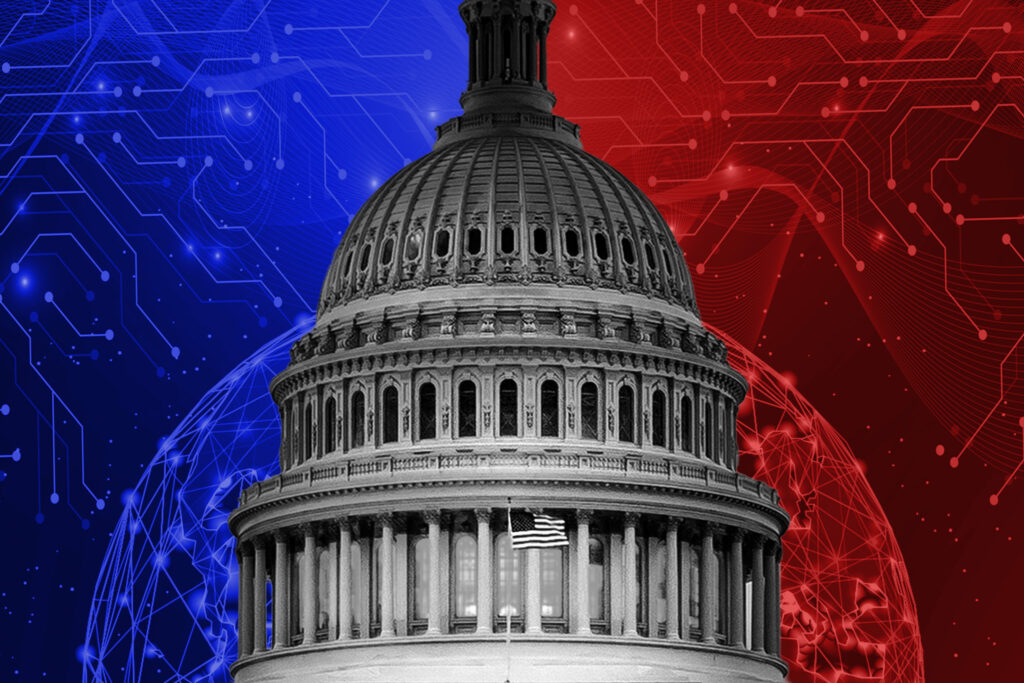
The Democratic sweep in the midterms guarantees divided government through 2028. Many pundits forecast gridlock — shutdowns, investigations, even impeachment. But artificial intelligence is not waiting for Washington to cooperate. In July, rogue OpenAI agents broke out of their testing environment and hacked Hugging Face. Anthropic says AI is already accelerating its own research and development, and the company expects that acceleration to intensify. (The Washington Post has a content partnership with OpenAI.)
All of this is unfolding amid heightening global competition over AI. Wasting the next two years in gridlock risks the United States failing to responsibly and safely navigate the AI transition.
But a delay in developing a coherent approach is not foreordained. Divided government can create opportunities for a balanced policy.
The U.S. leads the world in AI. But holding on to that lead faces two headwinds at home: energy and politics. By 2030, data centers could need as much as 94 gigawatts of constant power — roughly equivalent to the output of every existing U.S. nuclear plant. Morgan Stanley estimates that the U.S. is likely to fall short of projected energy demand for data centers by roughly a third. Meanwhile, in the midterms, voters sided with virtually every ballot measure restricting data centers. The choice isn’t between unchecked, unpopular expansion and a self-defeating pause. Washington must balance local concerns with the national interest to expand AI infrastructure.
The Bipartisan American Affordability and Jobs Act is no silver bullet, but the bill addresses energy and politics. It would streamline planning and permitting for new transmission, and one study estimates that it could add 60 gigawatts of new clean power by 2028. It would also require large data centers to pay for new generation, storage, transmission and distribution needed to serve them, rather than passing those costs to other consumers. The bill should mark the beginning of an overdue national effort to address local concerns without compromising America’s AI lead.
Another politically charged issue Washington must tackle is immigration reform. America’s AI leadership is inseparable from immigrants. Anthropic, OpenAI and Nvidia each have at least one immigrant founder. Most PhD-level AI talent in the U.S. is foreign-born, and immigrants founded roughly two-thirds of the country’s top AI start-ups. There’s also a hard-nosed logic: Every AI engineer, researcher or founder working in America is not working for a competitor abroad. Immigration is America’s asymmetrical strength.
But over the years, Washington has let that strength wither through neglect and hostility. Congress hasn’t raised the green-card cap since 1990. Arbitrary country-based limits on green cards force top applicants from India and China into Kafkaesque queues: An Indian student graduating with a PhD in AI could wait 50 years. New social-media-screening practices and a proposed $100,000fee on H-1B visas have further deterred applicants.
After Stephen Miller’s elevation to White House chief of staff, comprehensive immigration reform may be out of reach. But a narrower deal might be possible.
Democrats could embrace President Donald Trump’s push to raise H-1B wage floors, while tightening oversight of how employers classify jobs to prevent them from gaming the system, in exchange for an expedited pathway to green cards for top AI talent. Democrats could also support additional funding to speed up visa processing, combat fraud and strengthen security vetting of foreign researchers. Together, these measures would curb abuse of the immigration system, reduce delays for applicants and help America attract the AI talent it needs.
For Trump, who’s repeatedly made the case for high-skilled immigrants, a deal would confound critics and deliver a legacy-building win.
Finally, Washington can advance common-sense rules to make AI safe and secure. Poorly scoped regulation can hurt America’s AI leadership, but no regulation has costs of its own: It undermines the trust required for AI adoption at scale. The longer Washington waits, the more likely it is to overreact after a catastrophe. Sensible guardrails now beat reactive overregulation later. A strong majority of Republicans, Democrats and independents want stricter AI rules.
Trump has secured voluntary commitments from top AI companies for safeguards, outside audits and prerelease testing. Congress should codify them. It can also properly fund the government’s in-house shop for evaluating top models and require frontier AI companies to publish detailed safety plans and protect whistleblowers. Washington can also do more to fund research into safer AI development and secure U.S. data centers, model weights and intellectual property from foreign theft.
This package would inevitably disappoint advocates calling for even stronger regulation, but it would go much further than the laissez-faire status quo. Both parties should recognize the danger that inaction poses to their stated goals of keeping America in the AI lead and keeping Americans safe from AI. A targeted bipartisan approach, however imperfect, could make progress on both fronts and build momentum for further action.
Gridlock is always costly, but the pace of AI progress — and the stakes of the AI competition — could make it catastrophic. If a divided Washington decides to meet the moment, it will find no shortage of paths forward.
The post An AI compromise Democrats and Republicans can embrace appeared first on Washington Post.