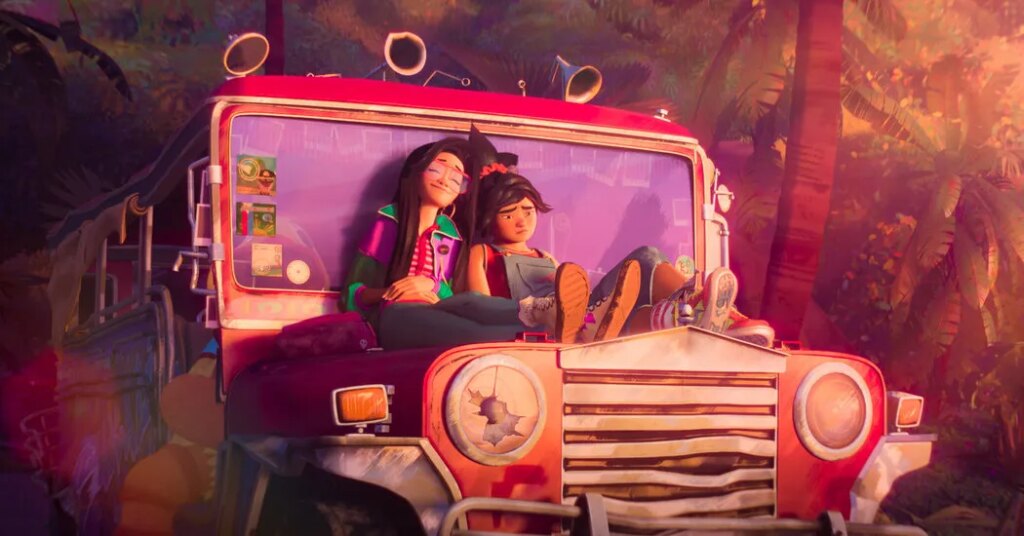
When Jo and Raissa, the best friends at the heart of “Forgotten Island,” describe the mythical island of Nakalimutan (Nakali for short), it’s absolutely enthralling. The island’s a vibrant wonderland populated with aswang, the supernatural creatures of all shapes, sizes and temperaments in Filipino folklore. But it’s the very richness of this world that works against the film: The wonders of Nakali and its inhabitants make the movie’s actual story pale in comparison.
Jo (voiced by H.E.R.) is confident, a bit reckless and chaotic, but in the most charming way. She’s been raised by her grandmother, who told her tales about Nakali, and it’s these stories that bond her with the more reserved, nerdy Raissa (Liza Soberano) as 1990s kids growing up in the Philippines. But when a teenage Raissa decides to go the United States for college, the friends have to confront the reality that their paths may soon diverge.
On their last night together, they discover a portal that transports them to Nakali. When they wake up with no memory of what transpired the night before and no idea of how to get back home, they spend the rest of the movie trying to retrace their steps.
Memory is of course the central theme of the film, which was written and directed by Joel Crawford and Januel P. Mercado. But the movie shortchanges itself by relying too heavily on its “Hangover”-style, “What did we do last night?” conceit, which offers obvious plot tension and some cute comic opportunities. (What’s with the new tattoos and Raissa’s creepy demon wings?) But we don’t get the novelty of witnessing these characters be their wildest, most exploratory selves while encountering the place of their childhood fantasies for the first time.
Also sacrificed is the development of the other fun characters — a puka-shell-necklace-wearing weredog bro (Dave Franco), a tiny monarch named King Truffle Wuffle (Ronny Chieng) and an oversized demon baby (Manny Jacinto), among others — some of whom become part of Jo and Raissa’s adopted island crew. The film feels like it’s bursting at the seams with these fanciful figures, voiced by a delightful supporting cast.
Each appearance feels abbreviated, as though this gang of colorful characters needs more space to expand beyond the feature film format, like a TV series. This is especially the case for the Dreaded Manananggal (Lea Salonga), a terrifying vampire creature from Filipino folklore who can detach her upper body from her lower half. Her design is the most impressive feat in the film; technically, her movements show off complex animation rigging work, and visually, she’s an exquisite fright to behold. Her dark silhouette casts a shadow on the bright, lively world of Nakali.
The island is, after all, a special sight all on its own: It bursts to life with neon shades as though this ancient mythical locale were also home to an everlasting rave. Thousands of brilliant, detailed plants help create the dense, textured backgrounds, and the details of the stalls and vendors at a Nakali street market, inspired by local convenience stores, also help build a world lovingly inspired by the Philippines.
The movie also has fun playing with character designs, including the girls’ funky ’90s looks, and a variety of animated styles; flashbacks are rendered differently according to a character’s personality, and anime-style sequences inspired by shows like “Dragon Ball Z” add in an extra dimension of humor for audiences in the know.
By the movie’s third act, the logic behind some of the memory-bending gets hazy. And even after a heartwarming resolution, the film still feels like it’s missing out on a deeper exploration of cultural memory, on how these myths connect not just these two friends but a whole community and what this all may mean to Raissa, a soon-to-be expat.
“Tayo na,” the girls say to each other throughout the movie. The phrase, which translates to “let’s go” in Tagalog, is an embrace and an invitation. It indicates that these friends are bonded in their journey together, but also that they are part of a larger set of cultural traditions and history. When the girls say “tayo na,” it feels like it’s as much a call to the audience as to each other. But while “Forgotten Island” introduces a beautiful world of myth and adventure, it doesn’t go quite far enough to develop the relationships that keep it alive.
Forgotten Island Rated PG. Running time: 1 hour 49 minutes. In theaters.
The post ‘Forgotten Island’ Review: A Supernatural Filipino Adventure appeared first on New York Times.