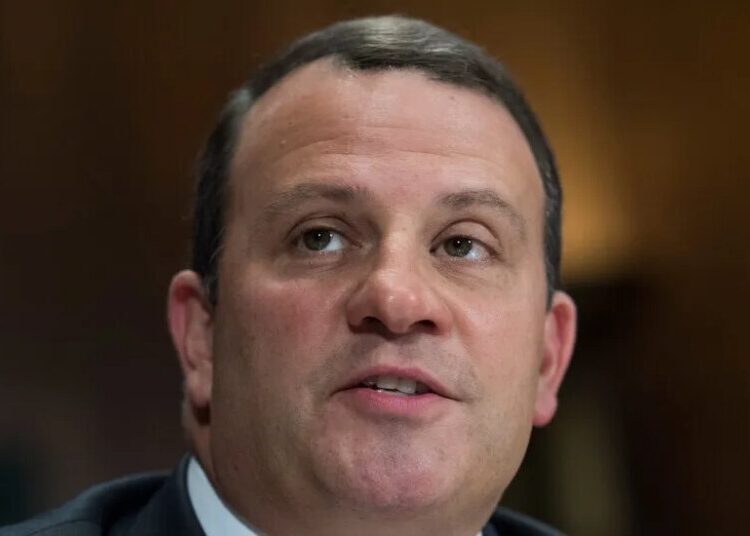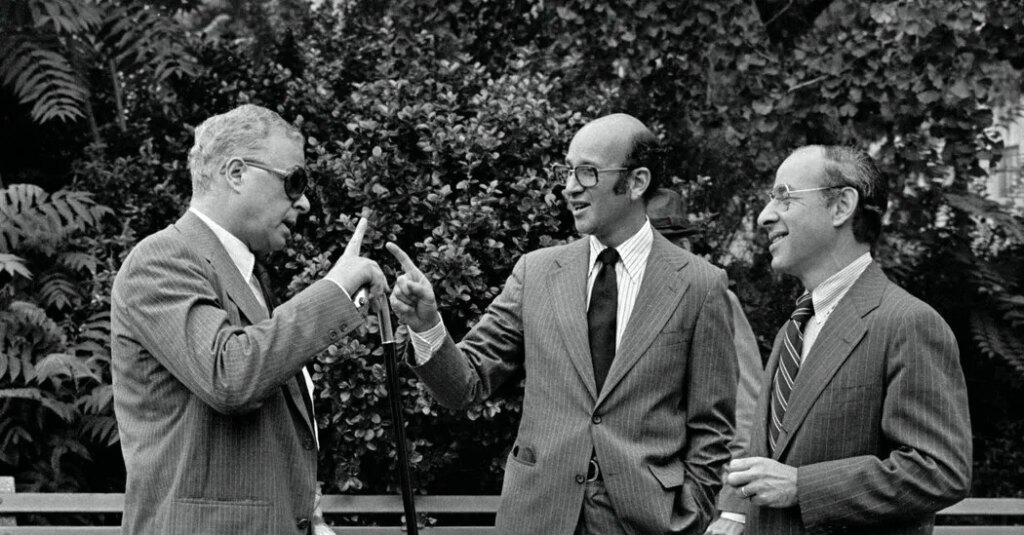
Edward H. Lehner, a New York lawyer, legislator and judge who, as a state assemblyman in the 1970s, helped pass a groundbreaking “pooper-scooper” law — garnering public support in part by showing random dog-walking pedestrians how to pick up excrement using a disposable plastic bag affixed to a pole — died on Sept. 9 in Brooklyn. He was 93.
His death, at an assisted living facility, was confirmed by his family, who said that he had been suffering from head and neck cancer.
Before the passage of Public Health Law 1310, as it was officially known, New York City was a minefield of dog dirt. On the sidewalks, in the streets, around the parks — negotiating the city was a harrowing exercise in feces avoidance. Or not. Sometimes, Justice Lehner said in a 2015 oral history interview for the New York Public Library, “you would come home and have it all over you.”
City officials had tried various creative ways of tackling the problem. But proposals like requiring dogs to go the bathroom only in their owners’ homes or yards, or mandating that they use sewer drains as toilets, understandably fell by the wayside.
The biggest obstacle was hostile pet owners, who argued that it would be physically challenging to hold onto a dog while simultaneously collecting its waste. They also complained that they would be “humiliated by being forced to pick up excrement from the gutter,” a spokesman for the New York Dog Owners’ Guild said of one proposal. A law mandating cleanup, the group predicted, would cause thousands of dog owners to abandon their pets on the city’s streets, flooding animal shelters.
But the idea gathered steam in Albany, and the pooper-scooper bill was introduced in 1977 — by Mr. Lehner (pronounced LAY-ner) in the Assembly and by State Senator Franz S. Leichter in the Senate. It required people in cities with more than 400,000 residents to pick up after their dogs or risk a fine of up to $100.
Explaining the two legislators’ interest in the subject, G. Oliver Koppell, a lifelong friend of Justice Lehner’s, said that it arose from their execrable personal experiences as New York City pedestrians. “They were assaulted by dog doo on a regular basis,” Mr. Koppell, a lawyer and a former New York State attorney general, said in an interview.
The bill became law in 1978, inspiring other cities and states to follow suit, helping “the broader campaign of urban renewal, and convincing people, and corporations, to move back to the city,” Michael Brandow, the author of “New York’s Poop Scoop Law: Dogs, the Dirt and Due Process,” said in an email.
While anyone who lives in the five boroughs knows that it not universally obeyed, there is little doubt that it has changed the city for good. Henry J. Stern, the parks commissioner in the 1980s and 1990s, called it “one of the best things that ever happened to New York City parks.”
Edward Harvey Lehner was born in Far Rockaway, Queens, on March 6, 1933. His father, Irving Lehner, was the manager of a health club in Midtown Manhattan.
A lifelong resident of Washington Heights, Edward attended the Bronx High School of Science; graduated from the City College of New York in 1954 with a degree in business administration; and earned his law degree from the New York University School of Law in 1957.
Active in Democratic politics and an opponent of the Vietnam War, he was elected to the State Assembly in 1970, representing Washington Heights and parts of Inwood, after more than a decade in private practice as a lawyer.
In the Assembly, Mr. Lehner served as chairman of the housing committee and was a champion of tenants’ rights. One law that he sponsored, which is still on the books, protected consumers and residential tenants from “small print” — contract provisions that were illegible, unclear or written in print that was prohibitively minuscule.
But the pooper-scooper law was his signature achievement, born of his daily experience of negotiating piles of dog dirt across the street from his house. He was aware that there was a comedic element to the issue. In his effort to sway skeptics, he took to bringing a poop-scooping device he called the Dogmatic — described by The New York Daily News as a “rod about three feet long with a disposable plastic bag at the end which snaps closed over the poop” — into the Assembly chamber to illustrate its ease of operation.
Wielding the device on a walkabout near Fort Tryon Park in 1977, Mr. Lehner attempted to demonstrate his scooping technique to the owner of Thunder, a 60-pound dog who “did a no-no poop on New York City pavement,” The Daily News reported.
While the device performed well enough when he tested it on a “crumpled-up ball of tissue paper,” the paper said, it faltered when confronted with a fresh pile of real poop. The article, headlined “The Real Poop Sends Him for a Loop,” went on to report that “it took him three tries to scoop up the whole mess.”
The bill faced headwinds in the legislature: opposition from dog owners’ groups; questions in the Assembly about what dog-walking Orthodox Jews were meant to do on Shabbat, for instance, and how to handle unexpected canine diarrhea situations.
There were also questions about enforcement.
“The purpose of this bill is laudable, i.e., to require each pet owner to take care of his own,” the future Gov. Mario M. Cuomo, then New York’s secretary of state, wrote in a memo outlining his department’s view of the bill. But not only would an officer have to catch “a dog and his owner in flagrante delicto” to enforce the law, he added, there was also the “sticky problem” of proving that “a particular piece of evidence emanated from a particular aperture.”
Mr. Lehner and Mr. Leichter “endured a great deal of mockery” in the legislature for their anti-excrement zeal, Mr. Brandow, the poop-scoop law expert, said.
“Upstate legislators were unable to understand why these two city snobs thought canine waste was such a big issue in New York City, or why they were being subjected to this absurd display,” he said.
Gov. Hugh L. Carey signed the bill in 1978, although “he made a joke of it,” Justice Lehner recalled in 2015.
But in New York City, Edward I. Koch, then the mayor, declared that “cleaning up after your pet is no longer a courtesy — it’s the law,” and directed city agencies to enforce it.
“This is serious business,” Maureen R. Connelly, a spokesman for Mr. Koch, told The New York Times.
Mr. Lehner left the Assembly in 1980 to become a judge — first in New York City Civil Court and then on the State Supreme Court. His significant rulings included rejecting the efforts of Donald Trump, then a mere real estate developer, to seize control of the Empire State Building in 1999 and denying a home buyer’s claim that he should have been informed, before making a down payment, that the house he was purchasing was infested with poltergeists. (The decision was famously overturned when an appellate court ruled that “as a matter of law, the house is haunted.”)
Justice Lehner is survived by his wife, Lois Naftulin; two daughters, Ivy Lehner and Brynne Lehner; and two grandsons.
Looking back on his career in the 2015 interview, he said he was surprised that dog owners had not embraced the bag-on-a-pole scooper device that he had championed. (In fact, Mr. Brandow said, city dog owners seemed to prefer using “whatever they had lying around the house, including paper bags and cardboard shirt inserts from the dry cleaners.”)
But the result was the same, Justice Lehner observed: “I can honestly say I haven’t stepped in it since.”
The post Edward Lehner, Who Made Dog Owners Pick ‘It’ Up, Dies at 93 appeared first on New York Times.