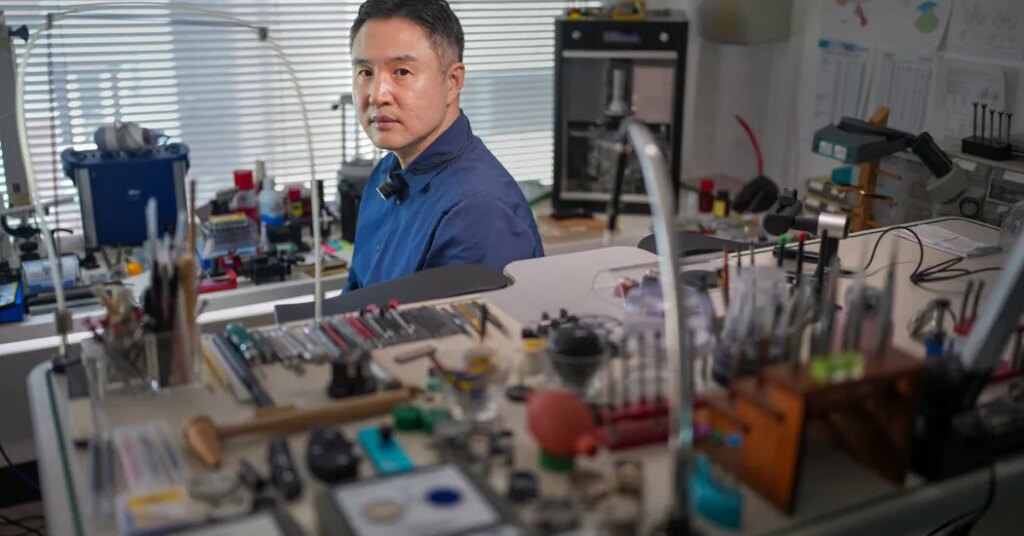
Hunched over a desk covered in tiny metal tools at his studio in southeastern Seoul, Hanmoi Kim examined a wristwatch with deep concentration. “The biggest challenge is learning to adjust a hairspring without deforming it,” he said, his face obscured by a pair of magnifying eyeglasses. “It’s thinner than a human hair.”
The owner of Moi Watch, a watch repair academy and workshop in Seoul, Mr. Kim, 47, is used to spending endless hours tinkering with nearly microscopic parts for mechanical watches. But the challenge, he said, is balancing an endless backlog of repair and authentication requests from clients around the world, attending overseas auctions to buy and to sell timepieces, making his own watches and teaching the next generation of wristwatch technicians and artisans — a dire need in an industry that has long struggled with a shortage of expertise.
“It takes months to get your first hairspring repair right, and my students sometimes get frustrated,” Mr. Kim said. “But when they finally manage to do it themselves, the sense of accomplishment they feel is one of my greatest joys as a teacher.”
Mr. Kim is one of just a handful of luxury watch repairmen left in Seoul, and his studio is one of only two remaining in South Korea, he said, that regularly teach the art of watch repair — basics that the academy says takes about three years to cover in a craft that takes at least a decade to master.
In 2009, he began teaching the art of watch repair to adult students, and formally established his academy in 2016. He now accepts one to three students at a time, who enroll in three-month training sessions, using a curriculum that he developed.
Over the years, he said, students have come from a wide range of countries, including China, the United States, France and Uzbekistan. Some, he said, come in search of a hobby, but the majority are in their 20s and 30s and want to learn a trade that will offer secure employment.
”Our most experienced technicians are getting older, and the industry’s infrastructure is gradually shrinking as a result,” Mr. Kim said. “Developing a new generation of watchmakers who meet international standards has become the industry’s challenge as a whole. And personally, I find it very challenging.”
A Lingering Shortage
For at least two decades, experts around the world have sounded the alarm over the dwindling ranks of timepiece technicians. Fewer than 4,000 watchmakers — the industry uses the term for both makers and repair specialists — are believed to be left in the United States, according to the American Watchmakers-Clockmakers Institute. It said that has been a decrease of about 90 percent since the 1960s.
In Britain, the number of professional clock and watch makers has dwindled to an estimated 1,500 people compared to about 6,000 more than a century ago, according to Colin Andrews, chairman of the British Watch and Clock Makers’ Guild.
”There is a shortage and has been for decades,” he wrote in an email, referring to the industry globally. The turning point was the 1970s, he said, when cheap quartz watches and clocks flooded the market and quickly dominated sales. Very quickly, that reduced the need for mechanical watch repairs, leading to fewer job opportunities for expert timepiece technicians and fewer training centers around the world.
The luxury watch industry took off again in the early 2000s, but “the whole industry has been very slow to react to the lack of skills available” since then, Mr. Andrews wrote.
“Action must be taken now,” he wrote, so that “skills that have been passed down and honed over hundreds of years are not lost completely.”
In South Korea, the only university degree program that covered watchmaking and repair was discontinued several years ago, according to Mr. Kim.
The shortage of qualified technicians has led to yearslong repair backlogs for some highly-sought-after brands, all while luxury watch manufacturers produce tens of thousands of new pieces annually.
Some brands are trying to address the situation. In 2023, for example, Rolex opened a training center in Dallas that offered free tuition to an 18-month program as well as a living stipend to successful applicants. Among other brands, Swatch has schools in several countries; Richemont, which owns brands such as Jaeger-LeCoultre and Vacheron Constantin, has several academies and partners with training institutions; and Patek Philippe has its own training program.
The Art of a Good Repair
Mr. Kim managed to rise in his profession without any formal training, but he acknowledged that it took a lifetime of experimenting with timepieces to get where he is now.
“To repair a high-end watch, some say you need to have a bit of innate talent,” he said. “But if I can be honest, I think I wasn’t born with it.” He recalled the moment, as a teenager, when he first fell in love with the art of a good repair.
At 19 years old, he picked up his father’s broken wristwatch, which had been unused for several years, and tinkered with it. “I disassembled it, cleaned it, applied fresh oil and it began ticking again,” he recalled, with a smile. “It was an incredible thrill, like I had breathed life back into something. That’s what drew me in.”
It is a story that he has recounted to his students countless times. “I always tell them: ‘Make a lot of mistakes,’” Mr. Kim said. “‘You have to mess up a watch to be good at repairing it. Don’t be afraid of failure.’”
Jeon Hyeonguk, a 26-year-old university student studying classical vocal performance, remembers swelling with frustration during some of his earliest classes with Mr. Kim. He has studied at Moi Watch for nearly two years now, with ambitions to become a professional watchmaker.
“The most frustrating moment was when a tiny component about the size of a grain of salt slipped out of my tweezers and bounced onto the floor,” Mr. Jeon recalled, with a sense of humor. “I spent hours crawling around, desperately searching for it.”
Custom Work
Mr. Kim and his wife, Alicia Lim — who met in 2014 when Mrs. Lim’s Swiss employer hired Mr. Kim for a training workshop — also collaborate with local artisans to create their own luxury watches.
The Moi Bespoke Watch line, which produces about 10 custom orders a year, uses traditional Korean mother-of-pearl lacquerware and a Korean papermaking craft called hanji to form intricate dial designs.
Mr. Kim said he saved his earliest morning hours — when his mind was fresh — for the most complex repairs. ”It is true that a watch can last forever,” he said. “And those who repair watches know that there’s a unique sense of fulfillment in bringing a watch back to life. It holds someone’s precious memories and years of personal history.”
While giving a tour of their academy and studio, the couple proudly pointed to a traditional Minhwa folk painting by Mrs. Lim. It depicted a tiger wearing a shining silver watch on its tail, and hangs not far from a wall of trophies and awards bearing Mr. Kim’s name.
“Sometimes, I feel very tired,” Mr. Kim said. “But then I remember I want to leave something good behind for future generations.”
The post He Is Training the Next Gen of Watch Repair Specialists appeared first on New York Times.