An explosive-laden drone at a German airport. A strike on a passenger train near the Polish border. A rush of warnings about more chaos to come.
If President Vladimir V. Putin of Russia was hoping to heap pressure on Ukraine’s closest allies, he’s succeeded with a series of provocations that Western officials have blamed on Russia and said could put citizens of NATO countries in danger.
The question is how Europe responds.
In the past week, European leaders have spoken with uncommon urgency about Russia’s shadow war. Prime Minister Donald Tusk of Poland, citing unspecified intelligence, said Moscow may be planning attacks in Europe. “No one is safe,” President Emmanuel Macron of France cautioned. The British prime minister, Andy Burnham, told the U.N. General Assembly that his country faced an “industrial-scale assault” in terms of information warfare.
Their theory is that Mr. Putin, bogged down on the battlefield, is stepping up attacks on Ukraine’s supporters, hoping to sow fear and panic and, ultimately, weaken their support for Kyiv.
It won’t work, says the NATO secretary, Mark Rutte. “Russia wants us to stop helping Ukraine,” he said in a recent address. “Their actions will only lead us to do more for Ukraine.”
For years, officials and experts have accused Mr. Putin of targeting Europe with hybrid attacks — hostile actions that are designed to evade culpability, and that generally stop just short of inflicting enough damage to trigger a forceful response. What has changed, according to Charlie Edwards, a former British intelligence official now at the International Institute for Strategic Studies, is the “potential lethality and operational ambition of Russian sabotage operations.”
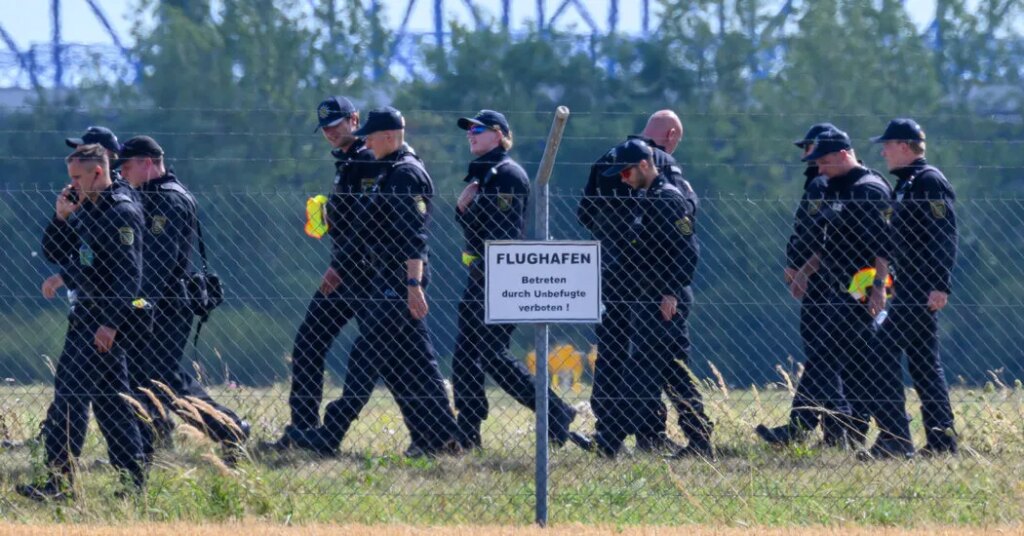
German investigators this month concluded that Russian operatives sent a drone equipped with military-grade explosives to Leipzig/Halle Airport in eastern Germany over the summer. Had the drone exploded, officials said, it would have caused significant damage and possibly killed people.
Earlier this month, a Russian drone smashed into a passenger train in western Ukraine, perilously close to the Polish border, as foreign visitors were leaving a diplomatic conference in Kyiv. It was widely seen as a warning to Ukraine’s allies.
“We have to be prepared more, and we have to understand that this activity is now becoming almost ever-present,” the European Union’s top military adviser, Gen. Sean Clancy of Ireland, said in an interview.
On Wednesday, President Volodymyr Zelensky of Ukraine warned that Russia’s war would continue to spread unless allies responded. “The more freedom Putin has to act, the more dangerous the world becomes for everyone else,” he said in a speech in New York.
The Kremlin has consistently denied involvement in hybrid activities. Russia’s foreign minister, Sergey V. Lavrov, has pointed instead to what he calls Western “large-scale political, economic, and coercive measures, including sanctions.”
“This is the hybrid war,” he said in a recent speech.
What’s driving Russia?
Western security officials say they have seen no sign of Russia preparing for a conventional war with NATO. Rather, officials say, Mr. Putin and his overstretched forces are looking for ways to undermine Kyiv and its allies.
“Russia doesn’t have the capacity to challenge NATO” right now, Baiba Braze, the minister of foreign affairs for Latvia, said in an interview in Riga.
“They cannot move the front,” she said. “They are not gaining territory.”
What Moscow can do, though, is continue to pursue relatively low-cost hybrid attacks.
That has included sending drones into NATO territory to surveil military bases and disrupt commercial air traffic, jamming navigation systems of passenger planes, and hacking into energy grids and dams. Last week alone, a Russian warship fired flares at a Danish helicopter over international waters, and a NATO fighter jet shot down a drone that had likely entered Lithuanian airspace from Belarus, a Russian ally.
“An attack will occur at the point when political intent, military readiness, and strategically favorable timing come together to allow it to happen,” Germany’s deputy defense minister, Nils Schmid, said last week.
“Our task — Europe’s task — is to make such a perceived favorable timing permanently impossible for Moscow,” he said.A challenge for Europe is that the United States seems less inclined to take a hard line on Russia. The Trump administration has even invited Mr. Putin to attend a Group of 20 summit in Miami in December.
What can Europe do?
European nations have spent the years since the full-scale invasion of Ukraine trying to stop Russia by issuing economic sanctions, freezing financial assets, expelling diplomats and naming-and-shaming Moscow for attacks. Yet Russia appears undaunted.
“The discussion has been if deterrence works when it comes to hybrid operations, and I would say, not well enough,” the Swedish defense minister, Pal Jonson, said in a recent interview.
The top E.U. diplomat, Kaja Kallas, is urging leaders to more aggressively pursue those penalties and, potentially, reduce the number of Russian tourists allowed into European nations. She also called last week for bolstering protections against Russian disinformation and recruitment.
Some security experts are pushing NATO to consider creating a new level of alliance-wide response to hybrid attacks. But the idea is in its early stages and remains theoretical for now.
Many European officials argue that continuing to send military support to Ukraine is the best way to keep Russia at bay. Just days after the train strike near its border, Poland pledged to send Ukraine additional Patriot interceptors — they are in scarce supply worldwide — to help defend against Russian ballistic missiles.
“This is the message: Regardless of your actions, Russia, we will support Ukraine even more,” Lt. Gen. Krzysztof Krol, assistant to the chief of staff of Poland’s armed forces, said in an interview.
Moscow is changing its tactics, he said, “sharpening their activities” to keep Europe off-balance.
After days of urgent warnings, European officials now seem eager to project steadiness.
“Russia is facing big difficulties when it comes to Ukraine, big difficulties, and we have to stay calm,” Mr. Rutte said Wednesday. “We also have to carry on.”
Mr. Macron said Europe must resist the urge to overreact. “Deterrence should remain discreet,” he said. “We must not show our hands.”
Adam Goldman contributed reporting from Riga, Latvia, and Michael Schwirtz from London.
The post As Russia Steps Up Shadow War, Europeans Waver on How to Respond appeared first on New York Times.