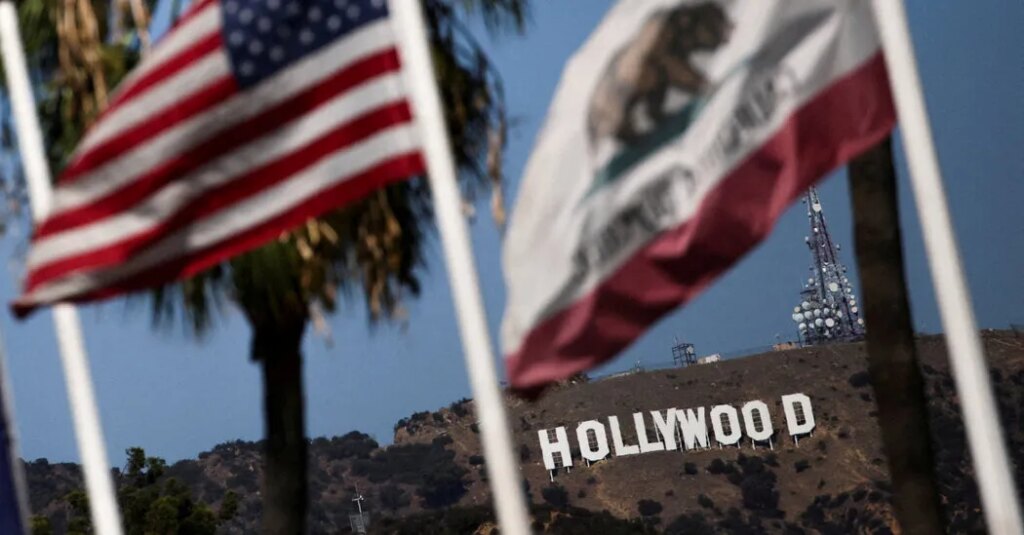
Hollywood has felt a little like a horror movie in recent years. As more and more filming has migrated overseas and production in the United States has plummeted, tens of thousands of workers have lost their jobs, plunging the industry into a state of despair.
On Thursday, the movie and television industry is expected to get its first glimpse of a potential lifeline: Lawmakers in Washington plan to introduce legislation, which The New York Times has reviewed, that would create the nation’s first federal tax credits for film and television production.
The bill provides a tax credit of at least 20 percent on the wages of the vast array of workers who create movies and TV shows. That includes actors and directors as well as camera operators and makeup artists.
Though such a program — which would amplify the subsidies offered by most states — has drawn bipartisan support and the public backing of President Trump, passage of the bill is far from assured as the midterms loom.
The proposal faces formidable obstacles in a divided Congress that has struggled to agree on any major policy changes and where tax legislation is particularly contentious. Lawmakers rarely agree to pass a tax break for an individual industry without seeking to pair it with a host of incentives for other interests, and the chances of such a package coming together are murky at best.
But the bill’s mere introduction is the culmination of a decades-long effort to address a crisis in Hollywood that has become even clearer since the coronavirus pandemic: Most major movies are not being made in America.
“We are going to lose the primacy of entertainment production if we don’t do this,” Sean Astin, the president of the actors’ union SAG-AFTRA, said last week during a conference call about the push for tax credit legislation.
At least three dozen states already offer tax incentives. A 2024 analysis by The Times found that states had distributed more than $25 billion through their programs, which essentially refund a portion — often 20 percent to 30 percent — of qualifying production costs. Those costs often include more than wages, the focus of the federal incentive.
But studios are filming less frequently in Los Angeles and Atlanta, traveling instead to cities like Vancouver, London and Bucharest because they are in countries with even larger tax incentives. In many of those locations, the cost of labor is also considerably cheaper.
Some recent studies estimate that as much as 60 percent of live-action filming is now done outside the United States. “Resident Evil,” the horror comedy by Zach Cregger, was filmed in the Czech Republic; Ridley Scott’s “The Dog Stars” was set in Colorado but filmed in Italy.
That runaway production, as it is known, has had a profound impact on Hollywood. By some estimates, production in Los Angeles has been down by a third over the past decade, which has left thousands of industry workers without jobs or severely underemployed.
The legislation that is expected to be unveiled on Thursday provides a federal tax credit for the cost of labor on feature films, television pilots or television seasons if it exceeds $1 million, according to the bill reviewed by The Times. It includes a similar incentive for visual effects and postproduction work.
At least three-quarters of the work must occur in the United States for a project to qualify for funding via the bill, known as the Motion Picture, Television and Entertainment Revitalization Act.
There is no cap on the funding, and it is unclear how much a federal program would cost. At the state level, California allocates $750 million annually in incentives, while the uncapped program in Georgia cost more than $5 billion between 2015 and 2022.
The federal tax credit is stackable atop state incentives. Productions can also qualify for additional funding, known as uplifts, if they film in certain rural or disaster areas, produce projects in 10 or more states or take certain steps to increase domestic filming. Independent films will also qualify for an uplift.
In total, the federal legislation allows for up to a 30 percent transferable credit. When stacked atop a state incentive, a studio could get about half of its qualifying costs covered.
Many moviemakers say that would level the playing field enough to make filming in the United States a realistic option again.
“It doesn’t need to be the best incentive. It doesn’t need to be the cheapest place to shoot,” said Scott Karol, who has worked closely with the actor Jon Voight to get Mr. Trump to endorse a federal film tax credit.
“We just need to be competitive,” added Mr. Karol, the president of SP Media Group. “Everybody wants to make movies here.”
The politicians and labor leaders supporting the legislation have framed it as a jobs bill and not, as detractors call it, a handout to Hollywood. Campaigns for similar programs have found success in both red and blue states using largely the same argument.
Leaders of the unions that represent hundreds of thousands of crew members, actors, directors and more have exuded a sort of relentless optimism about the legislation. But there are myriad political and logistical hurdles some have acknowledged more quietly.
It is unlikely anyone would act on the bill until after the midterm elections in November. And if Democrats take control of the House, it is unclear whether tax breaks for Hollywood would remain a priority for the president.
Some lawmakers may balk at a program that is likely to disproportionately benefit states with more generous incentives already in place. Fiscal conservatives could resist legislation that further deepens the federal deficit.
Proponents of the bill are pressing to fold it into a year-end spending measure Congress is expected to consider after the November elections to fund the government through the start of the new Congress in January. But inserting tax changes into such bills can be tricky, and would require a broader agreement by leaders in both parties.
In the Senate, the bill is being sponsored by Senators Tim Scott, Republican of South Carolina, and Adam B. Schiff, Democrat of California, who represented Hollywood when he was a member of the House.
A companion bill in the House is being sponsored by members of the Ways and Means Committee on different sides of the aisle: Representatives Nathaniel Moran, Republican of Texas, and Linda T. Sánchez, Democrat of California.
Representative Laura Friedman, who took over Mr. Schiff’s seat, has been a major advocate for the legislation. Also heavily involved is Representative Brian Jack, Republican of Georgia, a state with one of the nation’s most generous set of incentives.
Efforts to stem filming’s exodus from the United States date back a quarter-century or longer. After some productions began moving to Canada in the late 1990s, labor organizations led by the Directors Guild of America persuaded Congress to enact a tax incentive. But the legislation that resulted in 2004, a special accelerated tax deduction, had such a low cap and so many conditions that it had little impact. It expired at the end of last year.
In 2025, Mr. Karol, Mr. Voight and Steven Paul, Mr. Voight’s longtime manager, began meeting with Mr. Trump about ways to increase domestic film production. (The president’s proclamation that he would impose a 100 percent tariff on movies produced outside the United States never materialized.) They also met twice this year, in February and again in late August.
At the August meeting, they showed the president a study commissioned by the Motion Picture Association that extols the economic benefits of a federal film tax credit. Before the group’s time together ended, Mr. Trump had drafted a social media post about the need for an incentive. Then the scramble to write a bill began.
The post A Weary Hollywood Celebrates the Prospect of Federal Funding appeared first on New York Times.