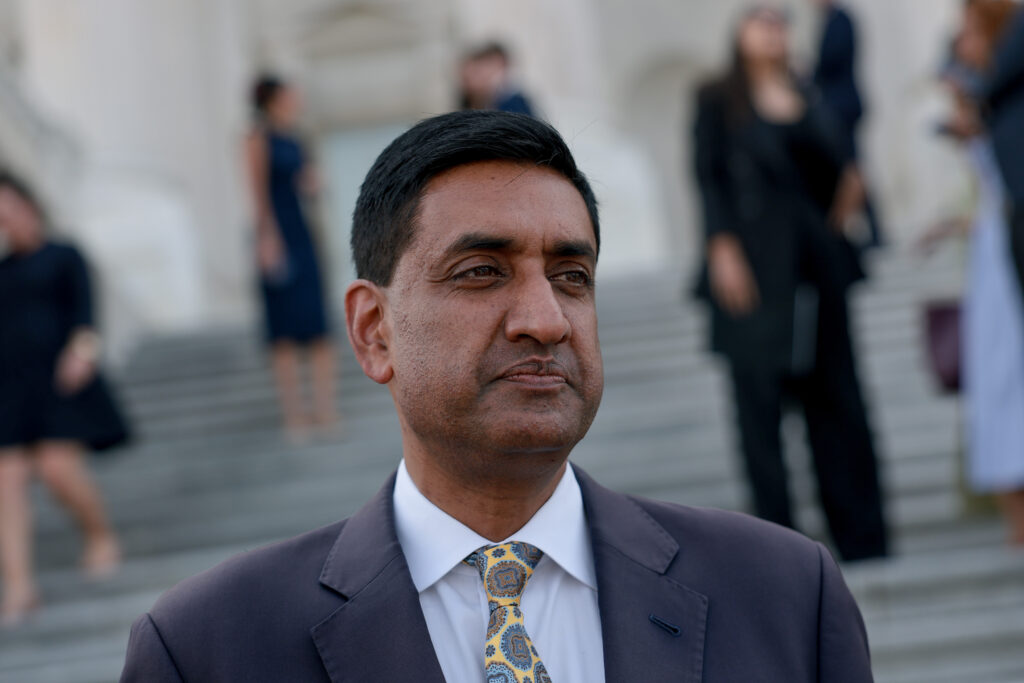
It’s easy to mistake Ro Khanna’s populism for a deep distrust of government. The congressman from California’s 17th District has dedicated much of the past two years to unearthing the government’s Jeffrey Epstein files and is now turning his energies to blocking tech lords’ greed-fueled race toward the apocalypse.
But Khanna is a happy warrior. He’s also chatty. When the congressman sat down last week at The Post to talk to me about his 2028 presidential prospects and his plan to shore up his party’s working-class support, he told me that he’ll talk to anyone, the left’s Hasan Piker and right’s Megyn Kelly being a couple of examples. “‘Are you really gonna go do this Washington Post podcast?’” he recounted a junior staff member asking him. “‘They’ve been writing editorials against you about the wealth tax!’”
Not even a judicious staffer can stop Khanna from spreading his gospel.
Khanna’s philosophy is built on a key optimism: Government is capable of solving our biggest problems. That’s an intoxicating, possibility-opening proposition, and Khanna certainly believes it applies to the issue dominating Washington right now: How do we keep killer robots from exterminating the human race?
The Silicon Valley representative tells me that reckless tech titans need more “safety and regulation that makes sure that we don’t lose control over AI.” Setting safety norms for such a volatile industry strikes me as reasonable enough. But can the government really competently govern a technology that Anthropic CEO Dario Amodei warned could hijack the entire internet in a year or so?
Khanna argues that the government has a good record of regulating the up-and-coming: “We’ve competently regulated electricity, and nuclear energy and aviation.” Aviation and power companies don’t come to mind when I think of our nation’s most efficient industries, but maybe I should take another sip of the Khanna Kool-Aid. To Khanna, the answers to the future are located in the lessons of governments past. “FDR had a New Deal for the industrial age,” he said, “I believe we need a next New Deal for the AI age.” His party, he says, should be a “New New Deal coalition.”
Khanna might add a few more “new”s. He is far from the first politician to tap into FDR nostalgia while proposing a major overhaul in social spending. The New Deal built the foundation of the modern entitlement state with the start of a relatively narrow Social Security program; the following decades saw its expansion and the rise of programs like Medicare and Medicaid.
The entitlement state exists at proportions FDR would have never imagined, in other words. But Khanna’s vision for government goes beyond caring for the sick, poor and retired millionaires. It’s time, he says, to “reindustrialize America.” We need “a plan to have an industrial investment bank that invests in these communities that were hollowed out, a thousand new trade schools, investment in child care jobs, investment in venture capital,” he preached. “A vision saying: We understand wealth generation, we know how to build wealth.”
It certainly takes a kind vision to assess the current state of federal spending and devise a plan for more. This year the national debt hit $40 trillion, and entitlements are a big reason why. But Khanna is undeterred by that dreary trajectory. One of his deficit-cutting ideas is ending “corporate profiteering” enabled by Medicare Advantage. His plan estimates that getting rid of “upcoding and fraud” would save $83 billion a year. But waste in the military is a particular fixation. “We need more accountability in government, and that to me would be cutting some of the waste in the Pentagon budget,” he said. Khanna’s deficit-reduction plan proposes ending “unnecessary weapons systems,” reducing bureaucracy and cutting excess basing infrastructure abroad.
There’s certainly bloat at the Pentagon. But defense spending has tended downward as a share of gross domestic product, while the total federal budget continues to trend upward. If the goal is to go after the most waste possible, there are bigger targets.
Khanna at least acknowledges that cutting waste alone won’t finance the reindustrialization of America — or all the other programs he’s proposing. A wealth tax, he tells me, will help fix an economy where “the rules have been written to privilege the shareholders, to privilege the executives, to privilege the capital class at the expense of the worker class.”
“We need to tax the wealthy more so that we can have free child care, free college, trade schools, Medicare-for-all, health care as a human right, and give people enough,” he said.
Still, unlike the decidedly unhappy warriors in his party, Khanna doesn’t think billionaires are villains. If anything, he wants to invite them into an exclusive club: “What I’m saying is, be an economic patriot.” The price of entry would be 5 percent of their wealth. “No one’s saying confiscate your wealth. We’re just saying pay some tax so everyone has a shot.”
There’s already quite a lot of money sloshing around federal coffers. The government spends enough on anti-poverty programming alone to give each family in poverty $181,000 a year. I wondered why the congressman wouldn’t start on his quest to root out inefficiencies before creating a new tax regime. “Well, we can walk and chew gum at the same time, right?” he said. It’s not a novel idea to suggest that government can fix its existing problems while addressing new ones, but at this point it does take a true optimist to believe it.
The post Ro Khanna looks on the bright side appeared first on Washington Post.