When Pierre Boulez was rehearsing contemporary music with Ensemble Intercontemporain, a group he founded, he had an unnerving habit. The conductor and composer would sing through a particularly difficult passage and then tell the musicians, “It’s very simple.”
In a way, that was true. Boulez was excellent at breaking down thorny moments into more approachable components. And few groups are as good at turning forbidding contemporary scores into transparent, expressive music as Ensemble Intercontemporain, which is celebrating its 50th anniversary this season. To get the festivities started, it played a concert in Paris last weekend made up largely of now-classic contemporary works.
The ensemble has brought many such pieces into the world. Since its founding, it has performed about 2,700 concerts and 1,000 world premieres by 800 composers. It even played at the opening ceremony of the 2024 Paris Olympics.
Ensemble Intercontemporain’s guiding philosophy is to play difficult music as if it were easy. “There never seemed to be a boundary for the musicians,” said David Robertson, a former music director of the ensemble.
Working with Ensemble Intercontemporain enables musicians to get comfortable in the most rarefied repertoire. “You’re like a sherpa,” he said, “who has been up in all the Himalayas.”
The ensemble was born in a moment of frustration. Boulez was a fierce partisan of modernist music who went on to lead some of the world’s leading orchestras, including the New York Philharmonic. In 1954, he started a music concert series called Le Domaine Musical in Paris. But he was rarely satisfied with the quality of the performances, which were hampered by scheduling problems. Musicians were often distracted, juggling work at the opera or in orchestras.
According to Boulez’s biographer, Christian Merlin, Boulez was rehearsing for a contemporary music concert in the early 1970s when several musicians arrived late.
“This is too much,” he told an assistant. “It’s time to make an ensemble.”
His idea was simple but original: What if contemporary music specialists had the same financial security as players working at established institutions?
“He wanted to attract the best musicians,” recalled Hervé Boutry, a former manager of Ensemble Intercontemporain. “And he said, ‘Well, I cannot attract the best musicians if the conditions are lower than in the opera.’”
Boulez used his extraordinary stature in France to persuade the culture ministry to fund Ensemble Intercontemporain. The musicians would draw a regular salary and would work a little less than full time, giving Boulez the dedicated performers he needed and the musicians the freedom to pursue side projects.
Ensemble Intercontemporain gave its first performance — of works by Ligeti, Xenakis, Boulez and others — in December 1976.
The group was conceived as an ensemble of soloists in which individual musicians’ personalities could shine. Unlike in a traditional orchestra, where two players sitting next to each other might receive different salaries, every member of Ensemble Intercontemporain was paid the same.
“There is no hierarchy,” said the pianist Pierre-Laurent Aimard, who joined in its first year. “There are no musicians who are more important than others.”
That egalitarian philosophy extends to the ensemble’s rehearsal style, in which each player is treated as a soloist. That helped the flutist Emmanuelle Ophèle, who joined Ensemble Intercontemporain nearly 40 years ago, stay invested in her work.
“I see friends who joined symphony orchestras who are starting to get bored stiff,” she said in an interview. “We’re always going full steam ahead.”
Ensemble Intercontemporain also helped launch careers for musicians who moved on. Aimard is now known for insightfully programmed recitals that blend old and new music. Matthias Pintscher, a former music director, now leads the Kansas City Symphony. And Susanna Mälkki, another former music director, has become a highly sought-after guest conductor.
The experience taught her to focus as much energy on the score as possible, she said. “The music is really in the center of things, and I think that’s an incredibly good work ethic to carry with you,” Mälkki added.
The group mastered many essential pieces — modernist masterpieces of the 20th century and darting new works that showcased the players’ skill — but for years it neglected other emerging styles of new music. In 1992, when Robertson was appointed music director, the ensemble’s repertoire was in danger of becoming a shtick.
“They had, in a sense, gotten into a rut,” Robertson said. He programmed more rhythmically vital and less floridly atonal music, by composers like John Adams and Louis Andriessen, and imposed moratoriums on pieces that he felt the ensemble played too often.
Although Boulez had acquired a reputation for dogma, that changed over time, and the resistance was often stiffer from individual players. After Ensemble Intercontemporain played Andriessen’s hypnotically repetitive “De Staat,” Robertson told Boulez, “I know it’s really not your taste.”
“No, not at all,” he recalled Boulez answering. “But it’s so wonderful that you did it.”
In the group’s first decades, “Boulez’s taste and judgment was really central,” Mälkki said. “And then little by little, there were more different musical styles introduced to the ensemble.”
Boulez continued to conduct some concerts and held the position of president until his death in 2016 at age 90. The group is now led by Pierre Bleuse, who is expanding the group’s reach and repertoire with a focus on contemporary opera and other interdisciplinary projects.
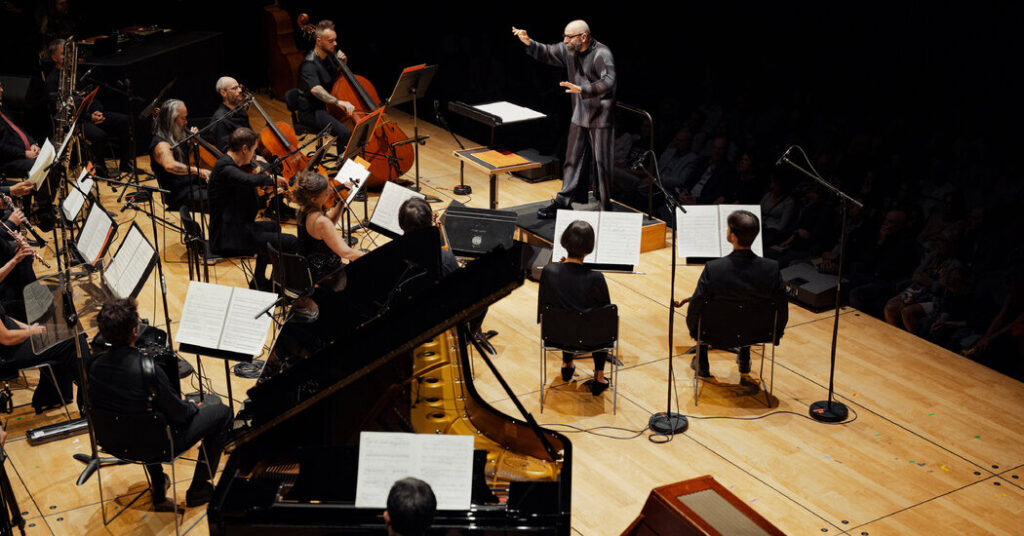
One such project was the opening concert of Ensemble Intercontemporain’s anniversary season on Saturday at the Cité de la Musique concert hall in Paris. The program, of modern and contemporary works, also featured turntable performances by Mariam Rezaei. But the focus was on the group’s virtuosic ensemble playing and its skill at changing sound to match each work.
In the world premiere of a recently rediscovered Boulez piece, “Dérive 3” for brass and percussion, the players treated jostling fragments of melody with the intensity of a wasp swarm defending its nest. In Ligeti’s “Chamber Concerto” — a reprise from Intercontemporain’s first concert — the group shaped fragile sonic textures with enough assurance to keep them intact. In Unsuk Chin’s “Gougalon (Scenes from a Street Theater),” its sound took on a rougher edge, with moods ranging from frenzied to lugubrious.
The concert made it clear that few musical challenges could daunt Ensemble Intercontemporain. The trickiest test may be to honor Boulez’s legacy while expanding the scope of the project: Ophèle said the ensemble’s newest generation of players was the first not to have met him.
So far, it seems to be working. The last piece on the program was “Partiels” by Gérard Grisey. That piece was probably not to Boulez’s taste either, but the ensemble played it with attention to nuance and a beauty of sound that rightly situated it in the tradition of Debussy.
The next day, at an outreach concert, the players performed an excerpt from “Partiels” to an audience of children and parents. The piece was inspired by the way that the ear perceives different combinations of frequencies, and the event’s host, Clément Lebrun, led the audience in a vocal exercise — singing while changing the shape of their mouths — that mimicked Grisey’s compositional technique.
They took music that seemed difficult and made it simple.
The post ‘It’s Very Simple’: 50 Years of Making Avant-Garde Music Sound Effortless appeared first on New York Times.