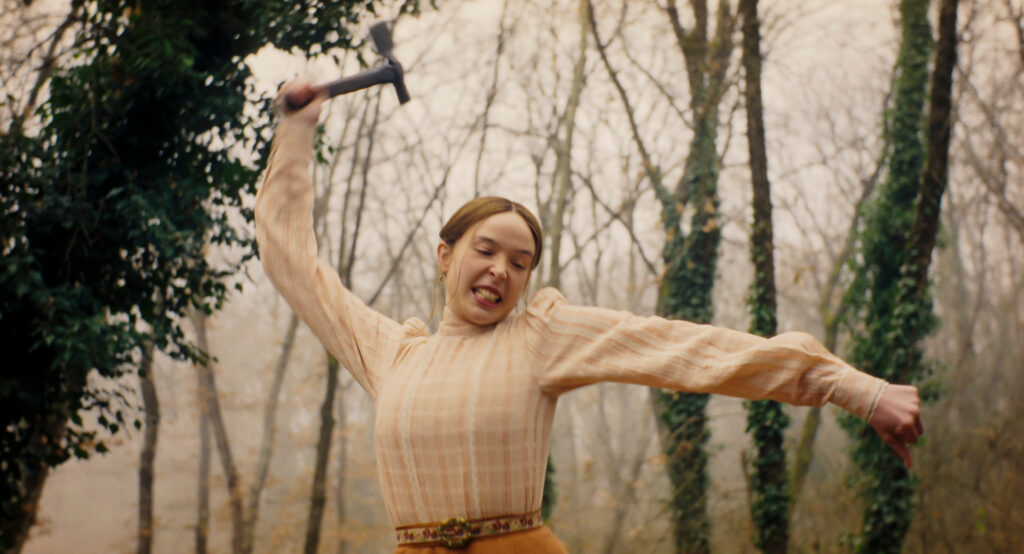
Any self-respecting student of history or women’s studies or schoolyard chants knows that Lizzie Borden murdered her mother by giving her 40 whacks with an extremely large hatchet, or, if you want to uphold a rhyme scheme, an ax. Not 38, not 39, but a tidy and even 40. And further, when she was finished with that unpleasant business — when she saw what she had done — she went and gave her father 41.
From this, we can infer a few things. One, that Lizzie could have stopped after the first killing, but the act so pleased her that she decided to continue. Two, that while Lizzie hated both of her parents enough to murder them, she either hated her father a tiny bit more, or, in the middle of the bloody frenzy, she maniacally lost count.
Either way, the extra blow to Daddy Borden reads as a little smirk at the end of the horror. The equivalent of a middle finger. A way to say, I’d do it again.
Why did she do it? Legally speaking, she didn’t. In an 1893 trial that inflamed the nation — it was that generation’s Scopes Monkey trial; their O.J. and Karen Read — Lizzie was found not guilty of murder by a jury of her peers. Her testimony had been odd and contradicting, the crime scene had been contaminated, the investigation was primitive and essentially amounted to a combo of smelling salts and vibes.
And perhaps most importantly, her “peers” were 12 men who reached their verdict after less than an hour of deliberation, and who might have believed the defense’s argument that it was simply impossible for a God-fearing woman to have done such a violent thing.
To tell the story of Lizzie Borden is to interrogate your own beliefs and assumptions about feminine nature. Are women ever intrinsically violent? Intrinsically evil? Or do they only kill when they are provoked, cornered, under the influence of a man or the moon? Do they, as an outlandish new Lizzie Borden show speculates, take baths in massive tubs of red cherry juice and pretend that it is blood?
“Monster: The Lizzie Borden Story” is the new Netflix show, created by Ryan Murphy and only the latest in a long line of Lizzie lore. There have been ballets, ballads, an opera, a miniseries, a Lifetime Original movie, scholarly articles, tours, novels and bobbleheads, all dedicated to the idea of Lizzie the monster, Lizzie the patsy, Lizzie the victim.
When I started writing this column, I had in my mind the vague concept that Andrew Borden had sexually abused his daughter, creating a motive for the killings.
Where did that notion come from? No idea. If he did abuse Lizzie, the accusation or evidence is nowhere to be found in the legal record. But that didn’t stop me, or apparently thousands of other true crime weirdos, from mentally inserting that explanation into our version of the story — a Mandela Effect of murder.
Others have wondered whether Lizzie was a lesbian, killing her parents so she could live authentically. Whether she did it for the substantial inheritance. Whether she was carrying out a secret affair with a suitor her family disapproved of. One 2016 critical essay about “Menstrual Murderesses” asks whether Lizzie might have been driven to kill because she suffered from a rare condition in which her monthly cycle caused seizures of the temporal lobe.
On the one hand, nobody in 2026 should want to be caught dead advancing a theory that menstruation causes women to become out of control.
On the other hand, police did apparently find a bucket of bloody clothes in the basement after the killings, but when Lizzie told them the mess was from her period, they decided to take her word for it rather than examine the clothing further. So while menstruation may or may not cause women to become murderers, it definitely caused male investigators in that case to become quite stupid.
The contours of the original story: In August of 1892, the bodies of wealthy businessman Andrew Borden and his wife, Abby, were discovered in their large home in Fall River, Massachusetts. Abby was in a guest room upstairs and was determined to have been killed a few hours before her husband. Andrew was in a downstairs parlor. Both had been hacked to death.
Lizzie, who in Victorian parlance was considered a spinster at 32, told witnesses and officials a variety of stories. She said she both was and was not home. She said that she both heard a call of distress and also that she heard nothing at all. She said that she was both reading a magazine at the time of the murders, and also ironing clothes in the dining room, or maybe searching for fishing equipment in the backyard.
She either had an unremarkable relationship with her family or a difficult one. Reportedly she and her sister had both quarreled so vehemently with their parents the month prior that when Lizzie returned from a vacation she opted to stay in a boardinghouse for a few days instead of the familial home. Abby Borden was her stepmother, not her biological mother; Lizzie told a seamstress shortly before the deaths that Abby was a “mean, good-for-nothing thing.”
“Monster” goes all in on several theories. In Murphy’s telling, naive Lizzie (Ella Beatty) was indeed gay, her sexuality awakened by the arrival of worldly housemaid Bridget Sullivan (Vicky Krieps), who dyes her hair, speaks French, and bestows Lizzie with not one but two wooden windup sex toys, one of which is the size of a large sewing machine. The pair do indeed become giddy accomplices in the crime.
“Monster” also proffers that Lizzie’s parents were abusive, but psychologically rather than sexually. Abby is the main tormentor, played sadistically by Rebecca Hall. She discovers that she cannot bear her own children and proves spectacularly and disturbingly unprepared for the task of raising her stepdaughters.
Andrew Borden’s crimes are primarily those of neglect. Played by Charlie Hunnam, fresh off his role as the so-called Butcher of Plainfield in Murphy’s previous season of “Monster,” Lizzie’s father spends most of his time running his undertaker business, chopping off the feet of the deceased who are too tall for his caskets. When he bothers to get involved in the affairs of his family, it’s to bemoan the fact that he’s surrounded by all of these infernal women, with nary a male heir in sight.
It’s all watchable enough if you like Gross Ryan Murphy. As in, if you enjoyed imagining the ungodly smells of Jeffrey Dahmer’s apartment, as Murphy made you do in the first season of “Monster,” or if you appreciated graphic depictions of necrophilia, as Murphy provided in the third, then you will probably like “The Lizzie Borden Story,” where you get to wonder why we are watching so many ankles be mutilated with pole axes in an undertaker’s office.
Personally, I think Murphy can be sly and witty and unflinching, but the “Monster” series in general to me often seems to confuse profligate shock value with social commentary. He’s made a few female-centered shows recently but his love of women to me always seems more like how a little girl loves her paper dolls — as two-dimensional things to put duster coats on and create saucy melodramas for.
Because “Lizzie Borden” is a production that also seems to want to say something important about feminism — look, at least Kim Kardashian is not in here playing a divorce lawyer — we also have, somehow, extended flashbacks to the Countess of Bathory, a 16th-century noblewoman who allegedly murdered and tortured young girls. And midway through the series Sarah Paulson appears in a Hawaiian shirt playing 1980s serial killer Aileen Wuornos.
One hundred years after the Borden murders, you see, Aileen fancies herself a Lizzie acolyte. She drags her lover up to Fall River to sign the Borden house guest book and go full Ouija in the attic.
According to the show, there’s a throughline here, from the Blood Countess to Lizzie Borden to Aileen Wuornos. In this telling, the countess’s murders can be traced back to her own rape as a teenager. Lizzie’s murders are caused by her abuse. Aileen’s murders are caused by a lifetime of horrors, assaulted by both her family members and the johns she later serviced as a sex worker.
Their crimes are revenge, either against their tormentors or against the society who created those tormentors. They put up with what they could, and when they could handle no more, it was time for the ax.
“Just admit that you’re afraid of strong women,” the housemaid Bridget Sullivan demands in one scene, brandishing a hatchet over a terrified man lying in bed. “And I will walk away and you can have it all.”
For what it’s worth, in real life Abby Borden actually had 18 or 19 wounds, not 40. And Andrew Borden had 10 or 11, not 41. But that’s not nearly as scintillating or poetic. And it makes it look as though Lizzie, rather than becoming even more energized by rage after she killed her stepmother, simply started to run out of steam.
The scholar Ann Schofield points out something fascinating about Lizzie Borden in her essay“Lizzie Borden Took an Axe,” about the murders’ depictions in American culture. She notes that while other captivating historical crimes, such as Jack the Ripper, continue to prompt spirited debates over whodunit, the Fall River murders are always presumed to be committed by Lizzie.
Occasionally someone trots out a theory about an uncle or an illegitimate son, but those explanations never stick. Lizzie Borden was found not guilty — but stories of other culprits don’t satisfy what we’re looking for in the Lizzie Borden story.
(“Did you do it?” another character demands of Lizzie in Sharon Pollock’s 1980 play, “Blood Relations.” “If you say yes, I’ll be horrified; if you say no, I’d be disappointed.”)
And what we’re interested in is a whydunit, Schofield writes: “The murders and Lizzie’s subsequent acquittal become an ur-text for the contemplation of motive, of power, of patriarchy, of sexuality, and of love.”
Since Lizzie would not admit that she did it, but the public is convinced that she did, what we’re left with is a set of gory murders as a blank slate for the feminine psyche. A slate onto which we can write the story that makes the most sense for each passing decade.
It’s not surprising that early theories often focused on financial motives related to Lizzie’s inheritance; at the time, Lizzie would have had very little way to make her own money. She was jobless, without skills and completely dependent on her father’s wealth. It’s not surprising that so many theories have focused on a secret romance; throughout history, one of the only ways a woman could escape from her familial home was by transplanting herself to her husband’s.
It’s not surprising that I, and so many other members of a modern audience, might have heard a story related to sexual abuse: because we’ve become more aware of what can happen behind closed doors, even in good God-fearing families.
Over the course of 130 years, Lizzie Borden has gone from being a criminal to an invitation, one that has allowed women to ponder what has troubled them, trapped them, haunted them or hampered them, and then decide that similar ailments must have afflicted the woman of Fall River.
The fixation on Lizzie Borden is similar to the fixations on Lorena Bobbitt, Gypsy Rose Lee, and yes, Aileen Wuornos. It’s the reason that so many people streamed “Furious” on Hulu, watching to see the female victim of a Jeffrey Epstein-like character take down his accomplices one by one.
The narrative has changed from, “she couldn’t have done it because she’s a woman” to “she did it specifically because she’s a woman.” Because the specifically female confines of her life were what led her to a breaking point.
In “Monster,” Murphy creates a highly fictionalized version of Lizzie’s life after the murders, and suggests that the killer was only able to find peace after she became — this is so silly it’s almost hard to type — a prominent leader in the suffrage movement, championing women’s rights to vote.
Reader, she did not become that. Not according to any historical document I could find. But now that we’ve seen it, I’m not going to be surprised if this becomes another part of the Lizzie apocrypha. Something else that gets incorporated to make sense of what was, in the end, a completely senseless crime.
Two people were murdered, and one woman went free, and then had to either live with the weight of her crimes, or witness as her innocent name became the source of jokes, costumes, speculation and macabre shorthand for a woman gone mad.
She died in 1927, 35 years after the deaths of her parents. By then, the schoolyard chant about the crime had become popular enough that it was published in newspapers beginning in 1894 and appeared a 1924 book called “Studies in Murder.” Surely Lizzie would have heard it.
In the earliest versions, before the story became a legend, Lizzie “gave her mother 20 whacks,” which is much closer to the actual number received by Abby Borden. And there was a second verse, too, one that gradually fell away from use:
Andrew Borden now is dead/ Lizzie hit him on the head / Up in heaven he will sing / On the gallows she will swing.
But, of course, she never did. She was innocent until proven guilty, but then once found innocent, she was guilty until the end of time.
correctionA subheadline in a previous version of this article misstated the year of the Borden killings. They took place in 1892, not 1893. The name of the Massachusetts town where the Bordens lived also was misspelled. It is Fall River, not Falls River.
The post For 130 years, we’ve been rewriting Lizzie Borden’s motive appeared first on Washington Post.