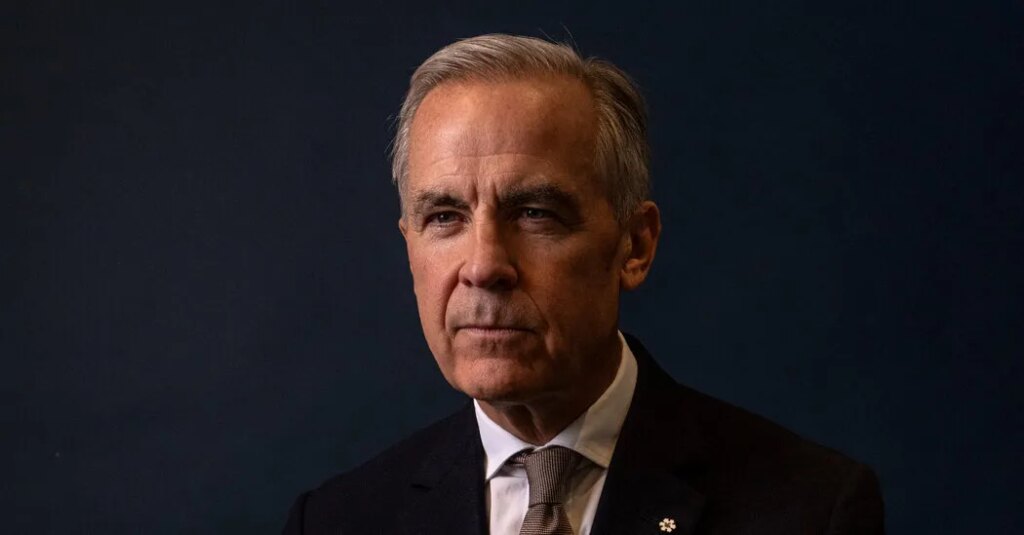
Prime Minister Mark Carney of Canada said that he had prepared over the past year for the “extreme tail risk” that President Trump might order military action against Canada, but disclosed that the two men have spoken “frequently,” even since trade talks collapsed last month, describing a tense, evolving relationship.
In a wide-ranging interview with The New York Times at its headquarters in Midtown Manhattan on Wednesday, Mr. Carney described in meticulous detail how he was systematically reducing Canada’s reliance on the United States for key technology — from space satellites to fighter jets — in an effort to make his country far less vulnerable to American threats. He outlined a plan to diversify Canada’s relationships and suppliers, and said that even with a different future president “we will be a better partner for the U.S. because of what we are doing.”
He talked about reducing reliance on Starlink, Elon Musk’s satellite systems; considering alternatives to buying F-35 fighter jets; and a focus on deepening economic — though not defense — relationships with China. Mr. Trump’s exploitation of Canadian dependency on American products had taught the country a bitter lesson: “There’s certain things, once you’ve seen them, you can’t unsee them.”
When pressed on whether he took Mr. Trump’s threats to make Canada a 51st state seriously, Mr. Carney suggested that he had carefully examined the possibility of a U.S.-led military invasion, but declined to discuss in detail what that involved.
“I think you have a responsibility in these roles to look at extreme tail risk,” said Mr. Carney, a former central banker for Britain and Canada who approaches the world by meticulously assessing worst-case scenarios and drafting responses. He added: “That’s just risk management. That’s not a base case, but it would be irresponsible not to” prepare.
Mr. Carney spoke for an hour on a variety of challenges, including artificial intelligence, trade, and Canada’s role as a “middle power.”
Over the past year, he has emerged as the most prominent global leader to take on Mr. Trump. Along the way, he has also begun to define a path toward reducing dependence on a superpower neighbor that he has come to regard as predatory. Around the world, other leaders have looked to him as a model for dealing with an erratic, unreliable ally — one that remains, in Canada’s case, critical to national defense and economic survival.
But few of those leaders have articulated their interests as clearly as Mr. Carney, who used a speech at the World Economic Forum in Davos, Switzerland, earlier this year to describe a strategy for dealing with the rupture. “Either you retreat wholly into yourself or you diversify,” he said then, making the choice he faces stark.
Still, Mr. Carney said he speaks “frequently” to Mr. Trump and that they had spoken “a number of times” since trade talks broke down last month.
“From my perspective, we have a good relationship in the sense of we can pick up the phone and talk to each other about issues,” he said on Wednesday. “He’s direct. I’m direct in terms of where positions are. It’s much more efficient that way, and so you know that exists and that will continue to exist.”
The Canadian leader made the case, too, that in many ways, what’s good for Canada is also good for the United States because of their decades-long integration that has created stability and prosperity. Mr. Carney gave the example of the automobile industry, which is highly integrated across the U.S.-Canada border but has been at the center of the Trump administration’s tariff policy against Canada.
“My entire life, and I’m 61, we’ve had an integrated auto sector,” Mr. Carney said, adding that breaking that deep connection to repatriate all auto production to the United States is not good policy. “We think it doesn’t make sense,” he said.
Mr. Carney said that a path remains to resuming negotiations with the United States that would revive the trade agreement that fell apart in late August. Since then, the two countries have imposed rounds of tariffs on each other, and rhetoric has been menacing, particularly from Mr. Trump, who has repeatedly called Canada’s leadership “nasty.” But Mr. Carney brushed that off.
“Is there a mutually beneficial trade deal between Canada and the U.S.? Absolutely, absolutely there is one,” Mr. Carney said. He said that he was interested, for example, in adding potash to the talks. Canada provides almost 90 percent of all potash, the key ingredient for fertilizer, imported into the United States. Earlier this week, Mr. Trump said that he wanted to replace Canada’s supply with potash from Belarus — an authoritarian state aligned with Russia that is under U.S. sanctions for its role in the war in Ukraine.
Mr. Carney said that Canada, the United States and potentially also Mexico could become “fertilizer independent” by securing special access to Canada’s potash, the world’s largest reserve. He added that the Canadian option was clearly better than buying potash elsewhere that would then need to be transported through the Black Sea or the Strait of Hormuz.
“I think this is a doable component of the deal, and there are other examples that exist, and we’re ready to work toward,” he added.
At home, Mr. Carney has come under pressure to use Canada’s most sensitive and important export to the United States — energy — as leverage in the trade war. Some 60 percent of all oil imports into the United States come from Canada, while the country is also a major source of electricity for American households and industry.
Mr. Carney said he was very reluctant to limit, tariff or otherwise curb those exports to the United States.
“If you’re a reliable partner and you supply energy or food to somebody it keeps running, it’s a very, very, very high threshold to change that,” he said. “Never say never, but it starts from a position of, we need to be a reliable supplier in all cases.”
Although optimistic that efforts to strike a trade deal could be revived, Mr. Carney said he was cleareyed about areas where Canada needs to reduce its dependence on the United States.
“Starlink, we will diversify away from, no question,” Mr. Carney said, referring to the American-based cluster of communication satellites, run by Elon Musk’s SpaceX, that have revolutionized the industry. He alluded to past disruptions and to Mr. Musk’s reluctance to provide Ukraine with data that would enable it to target parts of Crimea and Russia.
He acknowledged that other satellite network options are still less capable and resilient, but added that “from a defense perspective, and certainly pooled with other partners, Europeans, Koreans potentially, you get to scale and you cut that dependency.”
The Canadian government is reviewing a planned order of 88 Lockheed Martin F-35 jets and is also considering a counterproposal to acquire Swedish Saab Gripen fighters. Mr. Carney did not specify where he was on that decision, but he did say that he wanted to use Canada’s newly bolstered defense budget to order aircraft that perform well in the Arctic.
“It is a real decision because of differing capabilities, because of strategic dependencies, and because of the economic return,” he said.
Mr. Carney on Wednesday also reiterated his long-held view that a global financial system wholly dependent on the U.S. dollar was unsustainable. A move to a multipolar system in which there are several reserve currencies would “provide more flexibility,” he said.
He acknowledged that there was a “directional shift” underway in which countries were re-evaluating their exposure to the U.S. dollar, but he conceded that any pivot would be limited until there was “proper liberalization” of China’s currency and financial system. Still, Mr. Carney said he expected the demand for U.S. dollar alternatives to grow, in part because of the Trump administration’s decision to rewire trading relations and use integration as “leverage.”
“It’s the ‘fool me once, fool me twice’ point,” Mr. Carney said. “Once you see that, then you start to think, how do I diversify away?”
The post Mark Carney’s Balancing Act appeared first on New York Times.