Call it the lake effect.
Take away a body of water steeped in Canadian pride, as President Trump attempted when he ordered the federal government last month to rename Lake Ontario as Lake America, and reprisals from the north seemed bound to follow. Even from reputedly mild-mannered Canadians.
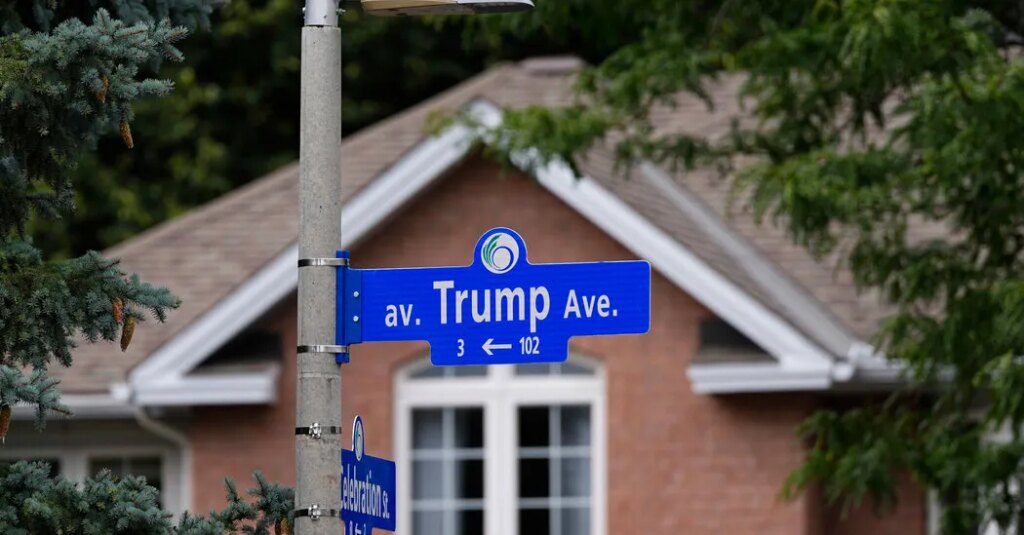
A backlash on a smaller scale came on Wednesday when the City Council in Ottawa, Canada’s capital, voted unanimously to remove Trump Avenue as the name of a residential street, the latest in a cross-border geographic spat that is making mapmakers’ heads spin.
The street is one of several in Ottawa’s Central Park neighborhood that were named for New York City institutions when it was developed in the late 1990s and early 2000s, long before Mr. Trump started a trade war with one of America’s closest allies.
And long before Mr. Trump audaciously suggested making Canada the “51st state” and imposed crippling tariffs on it.
“I don’t like the idea of anything that’s named for Donald Trump, who has demonstrated hostility towards Canada,” Mark Sutcliffe, Ottawa’s mayor and a council member, said at news conference after the vote.
The motion passed unanimously to change the name of the S-shaped street, which has about 65 homes on it and intersects with some other roads whose names might be familiar to New Yorkers, including Whitestone Drive and Bloomingdale Street.
John Germano, 65, a retiree who has lived on Trump Avenue since 2010, said in a phone interview on Wednesday that his address had become a dubious distinction, especially when ordering deliveries.
“It’s embarrassing, like they just chuckle and laugh,” Mr. Germano said.
He added, “It gets worse and worse every day.”
A working group of several Trump Avenue residents will help create a list of potential replacement names, said Riley Brockington, a City Council member who is spearheading the change.
Mr. Brockington said the erasure of Mr. Trump’s name from the street was not intended as retaliation for Mr. Trump’s bid to rename Lake Ontario but in response to what he described as the president’s attacks on Canadian sovereignty and the carnage caused by his economic policies.
“He does not deserve the honor of having his name on a city of Ottawa street,” Mr. Brockington said. “We’re the nation’s capital.”
The White House did not immediately respond to a request for comment on Wednesday.
Pete Hoekstra, the United States ambassador to Canada, who has been the subject of a petition effort seeking to expel him that has been signed by more than 200,000 Canadians, declined to comment on Wednesday.
Canada has at least eight other places with the name Trump in them, though those are not named after the president. Still, some have sought to change those names, too.
Two of them, East Trump Lake and West Trump Lake, can be found in Cochrane in eastern Ontario, according to the Canadian Geographical Names Database, which registered their origins in 1973.
Peter Politis, the mayor of Cochrane, said in an email on Wednesday that the lakes are in an unorganized township under provincial control. Not that renaming them hasn’t crossed his mind.
“That said, as mayor, I am sorely tempted to wave the mayoral pen and table a motion anyway, given how fitting it feels at the moment,” he wrote.
Mr. Politis mused that he might not stop there.
“On a tongue-in-cheek note, we’ve toyed with the idea of renaming our local landfill dump ‘Trump,’” he wrote.
Sudbury in Ontario is home to Trump Lake and Trump Creek, names that the Canadian Geographical Names Database recorded as originating in 1954.
Shortly after Mr. Trump’s executive action to rename Lake Ontario, Michel Lalonde, 36, a D.J. from the city of Sudbury, started a petition to rename Trump Lake. He said on Wednesday that he had never visited the lake, which is roughly six hours northwest of the city.
“The whole thing has become absurd and ridiculous,” he said.
Mr. Lalonde lamented the deterioration of U.S.-Canada relations.
“I just so wish we would go back to how things were 20 years ago,” he said. “It’s just an unfortunate stain on a relationship and an unfortunate stain on our history.”
In Ottawa, Mr. Brockington of the City Council said he had previously surveyed residents of Trump Avenue about changing the street’s name during the Covid-19 pandemic but they were divided. The opponents were concerned about the administrative hurdles associated with changing addresses, he said.
But after Mr. Trump returned to the White House and antagonized Canada, he said, momentum built for the change.
“This is not a tit for tat for Lake Ontario,” Mr. Brockington said. “At some point,” he added, “you have to take a stand.”
Mr. Germano said he was hoping to play a role in the selection of a new street name.
“We love New York,” he said. “We love Americans. It’s just that one person.”
He said he had kicked around some new names for Trump Avenue: Times Square, Strawberry Fields, Upper West Side.
“I’d go for Hell’s Kitchen,” he said.
The post Canada’s Capital Bids Good Riddance to Trump Avenue as Tensions With U.S. Rise appeared first on New York Times.