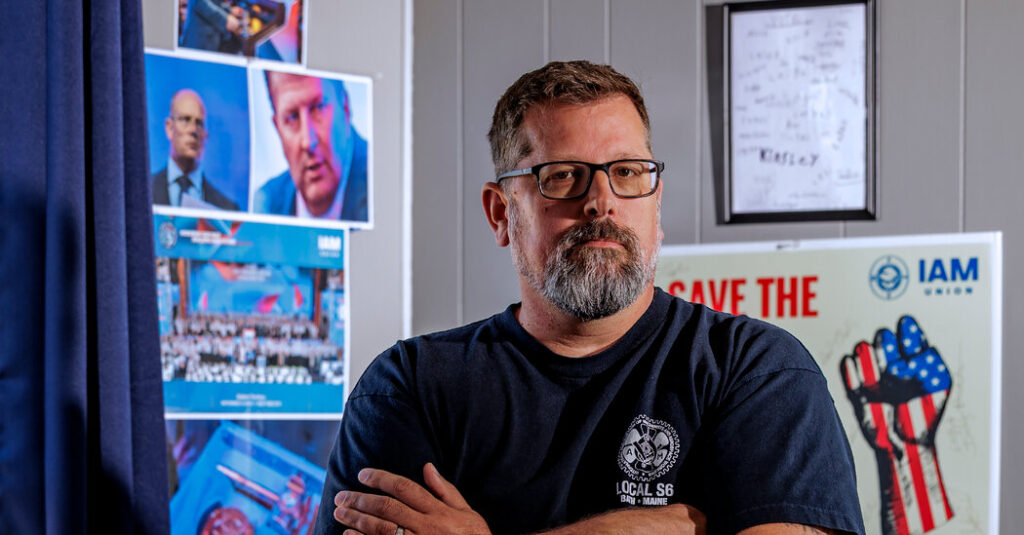
Tim Suitter knows change is coming to Bath Iron Works, creeping up the adjacent Kennebec River in Maine like a foreboding fog.
Mr. Suitter, the president of the union that represents more than 4,400 workers who build ships for the U.S. Navy at the shipyard, knows the workers must be prepared for the arrival of artificial intelligence.
“It’s going to be here,” said Mr. Suitter, 50, who has worked at the shipyard for nearly 30 years. “You have to wrap your head around it.”
Last month, when Local S6 of the International Association of Machinists and Aerospace Workers negotiated a new five-year contract with the defense company that runs the shipyard, the union insisted on updating longstanding language about technology. Now the union must be informed at the “conceptual stage,” rather than at implementation, of “any proposed addition or modified technology, equipment or process,” including A.I. and robotics.
“It was the union trying to force the company’s hand about being more transparent when it comes to A.I.,” Mr. Suitter said. “The sooner we can be part of that conversation and represent the members’ side of it, the better off we are.”
Unions are confronting A.I. as an existential danger to workers, not only because of the possibility of massive job losses but also because of its hand in the widening gap between wages and corporate profits. In April, Liz Shuler, the president of the AFL-CIO, called A.I. “the single biggest threat to working people of our lifetime.”
The threat has galvanized a labor movement that has been on its back foot for years. In terms of public opinion, unions are popular. A.I. is not. And yet union membership is at a low ebb — about 6 percent of American private-sector workers are represented by a union — and unions have been hobbled by state laws and a weakened National Labor Relations Board.
Putting A.I. at the top of the bargaining agenda is part of a strategy to overcome that disadvantage, using negotiations to establish boundaries and, labor leaders hope, direct A.I. from the ground up. As workers and employers try to make sense of the A.I. economy, these contracts could help shape policy.
“There is power, there is leverage right now,” said Moira Bulloch, a spokeswoman for the Communications Workers of America, which represents journalists, flight attendants and call center workers. A.I. policy is being set “contract by contract, employer by employer.”
The machinists union, which represents about 600,000 workers in the United States and Canada in industries like defense, aerospace, railroads and aviation, has been particularly proactive. Recognizing that A.I. portends promises as well as threats, the machinists have crafted model contract language and pushed for early, open conversations with companies that employ their members.
“Unions can set the pace,” said David Sullivan, the general vice president for the union’s eastern territory, who encouraged Local S6 to put in the new language.
Define the function
About a year and a half ago, Joseph Bonomo, a labor lawyer at Pitta, a law firm in New York, realized that while companies were incessantly talking about A.I. on earnings calls, the unions he represented were not. He set out to change that, starting at the bargaining table.
“A.I. is the hill to die on,” Mr. Bonomo tells union clients. “Because if you don’t have a job at the end of that contract, what good was the contract?”
Mr. Bonomo is working with the machinists’ air transport division as an adviser. Richie Johnsen, who runs the division, said he was fine with A.I. being used as a tool to improve corporate profits that can transfer to his members: “But it shouldn’t be replacing people.”
“We have to put in language into our contracts that addresses that,” he added. “Because that’s the only way that happens.” The machinists represent workers at nearly every U.S. airline. The union is in negotiations with United Airlines and Alaska Airlines, and will begin negotiations with Southwest before the end of the year and with American early next year, Mr. Johnsen said.
When Mr. Bonomo spoke to Mr. Johnsen’s team in June, he began by talking about language. “Define the Function, Not the Marketing Label,” read one of his slides. Corporate speak about A.I. can be euphemistic, vague and mind-numbing.
“Employers may not necessarily say, ‘Hey, there’s a new A.I. system,’” Mr. Bonomo said. “They’re going to label it, characterize it as a scheduling tool, a safety platform, a productivity system, a camera upgrade, some routing software.”
He challenged the machinists to interrogate the jargon. What does the system do? Does it collect data? Make predictions? Is it influencing discipline, staffing, scheduling, pay rates? Did the vendor consult with the union before writing the code?
Unions are particularly concerned that A.I. is going to be used to monitor and discipline workers. Mr. Bonomo urges his clients to press for contract provisions that guarantee human review of reports generated by an algorithm.
“I want to be able to say, at the top: ‘If we come back with a contract for ratification and it doesn’t have this, they’re not going to approve it,’” he said. “‘There’s going be a rat outside tomorrow morning, and there’s going be a line of 1,000 people saying that you’re trying to eliminate jobs.’”
Mr. Bonomo also encouraged the machinists and other unions to leverage A.I. to their advantage. Unions could build their own large language models to harness decades of institutional knowledge and records. They could use A.I. to organize more shops.
“Unions have to be in that driver’s seat,” he said.
‘It’s very real’
Like most Americans, the workers at Bath Iron Works primarily encounter artificial intelligence today in slop on social media, or web searches that spit out paragraphs instead of links. They may regard A.I. with distrust but fail to recognize that it’s already in use all around them.
This disconnect has made Devin Ragnar, who at 33 is one of the younger machinists at the shipyard, particularly nervous. Mr. Ragnar handles communications for Local S6 and has been pushing his colleagues, and the union, to be more aware of the reach of A.I. and more proactive about confronting it.
Last year, Huntington Ingalls Industries, a competitor to the shipyard, announced a partnership with Hyundai Heavy Industry that yielded a pilot program to bring A.I.-guided welding equipment to shipyards in Mississippi and Virginia.
“In construction, you hear a lot of ‘You can’t automate this!’,” Mr. Ragnar said. They think a robot can’t do the work, can’t climb a ship. But, he said “it’s very real — it’s happening.”
Mr. Ragnar served on the bargaining committee for the new contract at Bath Iron Works and pushed his fellow members to include language on A.I. He and Mr. Suitter said the company had seemed surprised by the request, as if they hadn’t put a lot of thought into the matter.
Recently, Bath Iron Works introduced a programmable arm that could weld — a co-bot, or collaborative robot, in modern parlance. “They didn’t exactly follow our contract language,” Mr. Ragnar said. The union filed a grievance, and is now working with the company to resolve it.
“A big part of our response was — imagine if this was a much more drastic, broad-reaching change?
In the past, the company might have just said, “Hey, we bought this $10 million machine,” according to Mr. Sullivan. In the future, the union would have warning. Mr. Ragnar said that since the contract was ratified, the company was coming to union leaders with questions about technology.
In response to questions, the company, General Dynamics Bath Iron Works, said it was “committed to being transparent with all its employees about future A.I. and new technology initiatives.”
Mr. Ragnar said he did everything he could to avoid using A.I. “If we let A.I. do menial tasks for us, we are letting these machines think for us,” he said. If welders surrendered some of their work to a co-bot, their skills would erode.
“It’s one of the best things about being human — creating, thinking, and problem solving,” he said.
Mr. Sullivan is more optimistic about the constructive use of A.I. in shipbuilding. If an A.I.-guided machine can weld a seam in 15 seconds — a fraction of the time it takes a human, without the risk of injuries — it could mean more ships under construction, and, in turn, more jobs, with a healthier work force.
“Maybe the new technology would be great,” Mr. Sullivan said. “It’s the unknown.”
The post Unions Rally Around the Threat of A.I. appeared first on New York Times.